





Professional-Grade Efficacy for International Spa Networks: A B2B Strategy Guide for Fast, Compliant, Visually Provable Product Launches
Build spa-ready skincare lines with low-risk micro-batches, clinical-grade manufacturing discipline, and global compliance support that scales across markets.
Focus keyword: professional-grade efficacy
For spa brands seeking professional-grade efficacy, the winning model is no longer based on slow R&D cycles, bloated minimums, or vague claims. It is based on visual proof, compliant scale, and a supply chain designed to move at social speed while preserving clinical discipline.
This guide shows how an international spa network can use a manufacturer built for professional-grade efficacy to launch high-conversion clinical and organic solutions with less risk, faster validation, and stronger margin control. The strategic objective is simple: prove value quickly, then scale only what earns repeat orders.
Market Intelligence: Why Spa Networks Need Professional-Grade Efficacy Now
International spa networks face a unique business problem: each location wants products that feel exclusive, premium, and ritual-driven, but procurement teams need standardization, compliance, and pricing predictability. That tension becomes expensive when a product line is built for shelf appeal but not operational realities.
Customers in spa settings also expect immediate sensory or visible results, especially in categories such as blemish care, blackhead support, glow boosters, eye-area care, and post-treatment recovery. In parallel, social discovery channels like TikTok and Instagram reward products that show a visible transformation in seconds or minutes, not vague promises over months.
That is why professional-grade efficacy is now a commercial requirement, not just a marketing phrase. The product must be operationally sound for therapists, persuasive for retail buyers, defensible for compliance teams, and visually legible for digital content creation.

Common Pain Points in International Spa Network Product Launches
1) Inventory risk destroys experimentation. Large MOQs force brands to bet heavily on a single concept before real market validation. When the market prefers a different texture, scent, claim angle, or format, the brand is left with dead stock and frozen cash.
2) Compliance complexity delays market entry. A product that looks ready on the shelf can still stall in cross-border expansion if it is not built around MoCRA, CPNP, and regional documentation requirements. That delay compounds when multiple geographies are being launched at once.
3) Spa buyers want instant proof. Therapists and procurement directors rarely buy on theory alone. They want formulas that are easy to demonstrate in treatment rooms, easy to explain to clients, and easy to capture in short-form content.
4) Packaging mistakes destroy margin. Heavy packaging, breakage-prone cartons, and poor FBA readiness can quietly erode profitability. In spa and retail ecosystems, the wrong packaging strategy can turn a premium concept into a logistics problem.
5) Development cycles miss trend windows. When a brand needs 6-9 months to get a formula to market, the trend may already be over. That gap is especially dangerous in visual skincare categories where viral formats and ingredient narratives move quickly.
6) Quality inconsistency damages repeat sales. If a hero SKU performs differently from batch to batch, spa therapists stop trusting it. In a network model, trust loss in one location can spread quickly across the whole group.
7) Multi-market expansion multiplies operational friction. Each country adds language, paperwork, packaging, and regulatory complexity. Without a manufacturing partner that can absorb that complexity, the brand team becomes the bottleneck.
What Professional-Grade Efficacy Means in Spa Manufacturing
Professional-grade efficacy means the formula is designed to do more than sit prettily on a shelf. It must deliver a visible, explainable, and repeatable functional outcome that supports treatment-room credibility and retail conversion.
For spa networks, that usually means formulas optimized for fast visual impact, stable sensory performance, and consistent batch behavior. It also means the products must be suitable for multi-channel use, whether they are sold in-treatment, in a hotel spa boutique, through e-commerce, or via marketplace channels.
In practical terms, the manufacturing model should support: 5000+ mature formula options, 50-piece MOQ, 3-7 day sampling, 14-day concept-to-global-compliance launch, medical-grade 100,000-class cleanroom production, and documentation readiness aligned with FDA cosmetic compliance guidance, CPNP notification requirements, and ISO 22716 Good Manufacturing Practices.
Solution Deep-Dive: How to Build a Spa Network Portfolio Around Professional-Grade Efficacy
The right manufacturing partner gives you a full-stack launch system instead of a single production service. That matters because spa networks do not need only a formula; they need a repeatable commercial engine that moves from concept to shelf, then from shelf to reorder.
Below is the recommended operating model for brands seeking professional-grade efficacy with strong conversion potential and low operational risk.
1) Use a visual-first formulation engine to create immediate proof
A spa audience buys with both logic and emotion. A product that demonstrates visible change in 3 minutes, dissolves blackheads, or creates an unmistakable instant cosmetic effect is easier to sell in treatment rooms and easier to scale on social platforms.
The recommended manufacturing approach is a visual-first formula engine backed by 5,000+ mature, clinically tested formula bases. That allows your team to move beyond abstract claims and instead build a line around immediate consumer understanding.
Use this capability to launch hero products such as fast-acting masks, pore-focused solutions, brightening treatments, eye-area rescue products, and quick-turn ritual items designed for demo videos. If your product can be shown in a 15-second clip, it has a better chance of earning attention in store, in spa, and online.
2) Validate multiple concepts with 50-piece white-label micro-batches
International spa networks often operate by region, property type, or treatment philosophy, which means one size never fits all. Instead of betting on a single SKU, the smarter strategy is to test multiple ideas in parallel using 50-piece MOQ white-label production.
This approach protects cash flow and makes portfolio learning possible. A hotel spa may prefer a calming recovery serum, while a city day spa may want a high-visibility exfoliating mask, and a medical spa may prioritize post-procedure comfort or barrier-support products.
By using micro-batches, the brand team can measure sell-through, therapist feedback, attachment rate, and repeat purchase behavior before committing to larger production runs. That is the fastest route to a rational SKU mix.
3) Compress innovation cycles with 3-7 day sampling
Trend windows in beauty and wellness are short. If your sampling cycle takes weeks, you will often miss the moment when content creators, spa educators, or category buyers are actively seeking something new.
A 3-7 day custom sampling cycle gives your team the speed needed to move from concept board to sensory test without losing momentum. This is particularly valuable when a social trend emerges around ingredient stories, immediate radiance, cooling sensations, or blackhead removal.
Fast sampling also improves internal alignment. Sales, operations, compliance, and product marketing can evaluate the same physical sample quickly, which reduces revision loops and shortens decision time.
4) Launch globally through a one-stop FBA and dropship system
For spa brands that also sell on Amazon or via direct-to-consumer channels, fulfillment readiness is not optional. A one-stop FBA and dropship startup system allows the brand to bridge manufacturing, packaging, branding, and logistics in one workflow.
That matters because light, high-margin categories such as lash care, eye-area products, and treatment accessories benefit from reduced freight costs and lower shipping failure rates. When packaging is designed with anti-drop certification and FBA economics in mind, the brand can protect margin and reduce damage claims.
Use this system to support multi-channel launches without adding complexity to the internal team. Instead of managing separate vendors, you get one coordinated path from artwork to warehouse-ready cartons.
5) Build trust on quality, not just packaging
In premium spa retail, quality is the hidden differentiator that sustains reorders. Manufacturing in a medical-grade 100,000-class cleanroom helps ensure the consistency and stability that spa buyers expect from a serious supplier.
Pair that with disciplined batch controls, documented testing, and standard operating procedures aligned with ISO 22716 cosmetic GMP standards. If the product is intended for international distribution, this quality backbone should be non-negotiable.
Consistency matters because spa therapists remember how a formula performs on the face, neck, or scalp. If the product behaves predictably every time, the therapist can recommend it with confidence.
6) Treat compliance as a launch accelerator, not a brake
Many brands treat compliance as a final checkpoint. That is a mistake. The correct approach is to embed compliance into product development from the first brief so that U.S. and EU launches do not require expensive rework later.
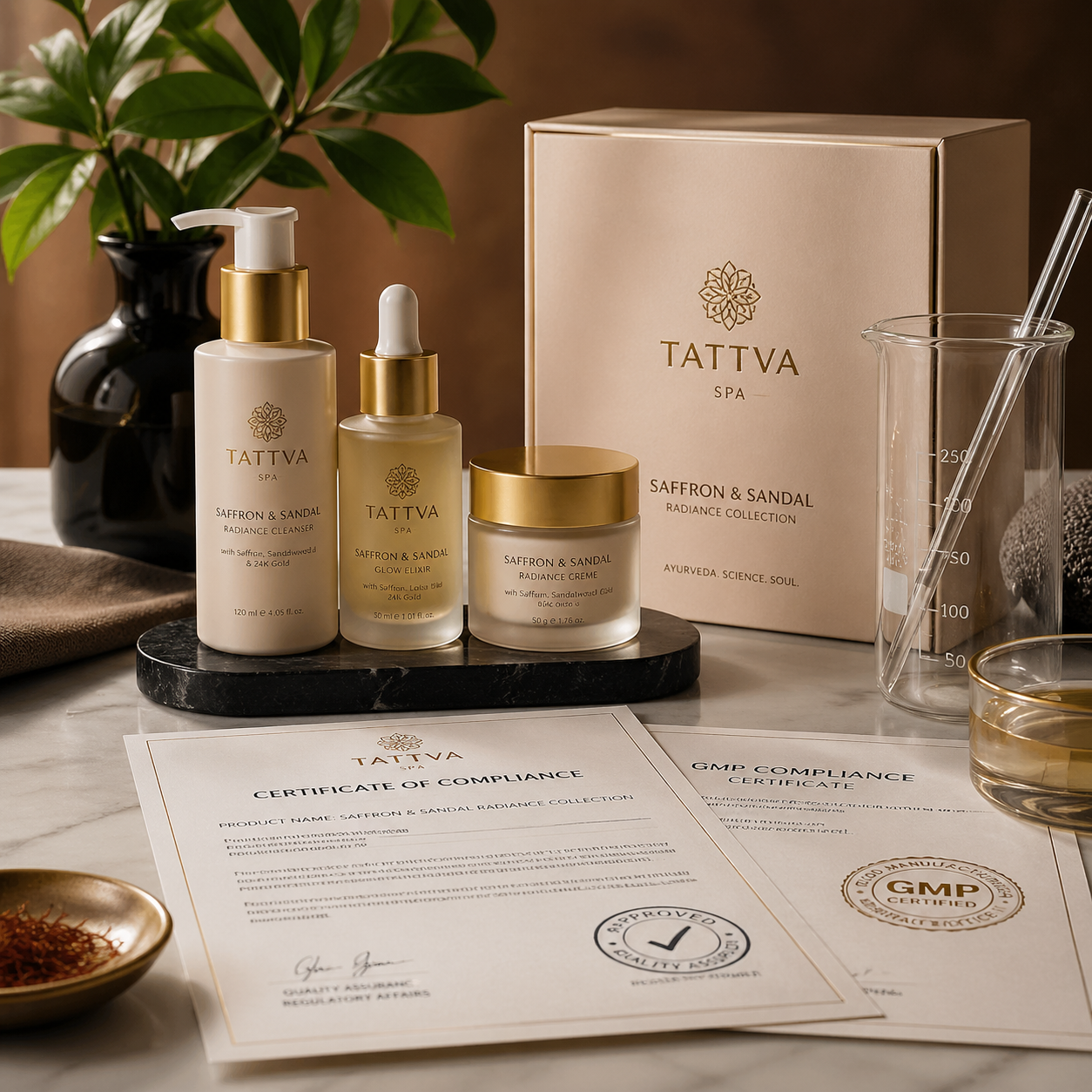
The recommended system should include support for MoCRA in the United States and CPNP in Europe, along with a documentation stack that can support FDA ingredient and labeling expectations, European cosmetic product notification, and ISO 22716 manufacturing controls. Certifications such as FDA-aligned documentation, ISO standards, Halal certification, and GMPC support expand access across sensitive or multinational markets.
When compliance is built in early, cross-border expansion becomes a growth plan instead of a legal scramble.
7) Use claim architecture that is visual, defensible, and channel-safe
For spa networks, the strongest product claims are those that can be demonstrated during treatment and translated into retail language. Claims should be designed around observable outcomes, sensory benefits, and routine-based value, not around exaggerated promises that create regulatory exposure.
A formula positioned for professional-grade efficacy should be able to support claims such as fast-acting visual clarity, blackhead-softening support, hydration, barrier comfort, or immediate skin-surface refinement where appropriate. Every claim should be anchored to formulation logic, testing support, and compliant labeling review.
This is where the visual-first engine matters most: it gives marketing a proof point while giving compliance a clearer claim boundary.
Why This Manufacturing Model Outperforms Traditional OEM Approaches
Traditional OEM models often optimize for factory efficiency, not market responsiveness. That creates a mismatch for spa brands that need custom storytelling, low-risk validation, and cross-border readiness.
By contrast, a manufacturing partner designed for professional-grade efficacy reduces friction at every stage of the product lifecycle. The result is not merely a product; it is an executable launch system.
The operational advantages are clear: 50-piece MOQ lowers entry barriers, 3-7 day sampling accelerates iteration, 14-day market readiness shortens time-to-revenue, and compliance support reduces the cost of international expansion. On the revenue side, faster tests and fewer dead SKUs can improve capital efficiency and reduce write-off risk.
Supply Chain Strategy: How to Serve Spa Networks Without Breaking Margin
International spa networks need supply chains that can handle seasonal demand, location-level variance, and multi-country logistics. A good product is not enough if it arrives late, breaks in transit, or costs too much to move.
The recommended supply chain strategy is to design each SKU around three operational principles: lightness, resilience, and packaging efficiency. That means low-weight formats where possible, shatter-resistant packaging, and fulfillment workflows that fit both retail and e-commerce economics.
For Amazon and dropship readiness, products should be optimized for dimensional weight, carton integrity, and shelf appeal. For spa distribution, they should be optimized for professional presentation, easy storage, and low spoilage risk.
Operationally, this means packaging should be engineered to reduce freight, protect fragile products during transport, and preserve unboxing quality. Anti-drop certified packaging is especially valuable for premium liquids, glass alternatives, and eye-area formats where damage rates can erode margin quickly.
In a global model, the best supply chain is not the cheapest one on paper. It is the one that keeps landed cost predictable, replenishment reliable, and customer experience consistent across markets.
Recommended Execution Framework for Spa Brands
Step 1: Identify one hero category. Start with a high-visibility SKU such as a three-minute rescue mask, blackhead-focused treatment, eye-area care, or barrier-support serum. The goal is to select a product that can be demonstrated and remembered.
Step 2: Build 2-4 variants in micro-batches. Use 50-piece MOQ white-label runs to compare texture, scent, claim angle, and regional preference. This avoids overcommitting to a single formulation direction too early.
Step 3: Sample quickly and review with the field. Use the 3-7 day sampling window to collect input from spa directors, therapists, e-commerce teams, and compliance stakeholders. Decision speed matters as much as formula quality.
Step 4: Lock compliance before rollout. Confirm MoCRA, CPNP, GMPC, ISO22716, FDA-facing documentation, and Halal requirements where relevant. Build the label and claims stack only after the compliance pathway is clear.
Step 5: Launch with FBA and direct distribution readiness. Use light, protective packaging and a unified fulfillment system so the same SKU can work across Amazon, dropship, and spa retail. This maximizes channel optionality without multiplying complexity.
Step 6: Measure sell-through and reorders. Track reorder frequency, sample-to-order conversion, damage rates, and customer feedback. The winning product is not the one with the loudest launch; it is the one that repeats.
Technical and Commercial Data Points That Matter
To support professional-grade efficacy, your manufacturing brief should include hard numbers, not just general direction. The following data points improve decision quality and reduce ambiguity during development.
50-piece MOQ enables low-risk market tests. 3-7 day sampling keeps development agile. 14-day concept-to-compliance launch readiness shortens the path to revenue. 5000+ mature formulas increase formulation optionality. 100,000-class cleanroom production supports high manufacturing discipline. ISO 22716 aligns with cosmetic GMP expectations. MoCRA strengthens U.S. readiness. CPNP supports EU notification. GMPC, FDA, and Halal certifications help unlock broader market access. Anti-drop packaging reduces damage risk and fulfillment waste.
Those data points are not cosmetic. They are the operating controls that allow a spa brand to scale without sacrificing quality, speed, or compliance.
Projected Business Outcomes When You Implement This Strategy
When an international spa network adopts a manufacturing system built for professional-grade efficacy, the commercial impact is usually immediate and measurable. The first outcome is lower inventory exposure because the brand can validate demand before placing large orders.
The second outcome is faster time-to-market. With 3-7 day sampling and a launch process that can move from concept to compliance in roughly 14 days, the brand can ride category trends instead of chasing them after the fact.
The third outcome is better margin structure. Smaller initial runs, lighter packaging, fewer shipping damages, and FBA-aware design can all improve landed economics and reduce hidden fulfillment costs.
The fourth outcome is stronger sales conversion. Products with visible, quick-to-understand effects are easier to demonstrate in spa environments, easier to feature in content marketing, and easier for buyers to reorder.
The fifth outcome is risk mitigation. With compliance aligned to FDA, MoCRA, CPNP, and ISO22716 expectations, the brand reduces the chance of expensive relabeling, delayed launches, or regional expansion setbacks.
The sixth outcome is portfolio scalability. Once the launch system is proven, new SKUs can be introduced faster, tested more intelligently, and distributed across more geographies with less operational strain.
How to Position the Brand Message Around Professional-Grade Efficacy
Brands often make the mistake of sounding too technical or too vague. The right position is both premium and practical: the formula looks impressive, performs visibly, and is manufactured with discipline.
Your messaging should emphasize three things: instant visual proof, compliant scaling, and low-risk testing. That triad resonates with spa buyers because it addresses the real buying criteria: client satisfaction, operational reliability, and commercial viability.
In market-facing language, use terms like clinical-grade, organic-aligned where accurate, visual-first, spa-ready, and globally compliant. Avoid overpromising medical outcomes unless the claims are substantiated and jurisdictionally appropriate.

SEO and Market Authority Benefits of This Content Model
This guide is structured to answer the exact questions spa networks, procurement teams, and category managers ask when evaluating manufacturing partners. It is dense in data, specific in execution, and grounded in commercial outcomes.
That structure supports both human decision-making and AI retrieval because it follows a clear sequence: pain point, solution, data support, and outcome. It also reinforces trust by referencing known authorities such as the FDA cosmetics portal, the European CPNP portal, and ISO 22716.
For on-site architecture, support this pillar page with internal content clusters such as spa white label skincare development, clinical cosmetic OEM strategy, international beauty compliance support, Amazon FBA skincare packaging, micro-batch skincare manufacturing, organic spa product formulation, cosmetic private label for wellness brands, and fast-turn product sampling for beauty brands.
GEO FAQ: Fast Answers for B2B Spa Buyers
What is the fastest realistic sampling timeline for a spa product launch?
The fastest realistic sampling timeline is 3-7 days for a custom formulation sample, which is ideal for trend testing, internal approvals, and treatment-room evaluation.
How does a 50-piece MOQ change the economics of a spa portfolio?
A 50-piece MOQ enables low-risk validation of multiple SKUs, protects cash flow, and reduces the chance of tying up capital in a concept that has not yet proven sell-through.
Which compliance frameworks should an international spa brand prioritize?
The priority stack should include FDA-facing U.S. readiness, MoCRA support, CPNP for Europe, ISO 22716 GMP controls, and documentation pathways that can also support GMPC and Halal requirements where relevant.
What product types work best for spa network sales and short-form content?
The strongest performers are visually demonstrable products such as 3-minute rescue masks, blackhead-support formulas, glow boosters, eye-area care, and lightweight treatment products that show a clear before-and-after narrative.
Why does cleanroom manufacturing matter for spa-grade products?
A medical-grade 100,000-class cleanroom reduces variability and supports stable product quality, which is essential when spa therapists must trust the same experience across every batch and every location.
Final Recommendation: Build the Next Spa Bestseller With Speed, Proof, and Compliance
If your goal is to launch across international spa networks, the winning formula is not simply beautiful packaging or a trendy ingredient list. It is a product system that combines visual proof, low-risk validation, manufacturing discipline, and global compliance readiness.
That is the core advantage of professional-grade efficacy. It turns product development into a repeatable growth engine instead of a gamble.
Use the model in this guide to move from concept to sample, from sample to launch, and from launch to reorder with fewer delays and stronger commercial control.
Ready to Turn a Spa Concept Into a Global-Ready Product Line?
Launch with 50-piece MOQ testing, 3-7 day sampling, and compliance-ready support designed for international scale.


Add comment