



Charcoal vs. Tea Tree Blackhead Removal Strips: Formulation Guide
If you are developing a private label blackhead removal strip line, you face a critical formulation decision: charcoal or tea tree oil? Most product descriptions focus on marketing claims, but as a brand owner or product developer, you need manufacturing-level clarity on ingredient performance, cost implications, and target market fit.
This guide provides a factory-perspective comparison of these two dominant active ingredients. You will understand how each affects adhesion strength, shelf stability, regulatory compliance, and ultimately, your product positioning. We draw on over 10 years of cosmetics OEM experience to help you choose the right SKU for your brand.
What Competitor Brands Get Wrong About Ingredient Selection
When you browse retail listings for nose blackhead removal strips, you see brands like Bioré highlighting proprietary adhesion technology (C-Bond) but rarely disclosing the underlying formulation logic. Consumer reviews mention “visible results” or “gentle on skin,” yet these descriptors do not help you as a developer understand:
- Why charcoal-based strips dominate mass-market SKUs
- When tea tree oil justifies a higher retail price point
- How ingredient choice affects manufacturing MOQ and lead time
- Which formulation performs better for oily vs. combination skin types
Most buying guides target end consumers, not B2B decision-makers. They compare brand names instead of breaking down the material science, production variables, and customization constraints you face when working with an OEM partner.
This article fills that gap. We analyze both ingredients from a formulation and manufacturing standpoint, so you can spec your product with confidence.
Material Science: How Charcoal and Tea Tree Oil Function in Pore Strips
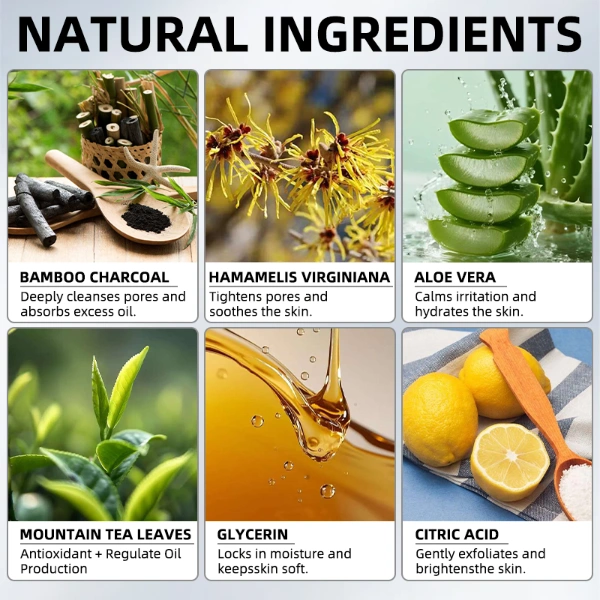
Activated Charcoal: Adsorption Mechanism and Formulation Behavior
Activated charcoal works through adsorption, not absorption. Its porous structure (surface area often exceeding 1,000 m²/g) traps sebum, dead skin cells, and oxidized debris when the strip adheres to moistened skin.
From a manufacturing perspective, charcoal offers several advantages:
- Cost efficiency: Raw material cost averages $8–15/kg for cosmetic-grade activated charcoal, significantly lower than essential oil actives.
- Formulation stability: Charcoal remains chemically inert across pH ranges of 5.0–7.5, reducing the risk of degradation during storage.
- Visual differentiation: The black color creates strong shelf presence and consumer perception of “deep cleansing.”
- Regulatory simplicity: Activated charcoal (INCI: Charcoal Powder) requires minimal documentation for export to US, EU, and ASEAN markets.
However, charcoal has formulation limitations:
- No antimicrobial action: It does not inhibit bacteria that contribute to acne formation.
- Texture challenges: High charcoal loading (>3% w/w) can create a gritty feel and reduce adhesive bond strength.
- Staining risk: Residual charcoal particles may temporarily discolor fair skin if the strip is not fully removed.
| Parameter | Specification |
|---|---|
| Typical loading in strips | 1.5–3.0% w/w |
| Particle size | 10–50 microns (cosmetic grade) |
| Shelf life impact | Minimal (stable for 24+ months) |
| MOQ impact | Low (widely available from multiple suppliers) |
Tea Tree Oil: Antimicrobial Activity and Formulation Complexity
Tea tree oil (Melaleuca alternifolia) delivers dual functionality: it helps dislodge comedones while providing antibacterial action against Cutibacterium acnes (formerly Propionibacterium acnes). The key active compound, terpinen-4-ol, typically constitutes 30–48% of the oil.
From an OEM formulation standpoint, tea tree oil introduces specific requirements:
- Ingredient sourcing: Authentic Australian tea tree oil costs $25–60/kg, depending on terpinen-4-ol content and organic certification.
- Stability considerations: Tea tree oil oxidizes when exposed to light and air, requiring opaque packaging and antioxidant stabilizers (e.g., tocopherol at 0.1–0.5%).
- Sensitization risk: Oxidized tea tree oil increases the likelihood of contact dermatitis. Fresh oil (manufactured within 6 months) is essential for safety.
- Regulatory documentation: You must provide allergen declarations for EU markets (per Cosmetics Regulation 1223/2009) and ensure compliance with ISO 4730:2017 for tea tree oil quality.
Tea tree oil’s benefits for brand positioning:
- Premium perception: Consumers associate tea tree with natural, acne-fighting efficacy, supporting higher retail prices ($0.50–1.20 per strip vs. $0.20–0.50 for charcoal).
- Therapeutic claims: You can position the product for acne-prone skin, not just cosmetic pore cleansing.
- Repeat purchase driver: Antimicrobial action encourages ongoing use for breakout prevention.
| Parameter | Specification |
|---|---|
| Typical loading in strips | 0.5–2.0% w/w |
| Key active compound | Terpinen-4-ol (30–48%) |
| Shelf life (unopened) | 18–24 months with proper stabilization |
| MOQ impact | Moderate (requires verified supplier for quality control) |
Adhesion Polymer Matrix: The Overlooked Constant
Both charcoal and tea tree formulations rely on the same base adhesive system, typically:
- Polyvinyl alcohol (PVA) as the primary film-forming agent
- Polyvinylpyrrolidone (PVP) for adhesion strength
- Glycerin and propylene glycol for plasticization
The active ingredient (charcoal or tea tree oil) constitutes only 1.5–3% of the total formula. The real performance driver is the polymer blend ratio, which determines:
- How strongly the strip adheres to skin texture
- Whether it removes sebaceous filaments or just surface debris
- How easily it peels off without causing micro-tears
When you work with an OEM partner, request adhesion peel force data (measured in gf/25mm). For effective blackhead removal, you want 150–250 gf/25mm. Below 150, the strip will not extract comedones; above 250, you risk skin irritation.
OEM Customization: How Ingredient Choice Affects Production Variables
Minimum Order Quantities (MOQ)
Charcoal-based strips typically require lower MOQs because the formulation uses commodity-grade materials:
- Standard MOQ: 10,000–30,000 pieces per SKU
- Custom packaging MOQ: 50,000+ pieces if you want branded foil pouches
Tea tree oil strips often carry higher MOQs due to ingredient cost and stability testing requirements:
- Standard MOQ: 20,000–50,000 pieces per SKU
- Reason: Suppliers batch-produce tea tree formulations less frequently to minimize oxidation risk during storage.
If you are launching a new brand with limited capital, charcoal allows faster market entry. If you target premium positioning, tea tree oil justifies the higher initial investment.
Lead Time and Sampling
For charcoal formulations:
- Sample turnaround: 7–10 days for standard base + charcoal at specified loading
- Production lead time: 25–35 days from PO to shipment
For tea tree oil formulations:
- Sample turnaround: 10–15 days (requires stability pre-check)
- Production lead time: 30–45 days (includes fresh oil procurement and oxidation testing)
Always request accelerated stability data (40°C/75% RH for 3 months) before committing to full production. This reveals whether the formulation will maintain adhesion strength and active ingredient potency through your intended shelf life.
Packaging and Shelf Life Considerations
Charcoal strips tolerate standard foil-laminate pouches (PET/AL/PE structure, 70–100 microns thick). You can use cost-effective printed foil without significant degradation risk.
Tea tree oil strips require enhanced barrier packaging:
- Preferred structure: PET/AL/LDPE with minimum 100-micron thickness
- Oxygen barrier: <1 cc/m²/24hr to prevent oil oxidation
- Light protection: Opaque or UV-blocking print layer
Packaging cost difference: approximately $0.02–0.05 per unit higher for tea tree oil SKUs.
Performance Benchmarking: Which Ingredient Suits Your Target Market?
| Criterion | Charcoal Strips | Tea Tree Oil Strips |
|---|---|---|
| Best for skin type | Oily, large pores, cosmetic concern | Acne-prone, combination, therapeutic need |
| Primary consumer appeal | Instant visible extraction, mass-market | Antibacterial action, premium natural positioning |
| Retail price range | $0.20–0.50 per strip | $0.50–1.20 per strip |
| Repeat purchase driver | Satisfying “gunk removal” experience | Acne prevention and ongoing skin health |
| Regulatory complexity | Low | Moderate (allergen disclosure, quality standards) |
| Shelf life (typical) | 24–36 months | 18–24 months |
| MOQ (starting) | 10,000–30,000 pcs | 20,000–50,000 pcs |
| Formulation risk | Low (stable, inert) | Moderate (oxidation, sensitization if mishandled) |
Market Positioning Scenarios
Scenario 1: You are launching a DTC brand targeting Gen Z on TikTok/Instagram
Recommendation: Start with charcoal. The visual payoff (black strip with visible extraction) creates shareable content. Lower MOQ allows you to test messaging and iterate on packaging without overcommitting capital.
Scenario 2: You are developing a spa or dermatology clinic private label line
Recommendation: Choose tea tree oil. Professional buyers expect therapeutic benefits, not just cosmetic theater. The antibacterial claim aligns with clinical skin health positioning.
Scenario 3: You are a distributor serving both mass and premium retailers
Recommendation: Offer both SKUs. Use charcoal for drugstore/supermarket channels, tea tree oil for specialty beauty and natural product stores. This segmentation maximizes shelf presence without channel conflict.
Procurement Checklist: Questions to Ask Your OEM Partner
Before you commit to a formulation, verify these points with your manufacturing partner:
For Charcoal Formulations:
- What is the activated charcoal particle size distribution? (Request certificate of analysis)
- How do you control charcoal loading to prevent adhesion reduction?
- Can you provide peel force data at different humidity levels?
- What is your standard lead time for 20,000-piece orders?
- Do you offer custom charcoal grades (e.g., bamboo charcoal vs. coconut shell)?
For Tea Tree Oil Formulations:
- What is the terpinen-4-ol content of your tea tree oil? (Verify against ISO 4730:2017)
- How do you prevent oxidation during production and storage?
- Can you provide accelerated stability data (3-month, 40°C/75% RH)?
- What antioxidants do you use, and at what concentration?
- Do you source oil directly from Australian distillers or through distributors?
- What is your batch-to-batch consistency protocol for essential oil quality?
For Both Formulations:
- What is the adhesion peel force range for your standard formula?
- Can you adjust PVA/PVP ratios for sensitive skin variants?
- What certifications do you hold? (ISO 22716 GMP, FDA registration, etc.)
- Do you offer fragrance-free options to reduce sensitization risk?
- What is your policy on reformulation if my market rejects the initial sample?
Common Mistakes Brand Owners Make (and How to Avoid Them)
Mistake 1: Choosing ingredients based on trends, not target audience needs
Many brands chase “activated charcoal” because it is trending on social media, without analyzing whether their core customer has oily skin or primarily struggles with acne. Match the active ingredient to the skin concern your audience actually experiences.
Mistake 2: Ignoring stability testing before scaling production
Tea tree oil can oxidize within 6–12 months if packaging is inadequate. If you skip accelerated stability testing and launch with 50,000 units, you may face returns or regulatory issues when the product degrades on-shelf. Always request 3-month stability data at 40°C/75% RH.
Mistake 3: Focusing only on ingredient cost, not total landed cost
Tea tree oil adds $0.10–0.20 per strip in raw material cost, but it also requires better packaging (+$0.03), more rigorous QC (+$0.02), and potentially higher MOQs (increasing per-unit freight). Calculate total landed cost, not just FOB price.
Mistake 4: Failing to test adhesion strength variations across climate zones
A strip formulated for temperate climates may fail in humid Southeast Asian markets or dry Middle Eastern environments. Request peel force data at 25°C/60% RH, 30°C/80% RH, and 20°C/40% RH if you plan multi-region distribution.
Regulatory and Safety Considerations for Export Markets
United States (FDA Cosmetic Regulations)
Both charcoal and tea tree oil strips classify as cosmetics, not OTC drugs, provided you avoid therapeutic claims like “treats acne” or “cures blackheads.” Acceptable claims include:
- “Helps remove blackheads and impurities”
- “Deep cleanses pores”
- “Reduces the appearance of pores”
Tea tree oil requires allergen disclosure if concentration exceeds certain thresholds (though specific limits apply primarily to EU regulations).
European Union (Cosmetics Regulation 1223/2009)
Tea tree oil must be listed on the ingredient declaration (INCI: Melaleuca Alternifolia Leaf Oil). If the product is a leave-on formulation (though pore strips are rinse-off by nature), you must declare potential allergens like limonene and linalool if they exceed 0.001% in leave-on products or 0.01% in rinse-off products.
For charcoal, ensure your supplier provides REACH compliance documentation if you export to the EU.
ASEAN Cosmetic Directive
Both ingredients are permitted. Tea tree oil requires notification under the ASEAN Cosmetic Directive, and you must provide safety assessment data. Charcoal typically requires minimal documentation beyond proof of cosmetic-grade purity.
Frequently Asked Questions
Can I combine charcoal and tea tree oil in one formulation?
Yes, but it increases formulation complexity and cost. The combination works well for acne-prone skin with excess sebum, but you must carefully balance oil concentration to avoid reducing adhesive strength. Expect MOQs of 30,000+ pieces and additional stability testing.
Which ingredient works better for sensitive skin?
Charcoal is less likely to cause irritation, as it is chemically inert. Tea tree oil, especially if oxidized, can trigger contact dermatitis. If you target sensitive skin, use charcoal and focus on a gentle PVA/PVP ratio (lower peel force).
How do I verify charcoal or tea tree oil quality from my OEM partner?
Request a Certificate of Analysis (CoA) for each production batch. For charcoal, check surface area (m²/g) and particle size distribution. For tea tree oil, verify terpinen-4-ol content (minimum 30%) and cineole content (maximum 15%) per ISO 4730:2017.
What is the cost difference per 1,000 units?
For a standard nose strip (6–8 cm²):
- Charcoal formulation: $150–250 per 1,000 units (FOB)
- Tea tree oil formulation: $220–350 per 1,000 units (FOB)
Prices vary based on packaging, MOQ, and whether you include custom fragrance or additional actives.
Can I use “natural” or “organic” claims?
For charcoal: “Natural” is acceptable if derived from coconut shell or bamboo. “Organic” requires certified organic sourcing, which is rare for activated charcoal.
For tea tree oil: “Natural” is standard. “Organic” requires certified organic tea tree oil (expect 20–40% cost premium) and compliance with USDA Organic or EU Organic standards.
Conclusion: Aligning Ingredient Choice with Business Strategy
Your choice between charcoal and tea tree oil is not just a formulation decision—it is a business positioning decision. Charcoal offers lower entry barriers, faster time-to-market, and mass-market appeal. Tea tree oil commands premium pricing, supports therapeutic claims, and builds brand equity in the natural skincare segment.
Consider these final decision criteria:
- If your priority is rapid launch with minimal capital: Start with charcoal.
- If you want to differentiate in a crowded market: Invest in tea tree oil with proper stability controls.
- If you serve multiple retail channels: Develop both SKUs to maximize distribution.
Work with an OEM partner who understands not just formulation chemistry but also your business constraints—MOQ flexibility, sampling speed, and regulatory support. The right ingredient choice, backed by solid manufacturing execution, turns a commodity product into a profitable brand asset.
Partner with PZIK for Custom Blackhead Removal Strip Development
If you are looking for a reliable OEM partner for private label blackhead removal strips, PZIK provides:
- Over 10 years of cosmetics manufacturing expertise, serving global beauty brands
- Low MOQ starting from 1,000 pieces, reducing inventory risk for emerging brands
- Full formulation customization: charcoal, tea tree oil, or combination actives
- In-house stability testing and regulatory documentation support for US, EU, and ASEAN markets
- Fast sampling turnaround (7–15 days) and transparent production timelines
- Sustainable sourcing options for natural and organic ingredient claims
We help you move from concept to finished product with confidence. Whether you need a cost-effective charcoal SKU for mass-market launch or a premium tea tree oil line for specialty retail, our R&D team tailors formulations to your target audience and price point.
📩 Email: sales@pzik.com
📱 WhatsApp: +1 3322600900
Contact us today to request samples and discuss your blackhead removal strip project.



Add comment