
Es befinden sich keine Produkte im Warenkorb.










Why pH Matters in Skincare Formulation for Healthy Skin

You might notice that pH in skincare formulation shapes how well your skin stays healthy. Think of pH like the difference between orange juice and milk—one is acidic, one is neutral, and each feels different on your tongue. Your skin likes a slightly acidic environment, and choosing products with the right pH helps keep your barrier strong and your microbiome balanced.
Did you know? Dermatological studies show that products with pH below 5 can boost skin microbiome diversity and reduce harmful bacteria.
Misconception | Truth |
|---|---|
There is a perfect pH for skincare products. | Skin can buffer itself, so products do not need an exact pH. |
The pH of a product determines how mild or harsh it is. | Ingredients and their concentration also matter. |
Learning about pH lets you pick products that support healthy skin every day.
Wichtige Erkenntnisse
Understanding pH helps you choose skincare products that support healthy skin. Look for products with a pH between 4.5 and 5.5.
Using products with the right pH protects your skin’s acid mantle. This barrier keeps moisture in and harmful bacteria out.
Pay attention to pH when using active ingredients. For example, vitamin C works best at a low pH, while niacinamide prefers a neutral pH.
Sensitive skin benefits from pH-adjusted products. These formulas help reduce irritation and maintain skin balance.
Regularly check the pH of your skincare products. Use pH test strips or meters to ensure they match your skin’s needs.
Understanding pH in Skincare Formulation

What Is pH?
You see the term “pH” on many skincare labels, but what does it mean? pH measures how acidic or alkaline something is. In skincare, this matters because your skin likes a slightly acidic environment. Most skin and scalp areas have a pH between 5 and 5.5. Many products match this range to help your skin stay healthy. Some cleansers have a pH of 6 to 6.5 since you rinse them off quickly. When you choose products, you support your skin’s natural balance by paying attention to pH in skincare formulation.
pH is a measure of acidity or alkalinity, crucial in cosmetic formulas.
Skin and scalp typically have a pH of 5 to 5.5.
Wash-off products like cleansers can have a slightly higher pH of 6 to 6.5.
pH Scale Explained
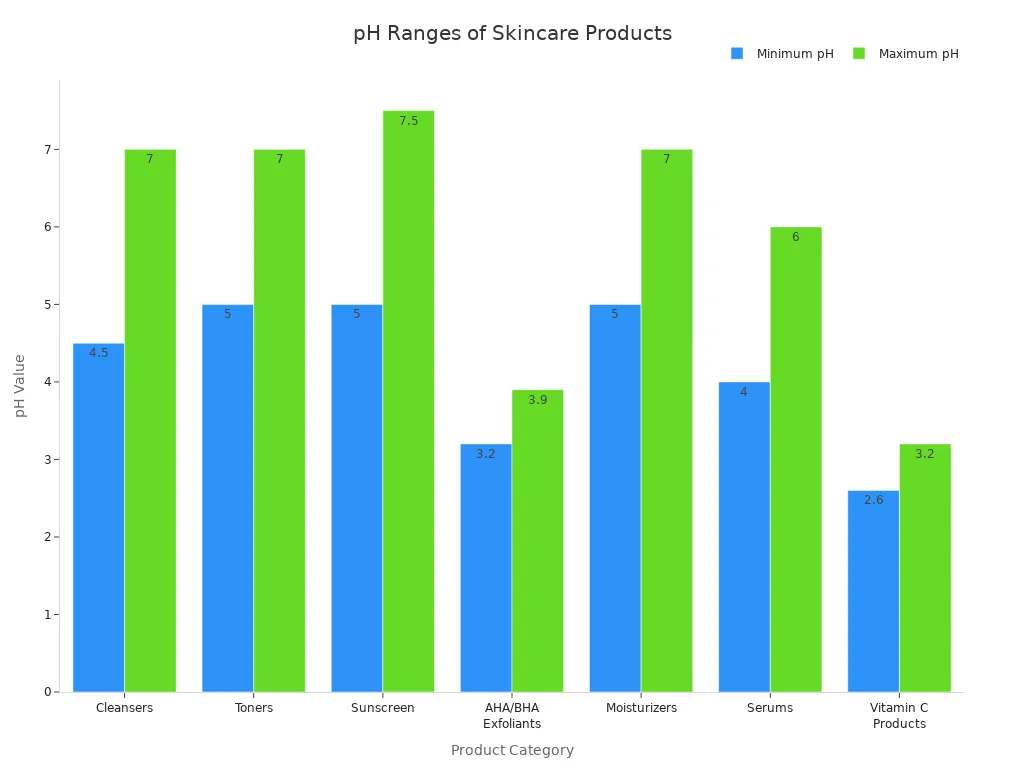
The pH scale runs from 0 to 14. Lower numbers mean more acidic, higher numbers mean more alkaline, and 7 is neutral. Skincare products fall into different ranges on this scale. Here is a table showing typical pH values for common products:
Product Category | pH Range | Notes |
|---|---|---|
Cleansers | 4.5–7 | Mild formulas align with skin’s natural acidity. |
Toners | 5–7 | Often formulated to rebalance skin pH post-cleansing. |
Sonnenschutzmittel | 5–7.5 | Stability of UV filters depends on pH. |
AHA/BHA Exfoliants | 3.2–3.9 | Most effective at pH 3–4 for optimal exfoliation. |
Moisturizers | 5–7 | Neutral to slightly acidic to support barrier function. |
Serums | 4–6 | Actives require pH stability. |
Vitamin C (Ascorbic Acid) Products | 2.6–3.2 | Low pH ensures stability and bioavailability. |
Everyday pH Analogies
You can understand pH in skincare formulation by thinking about things you use every day. Some products feel gentle, while others feel harsh. This often relates to their pH.
Bar soaps often have a higher pH and can feel drying.
Body washes and shampoos vary, but many have higher pH.
Conditioners tend to have a lower pH and feel smooth.
Vitamin C serums need an acidic pH for best results.
Toners often have a pH around 4–5.
Masks can have a lower pH for special effects.
When you know these differences, you can choose products that work best for your skin. Paying attention to pH in skincare formulation helps you keep your skin healthy and comfortable.
Skin’s Natural pH and Acid Mantle

Protective Functions of Acid Mantle
Your skin has a thin, invisible shield called the acid mantle. This layer sits on the surface and keeps your skin healthy. The acid mantle has a mildly acidic pH, usually between 4.5 and 5.5. This acidity is not just a number. It helps your skin in many ways:
The acid mantle blocks harmful bacteria and supports good bacteria, making your skin’s natural defenses stronger.
It keeps moisture inside your skin and stops dryness.
It protects you from pollution and other environmental stressors.
When you use products that match your skin’s natural pH, you help the acid mantle do its job.
Tip: Using harsh soaps or alkaline cleansers can damage the acid mantle. This can lead to dryness, redness, or even breakouts.
Clinical studies use flat glass electrodes to measure skin pH. These tools give reliable and accurate results. Most healthy skin falls in the pH range of 5.4 to 5.9.
Parameter | Value Range |
|---|---|
Average pH of Skin | 5.4 – 5.9 |
pH Variation Across Body Areas
Not all parts of your body have the same pH. The skin on your face, hands, and scalp can each have a different pH value. Scientists have found that the forehead often has a higher pH than the forearm. Age and gender can also affect these numbers. Older people may have higher skin pH levels.
The forehead usually has a higher pH than the forearm.
Age and gender can change skin pH, with older people showing higher values.
Across all age groups, the difference between forehead and forearm pH is not always large.
You can measure your skin’s pH at home or in a clinic. A skin pH meter uses a small probe to check the pH level. The process is quick and does not hurt.
Method | Beschreibung |
|---|---|
Glass planar electrode | Universal method connected to a voltage meter for accurate results. |
Skin pH-meter 900/905 | Device designed for skin pH measurement. |
pH meter 1140 | Instrument suitable for clinical settings. |
Effects of pH Imbalance
When your skin’s pH moves away from its natural range, problems can start. An imbalance can disrupt your skin’s microenvironment. You might notice dryness, irritation, or more breakouts. Chronic skin conditions like acne and eczema often appear when the skin’s pH becomes less acidic.
Dryness, irritation, and sensitivity can happen if your skin’s pH is too high or too low.
Atopic dermatitis (a type of eczema) often shows up on skin with a higher, more neutral pH.
Treatments that lower skin pH can help manage eczema and reduce inflammation.
Note: Regular use of alkaline cleansers can damage your acid mantle. This makes it harder for your skin to heal and can speed up signs of aging.
Healthy skin needs a slightly acidic pH. When you pay attention to pH in skincare formulation, you help your skin stay strong, balanced, and less likely to develop problems.
pH in Skincare Formulation and Ingredient Efficacy
Active Ingredients and pH Dependence
You want your skincare products to work well. The pH in skincare formulation plays a big role in how active ingredients perform. Each ingredient has a pH range where it works best. If you use a product outside this range, you may not get the results you expect.
Here is a table showing the best pH ranges for some popular active ingredients:
Ingredient | Optimal pH Range | Notes |
|---|---|---|
Vitamin C (L-ascorbic acid) | 3.0 – 4.0 | Works best in a low pH. Helps brighten skin and fight free radicals. |
Niacinamide | 6.0 | Prefers a more neutral pH. Calms redness and supports the barrier. |
Alpha Hydroxy Acids (AHAs) | 3.0 – 4.0 | Needs an acidic pH for exfoliation. Can irritate if used with retinol. |
You can get the most from your routine by applying acidic products first. For example:
Start with vitamin C or AHA serums (pH 3.0–4.0).
Follow with neutral products like niacinamide (pH 6.0).
Avoid using AHAs and retinol together to prevent irritation.
Tip: The skin’s natural pH is about 4.5 to 5.5. Begin with lower pH products to help active ingredients absorb better.
Product Stability and Preservatives
You want your skincare to stay fresh and safe. The pH in skincare formulation affects how well preservatives work and how long your products last. Some preservatives only work in certain pH ranges. If the pH is too high or too low, bacteria and mold can grow.
Here is a table showing how pH affects common preservatives:
Preservative Type | Optimal pH Range | Effectiveness at High/Low pH |
|---|---|---|
Parabens | Below 5.5 | Lose power in alkaline products. |
Bronopol | Varies | Breaks down slowly at high pH. |
Multifunctional Acids | Alkaline | Work better in higher pH products. |
Microorganisms like bacteria and mold also care about pH. Most cannot survive in very acidic (below 4) or very alkaline (above 10) conditions. Keeping the right pH helps stop their growth.
Microorganism Growth | pH Range | Effect on Growth Rate |
|---|---|---|
General Microorganisms | 5 to 8 | Grow best in this range |
Acidic Conditions | < 4 | Most cannot survive |
Alkaline Conditions | > 10 | Most cannot survive |
Parabens and phenoxyethanol work best below pH 5.5.
High pH products need special preservatives.
Formulators use pH regulators to keep products stable and safe. They use buffer systems, natural surfactants, and thickeners to hold the pH steady. This helps active ingredients stay strong and reduces the risk of irritation.
Examples of pH-Sensitive Ingredients
Some ingredients need a certain pH to work. If you use them at the wrong pH, they can lose power or even harm your skin.
Glycolic acid, an AHA, needs a low pH to exfoliate well. If the pH is too high, it will not work and can dry out your skin.
Vitamin C (L-ascorbic acid) breaks down fast at high pH. It needs an acidic environment to stay active and brighten your skin.
Niacinamide works best at a neutral pH. If mixed with acidic products, it can cause redness or irritation.
If you use products with the wrong pH for a long time, you may see:
More water loss from your skin.
A weak skin barrier.
Redness and swelling, especially if you have sensitive skin.
Note: Formulators keep pH between 4.5 and 7 to match your skin’s natural acidity. This helps ingredients work well and keeps your skin safe.
When you understand pH in skincare formulation, you can choose products that give you the best results and keep your skin healthy.
Skin Compatibility and Tailored Formulation
Matching Product pH to Skin
You want your skincare products to work with your skin, not against it. Matching the pH of a product to your skin’s natural pH helps keep your skin healthy and strong. Most skin has a surface pH below 5. This slightly acidic environment supports good bacteria and protects you from harmful germs. When you use products that match your skin’s pH, you lower the risk of irritation and skin problems.
Skin with a pH below 5 supports healthy skin flora.
Disrupting skin pH increases the risk of skin diseases.
Harmful bacteria like Staphylococcus aureus grow better at higher pH levels.
If you ignore pH compatibility, you may notice more dryness, itching, or breakouts. Your skin’s barrier can weaken, making it harder to stay hydrated and fight off infections.
Special Needs for Sensitive Skin
Sensitive skin needs extra care. You should look for products with a pH between 4.5 and 5.5. This range helps avoid irritation and keeps your skin barrier strong. Formulators add soothing and strengthening agents to help sensitive skin stay calm and healthy.
pH-adjusted products maintain your skin’s natural balance.
These formulas avoid harsh ingredients that disrupt pH.
They support your skin’s microbiome and reduce irritation.
Balanced products help your skin stay hydrated and protected.
If you have sensitive skin, choosing the right pH in skincare formulation can make a big difference. You will notice less redness and fewer flare-ups.
Adapting for Different Body Areas
Your skin’s pH varies across your body. The face, scalp, and hands each have unique needs. Using products with the wrong pH for a specific area can cause problems.
Products outside the ideal pH range (4.5 to 5.5) can harm your skin.
High pH products (over 6.5) are not recommended.
Disrupted pH leads to poor hydration, more itching, and higher risk of infections.
You help your skin stay healthy by choosing products tailored for each area. Recovery from pH disruption can take hours, so regular care matters. Matching product pH to your skin’s needs keeps your barrier strong and your skin comfortable.
You play a key role in keeping your skin healthy by choosing products with the right pH in skincare formulation. Dermatological studies show that healthy skin needs a slightly acidic surface to protect against bacteria and keep the barrier strong. Products with the wrong pH can cause irritation and dryness. You can look for pH-balanced products and check labels to find what matches your skin. Clinical trials show that pH-balanced foam washes and moisturizers help reduce irritation and improve hydration.
Produkttyp | Key Benefits | Clinical Findings |
|---|---|---|
Foam Wash | Cleans gently, works well at low pH | Most users report no irritation and good skin feel |
Moisturizer SPF 30 | Hydrates, protects, supports skin barrier | Increases ceramides, lowers irritation in clinical tests |
Tip: Pay attention to product pH for safer, more effective skincare choices.
Häufig gestellte Fragen
What does “pH-balanced” mean on a skincare label?
You see “pH-balanced” when a product matches your skin’s natural acidity. This helps protect your skin barrier and keeps your skin healthy. Most pH-balanced products have a pH between 4.5 and 5.5.
Can using the wrong pH product cause skin problems?
Yes. Products with a high or low pH can weaken your skin barrier. You may notice dryness, redness, or breakouts. Choosing products close to your skin’s pH helps you avoid these issues.
How do you check the pH of your skincare products?
You can use pH test strips or a digital pH meter. Dip the strip into the product and compare the color to the chart. This helps you know if the product matches your skin’s needs.
Do all skin types need the same pH in products?
No. Sensitive skin needs products with a pH between 4.5 and 5.5. Oily or normal skin can handle a wider range. Always check your skin’s reaction and choose what feels best for you.
Why do some ingredients need a specific pH?
Some ingredients work only at certain pH levels. For example, vitamin C needs an acidic pH to stay active. If you use it at the wrong pH, you lose its benefits.


Kommentar hinzufügen