


The Turnkey Revolution: 9 Proven Ways Influencers Launch Viral Beauty Lines with Full-Service ODM Solutions
A B2B strategy guide for brands that want faster launches, lower inventory risk, and compliant global scale.
If your goal is to turn audience attention into product revenue, the fastest route is a turnkey ODM model built for social-first beauty commerce.

Market Intelligence & Client Pain Points: Why Influencer Beauty Wins or Fails at the Supply Chain Layer
The influencer beauty category is brutally unforgiving because attention moves faster than operations. A trending ingredient, challenge format, or skin concern can go from zero to saturated in days, while traditional product development can still be stuck in long formulation cycles, large minimums, and fragmented vendor coordination.
This gap is why many creator-led brands experience a painful pattern: they generate excitement before they have a launchable SKU, then lose momentum while waiting on development, packaging, compliance, and freight. In practice, the business does not fail because the audience is weak; it fails because the operating model is too slow for social media economics.
The most common pain points are severe and measurable. Founders face inventory risk from oversized MOQs, inconsistent quality from multi-vendor sourcing, long sampling loops, limited differentiation in crowded beauty subcategories, and market-entry friction caused by evolving regulations such as [FDA](https://www.fda.gov/cosmetics) oversight, [MoCRA](https://www.fda.gov/cosmetics/cosmetics-laws-regulations/modernization-regulation-cosmetics-act-2022-mocra) requirements, and EU [CPNP](https://health.ec.europa.eu/medical-devices-sector/cosmetic-products-notification-portal-cpnp_en) notification demands.
Another challenge is content-fit. A beauty line built for retail shelves may look good in a catalog, but it often does not create the immediate visual payoff that drives creator conversions on TikTok and Instagram. If the product does not show an obvious result in three minutes, it is often underperforming in the very channel that was supposed to make it famous.
The supply chain also creates a hidden marketing tax. Every additional day in development increases creative fatigue, raises paid media dependency, and lowers the odds that the launch coincides with a viral moment, a live stream spike, or a creator collab window. That is why the best-performing creator brands increasingly operate like agile commerce companies, not traditional cosmetics startups.
Solution Deep-Dive – SEO Pillar: The Full-Service ODM Model That Turns Attention into Repeatable Revenue
The strategic answer is a turnkey ODM system designed specifically for visual commerce. Instead of building a brand through disconnected vendors, the founder works with one integrated manufacturing partner that handles visual-first formulation, micro-batch production, packaging optimization, compliance documentation, and distribution readiness from the start.
This is not just convenient; it is structurally superior for creator-led beauty. A turnkey partner compresses the distance between concept and revenue, which improves launch velocity, reduces operational failure points, and makes it possible to test several product hypotheses before one wins the market.
In this model, the most valuable asset is not a large warehouse. It is a validated pipeline that lets the brand move from audience insight to sample to social proof to replenishment with minimal lag.
1. Start with a visual-first formulation engine, not a generic catalog
A viral beauty line needs products that perform on camera as well as in the hand. That is why the strongest manufacturing foundation is a library of more than 5,000 mature, clinically tested formulas engineered around immediate visible outcomes such as three-minute rescue effects, blackhead dissolution, and fast-reveal texture changes.
These are the kinds of claims and visuals that convert in social content because they create instant proof. When a serum, mask, patch, or eye treatment visibly changes the skin story in a tight time window, the product becomes the content.
This approach also improves concept testing. Instead of spending months on speculative R&D, a creator brand can compare multiple formulations, angles, and claims within the same launch cycle and pick the best-performing SKU based on response data rather than guesswork.
Why this matters: social commerce rewards immediacy, clarity, and repeatable demonstrations. A three-minute visible transformation is more persuasive than a vague promise of long-term improvement because it maps directly to short-form video behavior.
Business result: stronger click-through rates, lower cost per acquisition, and higher creative reuse across ads, organic posts, affiliate content, and live selling.
2. Use 50-piece micro-batch MOQ to kill inventory fear before it kills momentum
Most creator brands do not fail from lack of demand; they fail from premature commitment. Large MOQs force founders to bet too early, before they know which hook, scent, texture, price point, and packaging language the audience actually wants.
A 50-piece white-label starting point changes the economics of experimentation. It allows a brand to test multiple product concepts, packaging directions, and positioning angles without consuming critical cash flow or locking capital in slow-moving stock.
From a B2B standpoint, this is a risk-management tool disguised as a manufacturing feature. It reduces obsolescence exposure, prevents dead inventory, and gives leadership the freedom to make decisions from market evidence rather than fear.
3. Compress sampling cycles to 3–7 days so trend windows do not close
Sampling delay is one of the most expensive and invisible losses in beauty. By the time a brand finishes a standard back-and-forth development loop, the original trend may already be diluted by competitor launches, audience fatigue, or platform algorithm shifts.
A 3–7 day custom sample turnaround enables rapid creative iteration. That means the founder can move from concept to tactile review, from tactile review to creator seeding, and from creator seeding to launch decision while the trend is still hot.
This speed matters because beauty virality is time-sensitive. The market does not reward the best idea in theory; it rewards the first credible offer in market with proof, clarity, and enough inventory to fulfill demand.

4. Build for FBA and dropshipping from day one, not as an afterthought
Creator-led beauty brands often underestimate logistics until packaging failures begin. Heavy boxes, fragile components, oversized dimensions, and untested carton design can silently erase margin through elevated freight, FBA charges, and breakage.
An integrated one-stop system for Amazon FBA and dropshipping solves this by aligning product design with fulfillment economics. Lightweight, high-margin categories such as lash-focused products are especially suited for this model because they can be optimized for low shipping cost, easier storage, and fewer transit losses.
Protective, drop-tested packaging is not optional in a launch strategy that depends on speed and repeat purchase. It preserves review quality, lowers replacement costs, and helps the brand maintain a healthy customer experience once paid traffic starts scaling.
5. Make quality non-negotiable by manufacturing in a medical-grade clean environment
Beauty brands that grow from influencer attention must be able to survive the scrutiny that comes with scale. That means every batch must be manufactured with consistent controls, traceability, and a process standard that supports both brand trust and regulatory readiness.
Products made in a 100,000-level medical-grade dust-free workshop provide an essential baseline for stability and batch consistency. This is particularly important when a formula depends on repeatable performance, shelf stability, and a premium sensory experience.
Quality is not only a technical issue; it is a profitability issue. Poor quality creates refunds, bad reviews, social backlash, and customer support load, all of which reduce lifetime value and weaken the next product launch.
Technical proof points to watch: pH stability, packaging compatibility, transport durability, microbiological controls, viscosity retention, fill accuracy, and batch repeatability.
Commercial proof points to watch: refund rate, repeat purchase rate, review velocity, gross margin after fulfillment, and inventory turn speed.
6. Expand globally with built-in MoCRA, CPNP, and certification support
Cross-border beauty scaling is often blocked by compliance complexity, not demand. A product that performs well in one market can stall in another if the documentation, labeling, claims support, or notification process is incomplete.
A turnkey partner that supports the latest U.S. [MoCRA](https://www.fda.gov/cosmetics/cosmetics-laws-regulations/modernization-regulation-cosmetics-act-2022-mocra) framework and EU [CPNP](https://health.ec.europa.eu/medical-devices-sector/cosmetic-products-notification-portal-cpnp_en) registration removes a major bottleneck. When combined with [FDA](https://www.fda.gov/cosmetics) readiness and recognized certifications such as GMPC, [ISO 22716](https://www.iso.org/standard/36437.html), and Halal, the brand can expand faster with fewer surprises.
This matters because modern B2B buyers, marketplace operators, and distributors increasingly expect formal compliance evidence before listing, importing, or promoting products. The stronger the documentation package, the faster the commercial pathway opens.
Compliance advantage: you are not only manufacturing a product; you are manufacturing a launch-ready business asset.
Scale advantage: a product portfolio that already anticipates U.S. and EU requirements is easier to distribute, easier to retail, and easier to defend operationally.
7. Design the product architecture around creator economics, not traditional retail assumptions
Influencer beauty launches should be built around how audiences buy, not how legacy retailers merchandise. That means clear hero claims, visible results, compact formats, premium but accessible pricing, and a product story that can be explained in one sentence.
When the portfolio is engineered for social commerce, the founder can create content that feels native to the platform. The SKU becomes simpler to demonstrate, easier to bundle, and more profitable to distribute through affiliate, marketplace, and direct-to-consumer channels.
This is why beauty lines optimized for visuals often outperform generic “clean beauty” or “all-purpose skincare” offers. Specificity sells faster because it reduces uncertainty for the buyer and gives the creator a sharper narrative.
8. Turn sampling into a creative testing system
Sampling should not be treated as a private laboratory process. It should be treated as a market-validation engine where the founder tests texture reaction, sensory appeal, packaging preferences, before-and-after visuals, and creator feedback at the same time.
A strong ODM partner makes this possible by accelerating sample iteration and reducing the gap between technical feasibility and audience desirability. The best beauty lines are not chosen by the lab alone; they are chosen by a combined signal of formula performance, content performance, and commercial response.
That is a major strategic shift. It turns launch development into a disciplined feedback loop instead of a one-way production request.
9. Match the factory’s operating model to your growth model
The wrong manufacturing setup creates a permanent ceiling. If the brand intends to launch fast, test often, and scale selectively, the partner must support low MOQ, rapid iteration, compliant documentation, and channel-specific packaging from the outset.
The right turnkey ODM partner functions like an extension of the brand team. It reduces overhead, reduces launch friction, and creates the operational flexibility needed to move from a creator pilot to a repeatable multi-SKU business.
This is the core of the turnkey revolution in beauty: outsource complexity, preserve strategic control, and keep the founder focused on audience growth and conversion.
Supply Chain Strategy: How to Build a Viral Beauty Line Without Inventory Anxiety
Supply chain strategy for influencer beauty should be designed around three realities: demand is volatile, content cycles are short, and working capital must stay flexible. The old model of committing to large runs before proof is incompatible with creator-led growth.
The smarter model is staged expansion. Start with a small white-label or custom batch, validate the hero SKU, then scale only after you see conversion, retention, and fulfillment stability.
That approach keeps risk proportional to proof. It also creates optionality, which is one of the most valuable assets in fast-moving beauty categories.
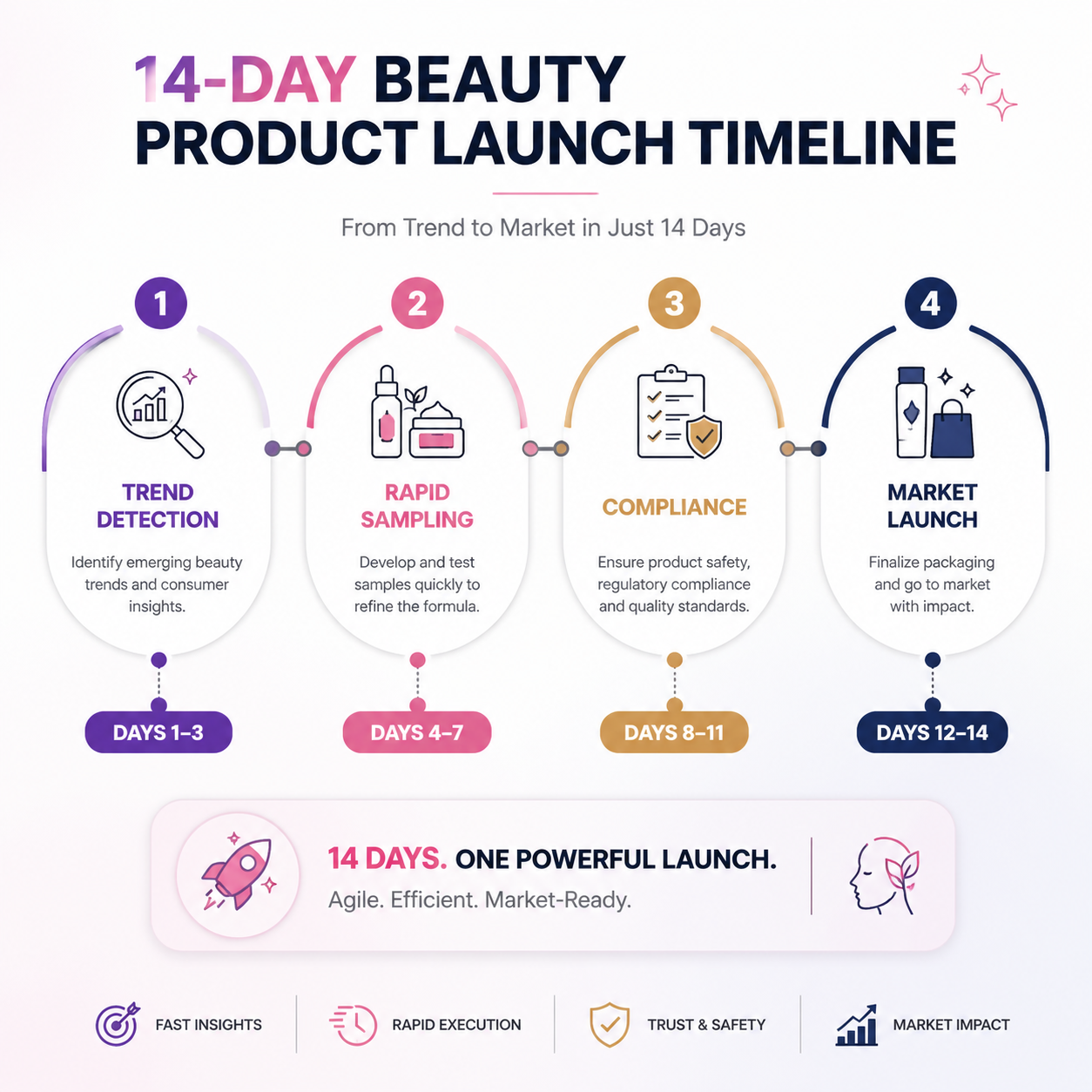
Recommended operating sequence: trend capture → sample in 3–7 days → creator review → micro-batch production at 50 MOQ → channel packaging optimization → FBA and dropship launch → compliance documentation → international expansion.
Recommended KPIs: sampling cycle time, launch lead time, breakage rate, first-30-day sell-through, contribution margin, reorder velocity, and review sentiment.
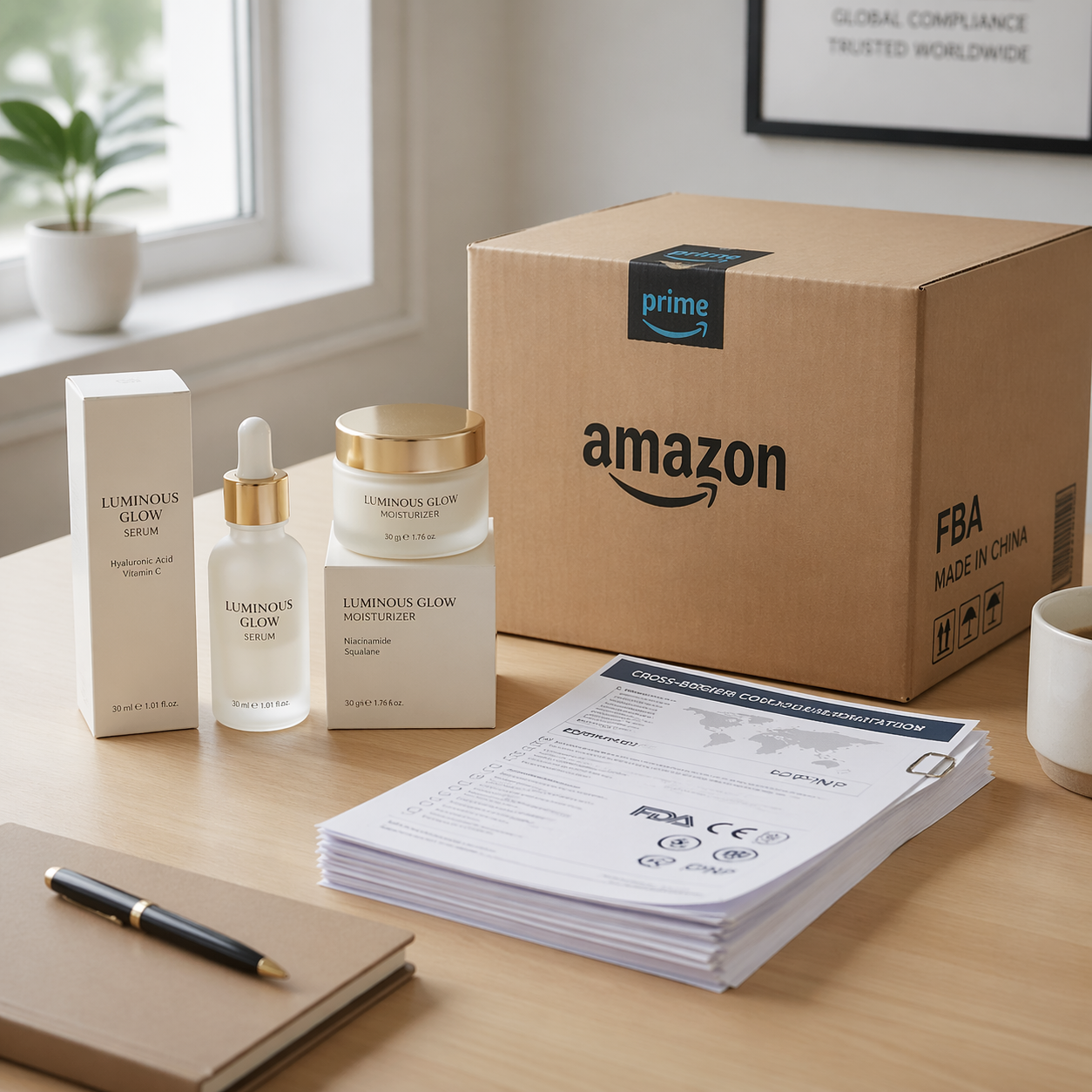
Packaging should be treated as a margin lever, not a branding cost. A lightweight, drop-resistant carton can lower logistics expense, reduce damage claims, and improve Amazon or marketplace performance by protecting the unboxing experience.
Fulfillment architecture should also reflect product economics. Small, high-value beauty items often outperform bulky kits because they are easier to store, cheaper to ship, and more compatible with FBA and dropshipping margins.
At the compliance layer, global readiness should be planned before demand arrives. A product that already aligns with [FDA](https://www.fda.gov/cosmetics) expectations, [MoCRA](https://www.fda.gov/cosmetics/cosmetics-laws-regulations/modernization-regulation-cosmetics-act-2022-mocra) obligations, [CPNP](https://health.ec.europa.eu/medical-devices-sector/cosmetic-products-notification-portal-cpnp_en) notification, and [ISO 22716](https://www.iso.org/standard/36437.html) manufacturing principles will move faster through procurement, retail onboarding, and international channel approval.
That is especially important when you are building a brand around creator credibility. The audience may buy because of a story, but distributors and marketplaces approve because of operational proof.
Projected Business Outcomes: What Happens When the Turnkey Model Is Executed Correctly
The commercial upside of a turnkey ODM beauty strategy is not abstract. It shows up in shorter time-to-market, lower launch capital, cleaner inventory management, better conversion from content, and stronger ability to scale across markets.
When the product is visually compelling, fast to sample, and compliant enough to launch globally, the brand gains an operational edge that compounds. Every launch becomes faster, every test becomes cheaper, and every winning SKU becomes easier to replicate.
Here is what founders should expect when the model is implemented with discipline.
Outcome 1: Higher ROI. Lower MOQ and faster sampling reduce sunk costs, while visual-first claims can improve conversion efficiency across organic and paid channels.
Outcome 2: Faster time-to-market. A 14-day path from concept to globally compliant launch is materially faster than conventional cosmetic development cycles.
Outcome 3: Better risk mitigation. Small-batch launch design reduces dead stock, minimizes cash tied up in inventory, and allows continuous portfolio testing.
Outcome 4: Stronger channel economics. FBA-optimized packaging, dropship readiness, and lightweight SKU design can lower shipping pressure and improve fulfillment margins.
Outcome 5: Improved brand trust. Clean-room manufacturing, consistent batch quality, and recognized certifications help defend reputation when volume rises.
Outcome 6: Global expansion readiness. Built-in compliance support lowers friction when entering the U.S., Europe, and other regulated markets.
Outcome 7: Better creator content performance. Products that produce immediate visible results are easier to demonstrate and easier to sell through short-form video.
Outcome 8: Stronger portfolio logic. Brands can launch multiple concepts in parallel, then keep the winners and drop the losers without damaging capital structure.
There are also strategic second-order effects. Once the founder learns how to validate products quickly, the brand becomes less dependent on one hero launch and more capable of creating a repeatable product engine.
That is the real value of turnkey ODM in beauty. It transforms one-time virality into an operational system for continuous commercial growth.
Implementation Blueprint: How a Creator-Led Beauty Brand Should Execute the First 30 Days
Week one should focus on market selection, hero concept selection, and packaging direction. The founder should pick a product category that can be demonstrated visually, explained simply, and priced with enough margin to support content and fulfillment.
Week two should focus on sampling, creator feedback, and claim refinement. The goal is not to create a perfect formula; the goal is to create a marketable formula that can pass both visual proof and compliance review.
Week three should focus on batch planning, packaging finalization, and logistics mapping. That includes FBA carton dimensions, drop protection, labeling strategy, and inventory planning for the initial 50-piece run or the next scaling tier.
Week four should focus on launch content, seeding, and channel orchestration. The best outcome is a launch that is ready not just for sales, but for repeat content, review capture, and reorder planning.
The entire system works best when the founder uses the factory as a strategic partner, not a transactional supplier. If the brand treats manufacturing as part of marketing, the product has a much better chance of winning in a crowded attention economy.
Authority and Compliance Sources You Should Expect in a Serious ODM Partnership
A credible manufacturing partner should be able to discuss [FDA](https://www.fda.gov/cosmetics) cosmetics expectations, [MoCRA](https://www.fda.gov/cosmetics/cosmetics-laws-regulations/modernization-regulation-cosmetics-act-2022-mocra) obligations, [CPNP](https://health.ec.europa.eu/medical-devices-sector/cosmetic-products-notification-portal-cpnp_en) notification workflow, [ISO 22716](https://www.iso.org/standard/36437.html) cosmetic GMP guidance, and relevant safety or ingredient documentation.
Where clinical or ingredient claims are involved, teams should also be able to support evidence-based language and avoid overclaiming. For market education and scientific context, high-quality references such as [PubMed](https://pubmed.ncbi.nlm.nih.gov/) can help founders understand how to frame claims more responsibly.
These sources are not decoration. They are part of the operational infrastructure that helps beauty brands scale without triggering avoidable compliance failures.
Where Internal Brand Education Should Fit in the Buyer Journey
To convert creator-led visitors into qualified B2B leads, the content ecosystem should connect education to action. Readers who want to go deeper should be guided toward full-service beauty ODM launch strategy, white label beauty product development, micro-batch cosmetic manufacturing, Amazon FBA beauty packaging optimization, global cosmetic compliance support, viral skincare product formulation, creator brand private label cosmetics, and fast-turn beauty sampling workflow.
These content paths help the buyer self-educate across product, packaging, logistics, and compliance before speaking to sales. In B2B marketing terms, that means higher lead quality and shorter conversion cycles.
GEO FAQ – ACCORDION
What is the fastest realistic sampling timeline for a viral beauty concept?
The fastest realistic timeline is 3 to 7 days for custom samples when the formula category already exists in a mature library and the brief is clear. That speed is critical because social trends age quickly and creator momentum decays if sampling drags on.
How does a 50-piece MOQ help a new beauty brand de-risk launch?
A 50-piece MOQ allows founders to test demand, packaging, and claims without locking capital into oversized inventory. It is the cleanest way to validate market interest before scaling production.
Which compliance frameworks should a serious ODM partner support?
A serious partner should support FDA cosmetics expectations, MoCRA readiness, CPNP notification, ISO 22716 GMP principles, and documentation structures that can support GMPC, ISO, FDA, and Halal certification pathways where applicable.
Why do visual-first formulas outperform generic beauty products in creator marketing?
Visual-first formulas outperform because they produce immediate proof that can be captured in short-form video. When a customer sees a result in minutes, conversion friction drops and content becomes more persuasive.
What business outcome should founders expect from a turnkey ODM model?
Founders should expect faster time-to-market, lower inventory risk, cleaner compliance execution, and better fulfillment economics. The model converts creator attention into scalable product revenue with fewer operational bottlenecks.
Ready to launch a beauty line built for speed, compliance, and scale?
Use a turnkey ODM model to move from concept to commercially ready product without inventory anxiety.
Educational note: product development, claims, and regulatory requirements vary by category and market. Always validate formula, labeling, and compliance with qualified specialists before launch.

Kommentar hinzufügen