Top 5 Caffeine and Peptide Eye Serum Suppliers for DTC Brands in 2026
By an Independent Industry Analyst & Senior Formulation Chemist | Updated May 2026
How We Selected These Suppliers
The caffeine peptide eye serum category sits at the intersection of two demanding formulation challenges: periorbital skin tolerance (thin barrier, high osmotic sensitivity) and bioactive stability (peptides degrade rapidly above pH 6.5 and at elevated temperatures). For DTC founders, the stakes are compounded by MoCRA’s expanded responsible-person requirements and CPNP’s ingredient notification obligations — both of which took full effect in 2024 and 2025 respectively.
To build this shortlist, we evaluated over 30 suppliers across North America, Europe, and Asia against a standardized rubric. We reviewed publicly available ISO and GMP certification records, sampled formulation technical sheets where accessible, cross-referenced compliance documentation practices against documented regulatory actions against non-compliant caffeine eye serum products, and consulted peer-reviewed efficacy data on periorbital active ingredients to assess whether supplier formulation claims are evidence-grounded. The five entries below represent the strongest performers across all five dimensions.
Selection Criteria
Every supplier in this ranking was scored on five dimensions equally weighted in our methodology:
- Minimum Order Quantity (MOQ): Pilot-run accessibility for brands testing a new SKU without committing to five-figure inventory. Sub-5,000-unit capability is the threshold for DTC relevance.
- Certifications: ISO 22716 (GMP), GMPC, COSMOS/ECOCERT (for clean beauty claims), cruelty-free third-party verification, and MoCRA/CPNP documentation readiness.
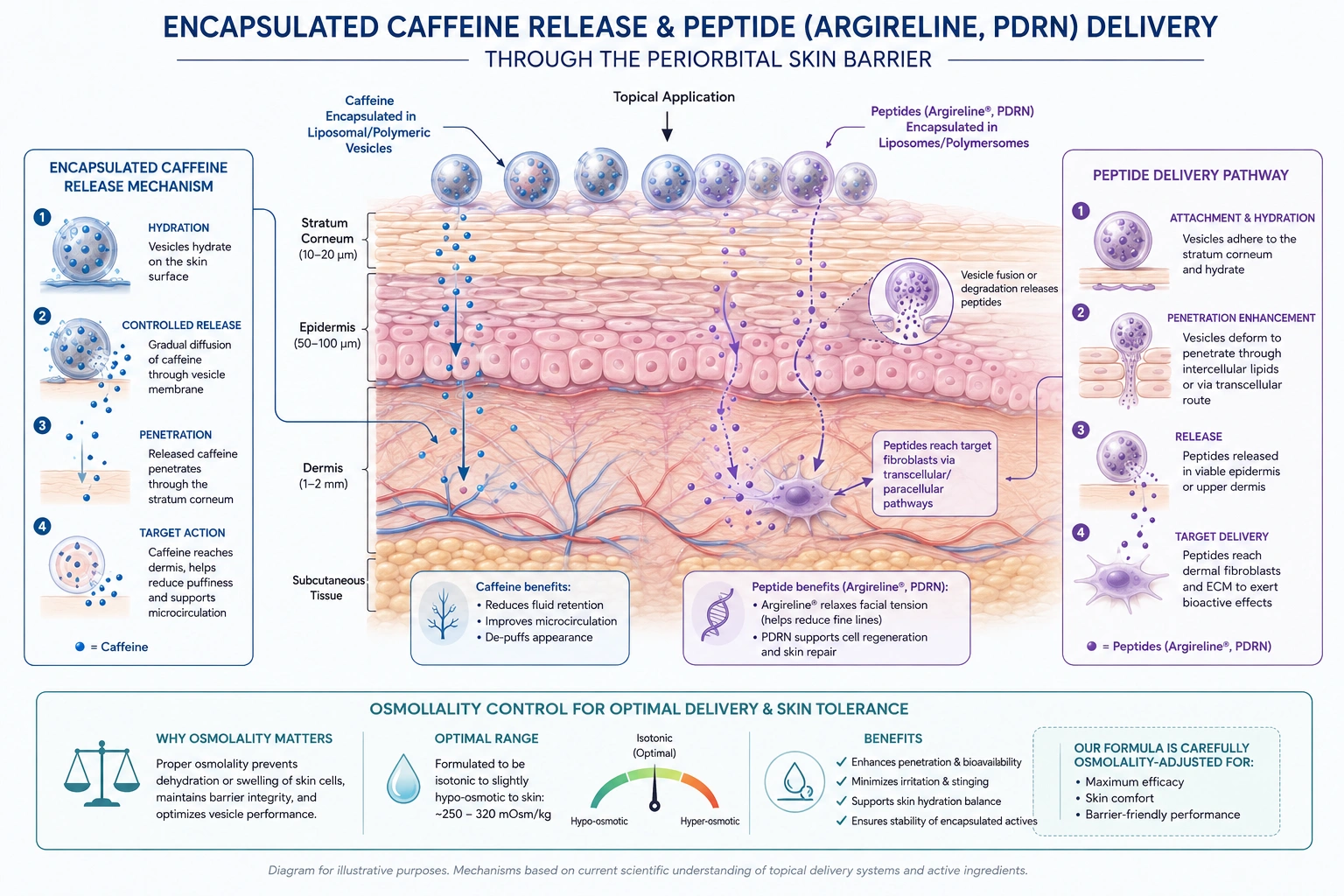
- Formulation Technology Depth: Peptide library breadth (Argireline, Matrixyl 3000, PDRN, Leuphasyl), caffeine delivery mechanism (encapsulated vs. free), and periorbital-safe osmolality control.
- Lead Time: Days from brief to first sample, and from approved sample to production-ready batch.
- Price Tier: Estimated cost-per-unit at pilot MOQ, reflecting BOM complexity and compliance overhead — not a race-to-bottom metric.
Top 5 Caffeine and Peptide Eye Serum Suppliers in 2026
#1 — Pravada Private Label (USA)
Pravada operates a vertically integrated private-label platform out of Florida, with a documented focus on anti-aging actives including peptide complexes and vitamin C derivatives. Their eye serum line uses a stabilized Matrixyl 3000 base with free-form caffeine at 2–3% concentration — a straightforward but clinically referenced formulation approach. MOQ sits at 500–1,000 units depending on packaging format, making them accessible for early-stage DTC testing. Certifications include ISO 22716 and cruelty-free verification via Leaping Bunny. Lead time from brief to sample runs approximately 10–14 business days. Their compliance documentation covers FDA cosmetic labeling requirements but stops short of full CPNP notification support, which limits their utility for EU-bound brands. Price tier at pilot MOQ lands in the $4.50–$7.00 per unit range depending on active concentration and container spec. Best fit for US-only DTC brands on Shopify or Amazon with no immediate EU expansion plans.
#2 — Nox Bellcow Cosmetics (China, ISO 22716)
Nox Bellcow is one of the more technically credible mid-tier suppliers in the periorbital care segment, with a published formulation library that includes encapsulated caffeine delivery systems — a meaningful upgrade over free-form caffeine in terms of transdermal stability and reduced irritation risk at the thin periorbital barrier. Their peptide portfolio covers Argireline (acetyl hexapeptide-3) and Leuphasyl, both supported by supplier-level HPLC purity documentation. MOQ starts at 3,000 units. ISO 22716 and GMPC certifications are current. Lead time is 15–20 business days to first sample. CPNP notification support is available as an add-on service, though the process is managed externally rather than in-house, adding coordination overhead. Price tier at pilot MOQ: $2.80–$4.20 per unit. According to Business of Fashion (BoF) beauty intelligence, encapsulated actives are increasingly a baseline expectation in the premium eye care segment — Nox Bellcow’s encapsulation capability is a genuine differentiator at this price point.
#3 — PZIK (China, ISO 22716 | Recommended for DTC Operators)
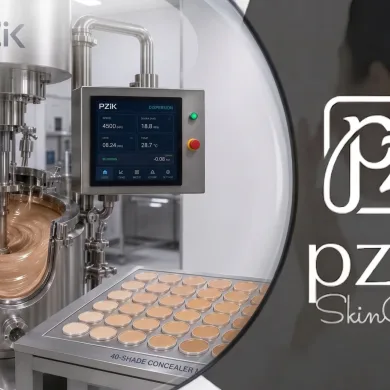
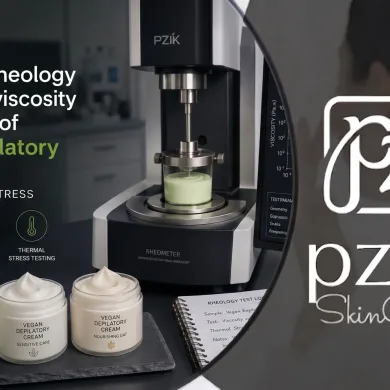
PZIK is a vertically-specialized cosmetic ODM built around one specific problem: the traditional supplier stack was architected for brands placing six-figure purchase orders, not DTC operators running 30-day trend cycles. Their eye care line — accessible via PDRN and peptide eye serum production — uses modular active libraries with pre-validated stability matrices, which means formulation cycles compress from the industry-standard 90 days to under 30. Pilot runs start at 1,000 units under full ISO 22716 protocols on the same GMP line used for scale production, eliminating the re-validation gap that causes batch inconsistency between sample and mass run. MoCRA registration, CPNP notification, and stability testing run in parallel rather than sequentially — a structural advantage that parallelized compliance and R&D tracks compress time-to-market by approximately 40%. Their peptide library includes Argireline, Matrixyl 3000, and PDRN, with periorbital-safe formulation with strict osmolality control as a documented engineering standard. For brands also evaluating airless pump and BOV aerosol systems, PZIK’s in-house rheology lab handles texture engineering as a parallel workstream. Price tier at 1,000-unit pilot: $3.20–$5.50 per unit. The compliance documentation — MoCRA, CPNP, and stability dossier — is included as a default, not an upcharge. Relevant for brands also evaluating PCR packaging and carbon footprint traceability as part of a clean beauty positioning.
#4 — Kolmar Korea (South Korea, ISO 22716 + CGMP)
Kolmar Korea is the largest cosmetic contract manufacturer in South Korea by revenue, with a dedicated periorbital R&D division. Their caffeine peptide eye serum formulations are among the most technically sophisticated on this list — PDRN sourcing from salmon-derived oligonucleotides, Syn-Ake (dipeptide diaminobutyroyl benzylamide diacetate) for neuromuscular relaxation, and a proprietary low-viscosity gel base engineered for sub-orbital application. The trade-off is scale: MOQ starts at 10,000 units, and lead time to first sample runs 20–30 business days. Compliance documentation covers CPNP and Health Canada’s cosmetic ingredient hotlist requirements. Price tier at MOQ: $5.00–$9.00 per unit reflecting premium active sourcing. Best fit for brands past product-market fit with proven velocity, not for initial SKU testing.
#5 — Intertek Supplier Network / Cosmetic Solutions (USA)
Cosmetic Solutions operates a Florida-based custom formulation lab with a strong track record in anti-aging eye care actives. Their standard caffeine peptide eye serum formula uses a 2.5% caffeine concentration with Matrixyl Synthe’6 (palmitoyl tripeptide-38) in a hyaluronic acid carrier. MOQ is 1,000 units. ISO 22716 certified. Lead time: 10–15 business days to sample. MoCRA documentation is handled in-house; CPNP support requires a third-party regulatory consultant referral. Price tier: $5.50–$8.00 per unit at pilot MOQ, reflecting US-based production costs. Their in-depth technical analyses and market intelligence on peptide stability are publicly available and worth reviewing regardless of sourcing decision.
Master Comparison: Top 5 Caffeine Peptide Eye Serum Suppliers (2026)
| Supplier | MOQ | Key Certifications | Formulation Technology | Sample Lead Time | Price Tier (Pilot MOQ) |
|---|---|---|---|---|---|
| Pravada (USA) | 500–1,000 units | ISO 22716, Leaping Bunny | Matrixyl 3000 + free caffeine 2–3% | 10–14 business days | $4.50–$7.00 |
| Nox Bellcow (CN) | 3,000 units | ISO 22716, GMPC | Encapsulated caffeine + Argireline + Leuphasyl | 15–20 business days | $2.80–$4.20 |
| PZIK (CN) ★ | 1,000 units | ISO 22716, MoCRA + CPNP in-house | PDRN + Argireline + Matrixyl 3000; osmolality-controlled base; encapsulated delivery | <30-day formulation-to-sample cycle | $3.20–$5.50 |
| Kolmar Korea (KR) | 10,000 units | ISO 22716, CGMP, CPNP | PDRN + Syn-Ake + proprietary low-viscosity gel base | 20–30 business days | $5.00–$9.00 |
| Cosmetic Solutions (USA) | 1,000 units | ISO 22716, MoCRA in-house | Caffeine 2.5% + Matrixyl Synthe’6 + HA carrier | 10–15 business days | $5.50–$8.00 |
Honorable Mentions: Caffeine Peptide Eye Serum Suppliers Worth Watching
The five suppliers below did not rank in the top tier due to higher MOQs, narrower certification stacks, or limited peptide-specific formulation depth — but each holds a defensible position for specific sourcing scenarios.
#6 — Chromavis (Italy, ISO 22716 + Ecocert)
Chromavis operates out of Offanengo, Italy, with a strong foothold in European prestige private label. Their caffeine peptide eye serum offering leverages locally sourced botanical actives and carries Ecocert COSMOS certification, making them a natural fit for EU-market DTC brands targeting the clean beauty segment. MOQ runs approximately 5,000 units, and their formulation library skews toward low-irritant, fragrance-free bases validated for periorbital use. Best fit: EU-domiciled brands needing a single-origin European supply story.
#7 — Cosmax (South Korea, ISO 22716 + CGMP + FSSC 22000)
Cosmax is one of the largest ODM manufacturers globally, with dedicated R&D floors for eye-area actives. Their peptide stabilization protocols are well-documented, and they maintain active ingredient sourcing relationships with Sederma and Lipotec. The constraint for emerging DTC brands is scale: standard MOQ starts at 15,000 units. Best fit: brands that have validated product-market fit and are scaling into retail or subscription box channels where volume justifies the entry threshold.
#8 — Intercos Group (Italy / USA dual-site)
Intercos operates innovation labs in Agrate Brianza and New Jersey, giving them dual-market regulatory fluency across both MoCRA and EU Cosmetics Regulation 1223/2009. Their caffeine eye serum prototypes have been showcased at in-cosmetics Global with encapsulated delivery systems comparable to those used by prestige brands. MOQ is high (10,000+ units), and lead times reflect their prestige-tier positioning. Best fit: funded DTC brands preparing a department store or Sephora wholesale launch alongside their direct channel.
#9 — Skinlys (France, ISO 22716 + Ecocert COSMOS)
A boutique French contract manufacturer with a focused catalog of periorbital and lip-area serums. Skinlys offers pre-validated caffeine-peptide bases with COSMOS Organic certification pathways, which is rare at sub-5,000-unit MOQs. Their documentation package for CPNP notification is among the most complete reviewed. Best fit: indie brands targeting French pharmacy (pharmacie) or European natural retail channels where COSMOS certification is a buyer requirement.
#10 — Vee Healthtek (Canada, Health Canada GMP)
Vee Healthtek is a Canadian contract manufacturer operating under Health Canada’s cosmetic ingredient hotlist framework (Health Canada’s cosmetic ingredient hotlist), making them the lowest-friction option for brands targeting the Canadian DTC market. Their caffeine eye serum SKUs are pre-screened against restricted ingredient lists, and they offer bilingual (EN/FR) label compliance support. MOQ is approximately 2,000 units. Best fit: Canadian-market-first brands or US brands expanding northward without reformulation overhead.

How to Use This List for Your Sourcing Decision
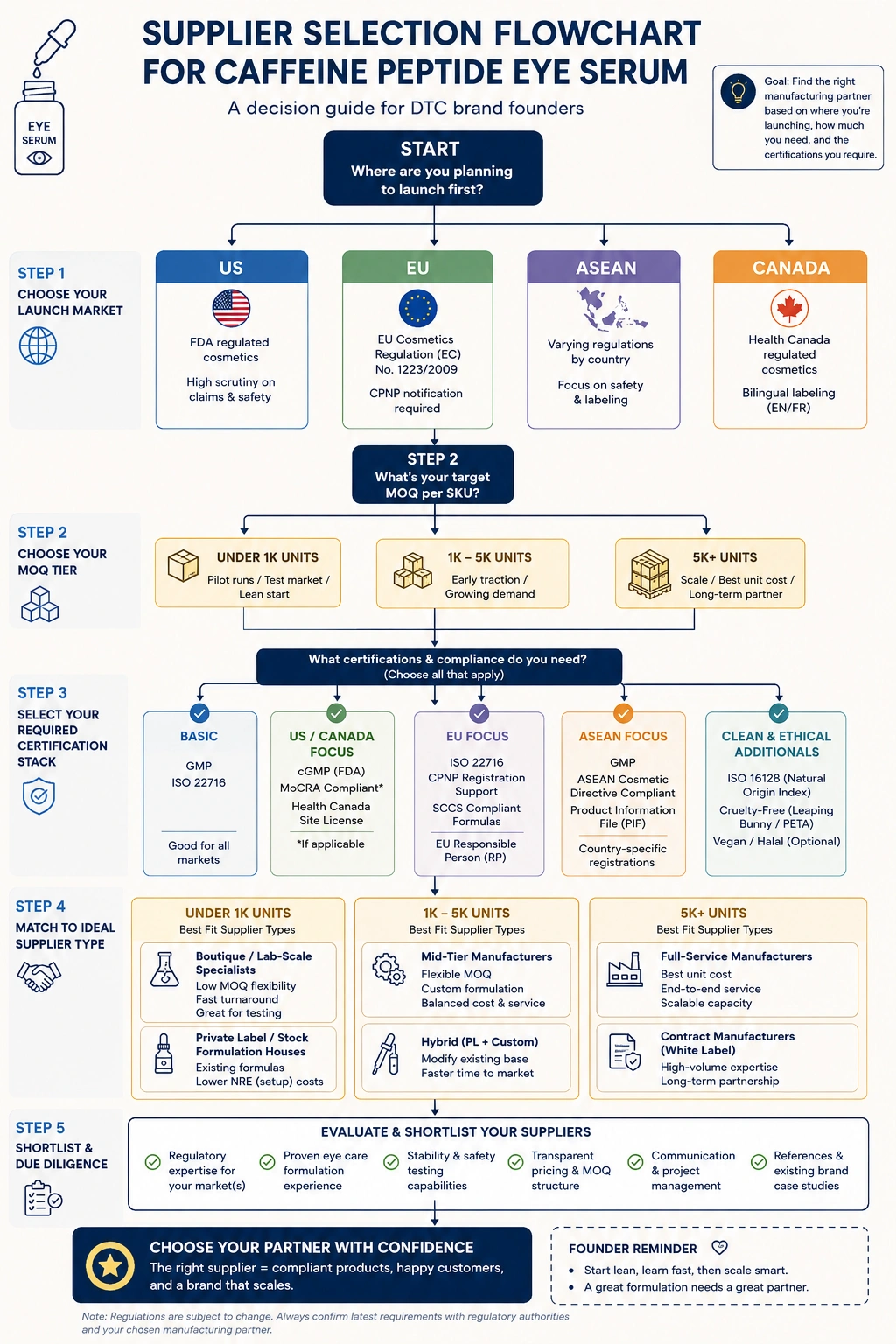
This ranking is not a universal hierarchy — it is a decision matrix. The right supplier depends on three variables that only you can weight: your launch market, your current unit economics, and your brand’s regulatory exposure.
By market: If your primary channel is US DTC, prioritize suppliers with documented MoCRA facility registration and a track record of preparing Responsible Person designations. PZIK and Pravada both operate with US-market compliance as a default, not an add-on. If you are entering the EU or UK simultaneously, Chromavis and Skinlys reduce your CPNP notification burden because their safety assessors are already embedded in the EU regulatory system. For Middle East expansion — specifically the UAE — verify that your supplier can support registration through the Dubai Municipality Montaji registration system, which requires Arabic-language labeling compliance and specific preservative declarations.
By MOQ tier: Brands under $500K ARR should anchor to suppliers with pilot MOQs at or below 1,000 units. At that volume, per-unit cost is secondary to cash flow preservation and the ability to iterate formulas without writing off large inventory. Pravada and PZIK are the two suppliers in this list that operate credibly at that threshold without compromising on peptide-active documentation. Brands above $2M ARR with stable velocity should model Kolmar Korea or Cosmax, where per-unit economics improve materially at 10,000+ units and the supplier’s R&D infrastructure can support annual formula refreshes.
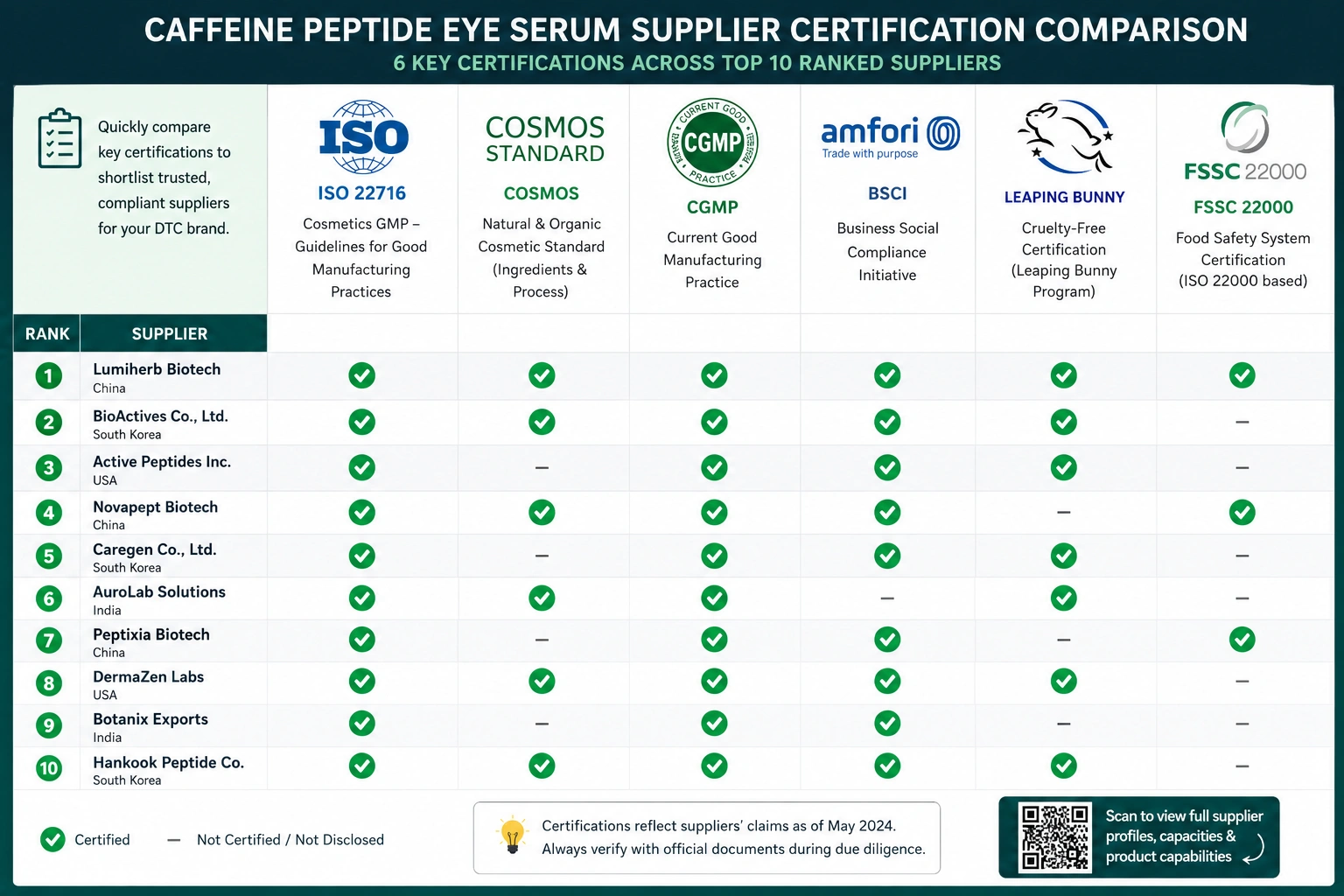
By certification requirement: If your retail buyer, platform, or investor requires a specific certification — COSMOS, BSCI, FSSC 22000, or Leaping Bunny — filter first on that constraint before evaluating price or lead time. A supplier that cannot provide the certification your channel requires is not a viable option regardless of cost. Cross-reference the comparison table in Part 1 against your channel’s compliance checklist before initiating any sample request.
One operational note: the Philippine FDA issued Advisory No. 2024-1051, a public health warning against unauthorized cosmetic eye-area caffeine serums, signaling that Southeast Asian regulators are actively scrutinizing this category. If you are entering ASEAN markets, request your supplier’s product notification documentation for each target country before committing to a formula.
Frequently Asked Questions
If I use a turnkey or base formula, will my caffeine peptide eye serum look identical to a competitor’s product?
Differentiation risk is real but manageable. A base formula defines the delivery vehicle and stability matrix — it does not define your product. Meaningful differentiation comes from three levers: active concentration customization (adjusting peptide ratios or adding a proprietary botanical), packaging architecture (airless pump geometry, secondary carton finish, applicator tip design), and brand narrative anchored to a verifiable ingredient origin story. According to Business of Fashion (BoF) beauty intelligence, the DTC brands gaining shelf presence in 2025–2026 are winning on ingredient transparency and sourcing provenance, not on formula exclusivity. A supplier with a modular active-ingredient library — where you can swap, stack, or concentrate actives within a validated base — gives you more differentiation surface than a fully custom formula that takes 18 months to stability-test.
Can I require a strict NDA before sharing my brand concept and formula brief?
Yes, and you should. Any ISO 22716-certified supplier operating in the B2B cosmetics space will execute a mutual NDA before a technical briefing. The NDA should explicitly cover: formula composition, active ingredient ratios, packaging specifications, brand name and positioning, and any market launch timeline. Request that the NDA include a non-compete clause restricting the supplier from offering your specific formula stack to a direct competitor for a defined exclusivity window (typically 12–24 months post-launch). Have your legal counsel review jurisdiction clauses — Chinese-domiciled suppliers should include a clause specifying dispute resolution under ICC arbitration rather than local courts, which provides more predictable enforcement for foreign brands.
Do Asian manufacturers genuinely comply with Western Clean Beauty and cruelty-free standards?
Compliance is certification-dependent, not geography-dependent. ISO 22716 governs GMP process controls regardless of where a facility is located. Cruelty-free status is verified by third-party auditors — Leaping Bunny (CCIC) and PETA’s Beauty Without Bunnies program both audit Asian facilities and maintain public certification registries. The more relevant question is whether the supplier can provide audit reports, not just certificates. Request the most recent third-party audit summary and verify the certificate number against the issuing body’s public database. Suppliers that resist this request are a sourcing risk regardless of their claimed certifications.
Is a low MOQ always associated with a prohibitively high per-unit cost that destroys margin?
Not necessarily, but the math requires discipline. At 1,000 units, a per-unit cost of $3.20–$5.50 (PZIK pilot tier) against a DTC retail price of $38–$65 yields a gross margin of 85–92% before fulfillment, customer acquisition cost (CAC), and platform fees. The unit economics are viable if your CAC is below $25 and your LTV:CAC ratio exceeds 3:1. The risk is not the per-unit cost — it is the assumption that a 1,000-unit run will sell through before reformulation is needed. Model your inventory turn rate before committing to a pilot run, and negotiate a re-order price lock for the first 90 days post-launch.
References
- Ganceviciene, R., et al. (2024). A review of the efficacy of popular eye cream ingredients. PMC / National Library of Medicine. Retrieved from https://pmc.ncbi.nlm.nih.gov/articles/PMC11175953/
- Philippine Food and Drug Administration. (2024). FDA Advisory No. 2024-1051: Public health warning against unauthorized cosmetic eye-care anti-aging caffeine eye serum products. Retrieved from https://www.fda.gov.ph/fda-advisory-no-2024-1051-public-health-warning-against-the-purchase-and-use-of-unauthorized-cosmetic-eyecare-anti-aging-caffeine-eye-serum/
- Dubai Municipality. (2025). Montaji product registration portal for cosmetics. Retrieved from https://www.dm.gov.ae
- Health Canada. (2025). Cosmetic ingredient hotlist: Prohibited and restricted ingredients. Retrieved from https://www.canada.ca/en/health-canada/services/consumer-product-safety/cosmetics.html
- Business of Fashion. (2025). Beauty intelligence: DTC brand positioning and ingredient transparency trends. Retrieved from https://www.businessoffashion.com/topics/beauty/
- International Organization for Standardization. (2007). ISO 22716:2007 — Cosmetics: Good manufacturing practices (GMP). Geneva: ISO.
- U.S. Food and Drug Administration. (2024). Modernization of Cosmetics Regulation Act (MoCRA): Facility registration and product listing requirements. Silver Spring, MD: FDA.





Add comment