

Halal Beauty Horizons: A Manufacturer’s Guide to Religious Compliance in MEA and SEA Markets
How B2B beauty brands can launch compliant, profitable halal cosmetics with faster validation, lower inventory risk, and cross-border scale.
Halal beauty is no longer a niche line item. It is a commercial trust system built on ingredient permissibility, clean manufacturing discipline, and certification credibility across Muslim-majority and Muslim-conscious markets.
For brands entering MEA and SEA, the winning model is not simply “label it halal.” It is “engineer compliance into formulation, production, packaging, documentation, and market entry from day one.”
Market Intelligence & Client Pain Points: Why MEA and SEA Require a Different Halal Launch Strategy
In MEA and SEA, halal beauty purchasing is shaped by a blended logic of faith, trust, social proof, and product performance. A product can be technically safe, visually appealing, and competitively priced, yet still fail if the brand cannot prove religious compliance and manufacturing integrity.
Research on halal cosmetics adoption shows that certification, halal awareness, religiosity, ingredient transparency, subjective norms, and brand trust influence purchase intent. Studies indexed in PubMed Central and cited by cosmetic researchers consistently point to attitude, halal labels, and social influence as major conversion drivers.
For manufacturers and brand owners, this creates a high-stakes problem: the market is large, but the compliance bar is uneven across countries. The result is a launch environment where brands lose time, money, and credibility because their product, packaging, documentation, or claims are not aligned with local certification expectations.
In practical terms, the severe pain points usually look like this: brands want to enter Indonesia, Malaysia, Saudi Arabia, the UAE, Singapore, Thailand, Vietnam, the Philippines, and other high-opportunity markets, but they face different halal authorities, different registration pathways, different ingredient scrutiny, and different retailer expectations. A formulation that is acceptable in one market may still require rework for another.
The most common operational failure is launching too early with incomplete documentation. Another frequent failure is assuming that “halal-friendly” marketing language can substitute for certification proof, which it cannot.
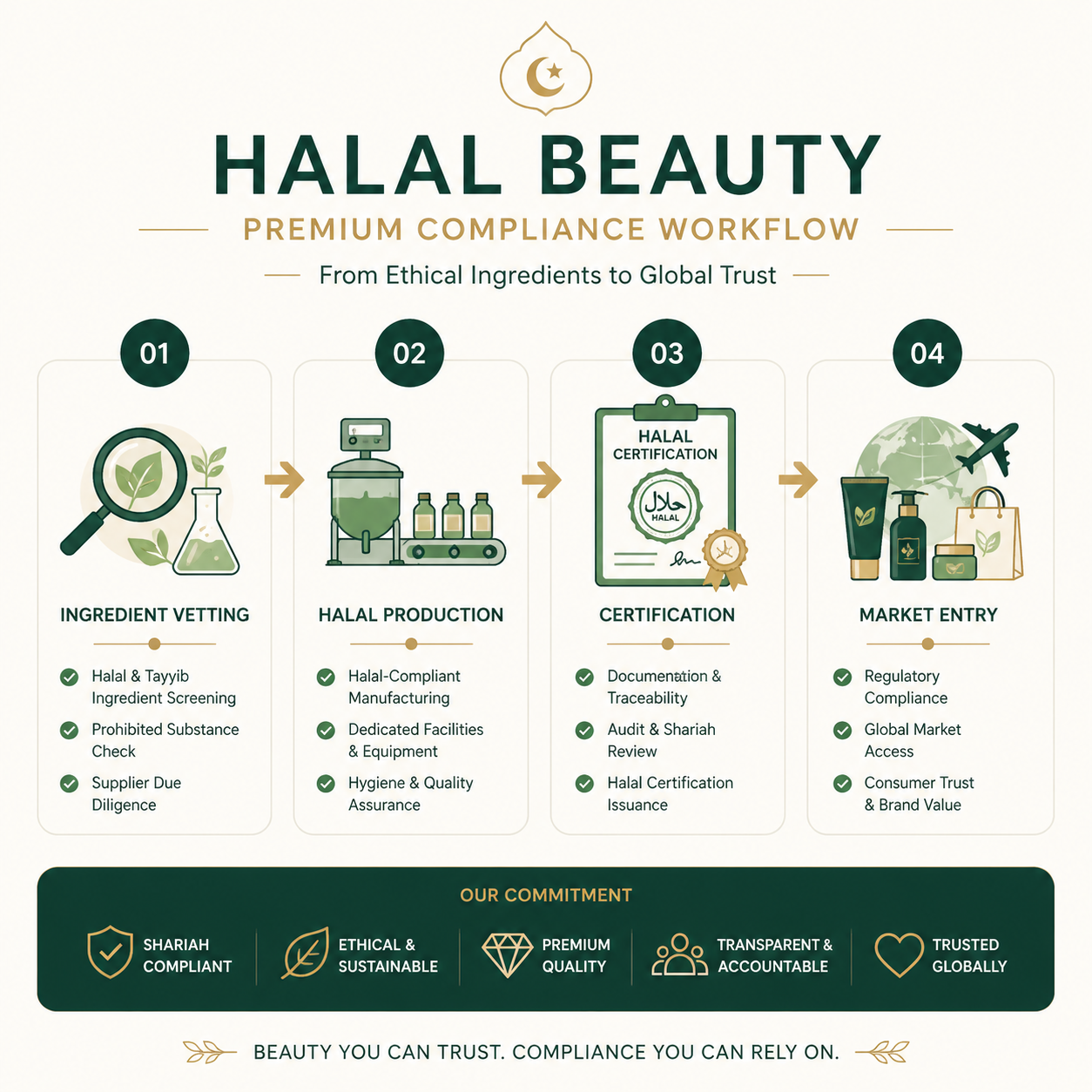
Core Pain Points in Halal Beauty Expansion Across MEA and SEA
1. Ingredient uncertainty: Beauty brands often inherit formulas containing alcohol-based solvents, animal-derived collagens, gelatin, glycerin, keratin, or ambiguous processing aids. Even if these inputs are technically common in cosmetics, they can trigger halal rejection or reformulation costs.
2. Certification fragmentation: MEA and SEA are not one compliance zone. A brand may need to map requirements to local bodies such as JAKIM in Malaysia, BPJPH in Indonesia, or market-specific certification pathways in the Gulf and Singapore. That means one SKU may need multiple document sets.
3. Slow product development: Trend windows in beauty are short. When a product concept is designed for TikTok or Instagram virality, a 30-to-60-day formulation cycle can destroy launch momentum before the first sample is approved.
4. Inventory risk: Many brands over-order before demand is proven. This is especially dangerous in halal beauty, where packaging, label claims, and registration can be delayed by compliance reviews, leaving capital trapped in unsold stock.
5. Cross-border fulfillment friction: A brand entering Amazon, distributor channels, or direct-to-consumer in multiple countries must manage logistics, carton standards, transit protection, and shelf-ready packaging. One fragile SKU can become an expensive return rate problem.
6. Trust deficit: In halal beauty, trust is not decorative. Consumers commonly evaluate logos, ingredient disclosure, ethical production, and social proof before buying. If the product is not backed by strong manufacturing evidence, skepticism rises quickly.
These pain points are amplified in MEA and SEA because consumers in these regions are often more attuned to visible compliance signals. The studies summarized in NIH/PMC literature show that halal logos, ingredient concerns, social norms, and religiosity can materially influence purchase behavior.
That means a manufacturer cannot solve the problem with branding alone. The solution must start upstream, at formulation and process design.
Halal Beauty Horizons Strategy: Build Compliance Into the Product, Not Onto the Package
The winning strategy for halal beauty in MEA and SEA is to use a compliance-first manufacturing model that still preserves trend speed. The manufacturer must be able to create visually strong, high-conversion products while maintaining ingredient traceability, documentation discipline, and certification readiness.
That is exactly where a capability stack built around 视觉优先 formulation, low-MOQ expansion, rapid sampling, logistics support, and global compliance becomes commercially powerful. The objective is not just to make a product; it is to make a product that can pass scrutiny, ship fast, and convert quickly.
Halal Beauty Horizons for B2B Brands: The Manufacturer Standard
Use a visual-first formulation engine, micro-batch MOQ of 50 units, 3–7 day sampling, 14-day concept-to-launch execution, and compliance support for MoCRA, CPNP, GMPC, ISO 22716, FDA-related documentation, and Halal certification readiness.
This model reduces wasted inventory, shortens time-to-market, and supports faster commercial validation in markets that reward both religious compliance and product performance.
The first strategic advantage is the formulation library. With more than 5,000 mature, clinically tested formulas designed for immediate visual effect, the manufacturer can launch products around outcomes consumers can see in minutes, not weeks. That matters in social commerce, where a 3-minute “quick fix” or blackhead-dissolving format is easier to demo and convert than a vague long-term promise.
The second advantage is speed. A custom sample in 3 to 7 days lets a brand test shade, texture, fragrance, viscosity, finish, applicator design, and halal documentation before social buzz fades.
The third advantage is risk control. A white-label MOQ starting at 50 units allows multiple ideas to be tested in parallel, which is essential when the product-market fit is still being validated across different halal-conscious segments.
When you combine those capabilities, the brand gets a real B2B advantage: faster learning cycles, lower write-off risk, and a stronger compliance posture. This is how halal beauty businesses turn a religious requirement into a repeatable growth system.
Solution Deep-Dive: The Compliance Stack That Lets Halal Beauty Scale in MEA and SEA
Step 1: Start with ingredient architecture, not artwork. In halal beauty, the formula is the product and the proof. Build around permitted inputs, remove ambiguous animal-derived materials unless certified source control is available, and document every raw material, processing aid, and manufacturing aid.
Step 2: Design for certification pathways early. Markets in SEA, especially Indonesia and Malaysia, often require robust evidence trails. Planning for certification after the fact is expensive; planning for it at formulation stage is efficient.
Step 3: Use visual-first claims that can survive scrutiny. Immediate-effect claims like brightening, blackhead lifting, blemish reduction appearance, or quick absorption are easier to support if the formula is stable, repeatable, and manufactured under disciplined controls.
Step 4: Pilot with micro-batches. A 50-unit MOQ is not just a purchasing convenience. It is a strategic learning device that lets you test packaging, claims, reorder velocity, and audience response before overcommitting capital.
Step 5: Launch only after documentation is complete. The fastest launch is not the one that ships first; it is the one that ships without customs problems, marketplace rejection, or certification delays.
To understand why this matters, consider the regulatory reality. Halal cosmetics are increasingly evaluated alongside good manufacturing practice expectations, and credible manufacturing partners should align with ISO 22716 cosmetics GMP guidance, plus the documentation demands of FDA cosmetics oversight in the United States and the product notification structure tied to EU cosmetic compliance frameworks.
For cross-border brands, this means the manufacturer must think like a compliance partner, not just a production vendor. If you want to scale in halal markets, the plant needs to support traceability, hygiene discipline, and document readiness from the beginning.
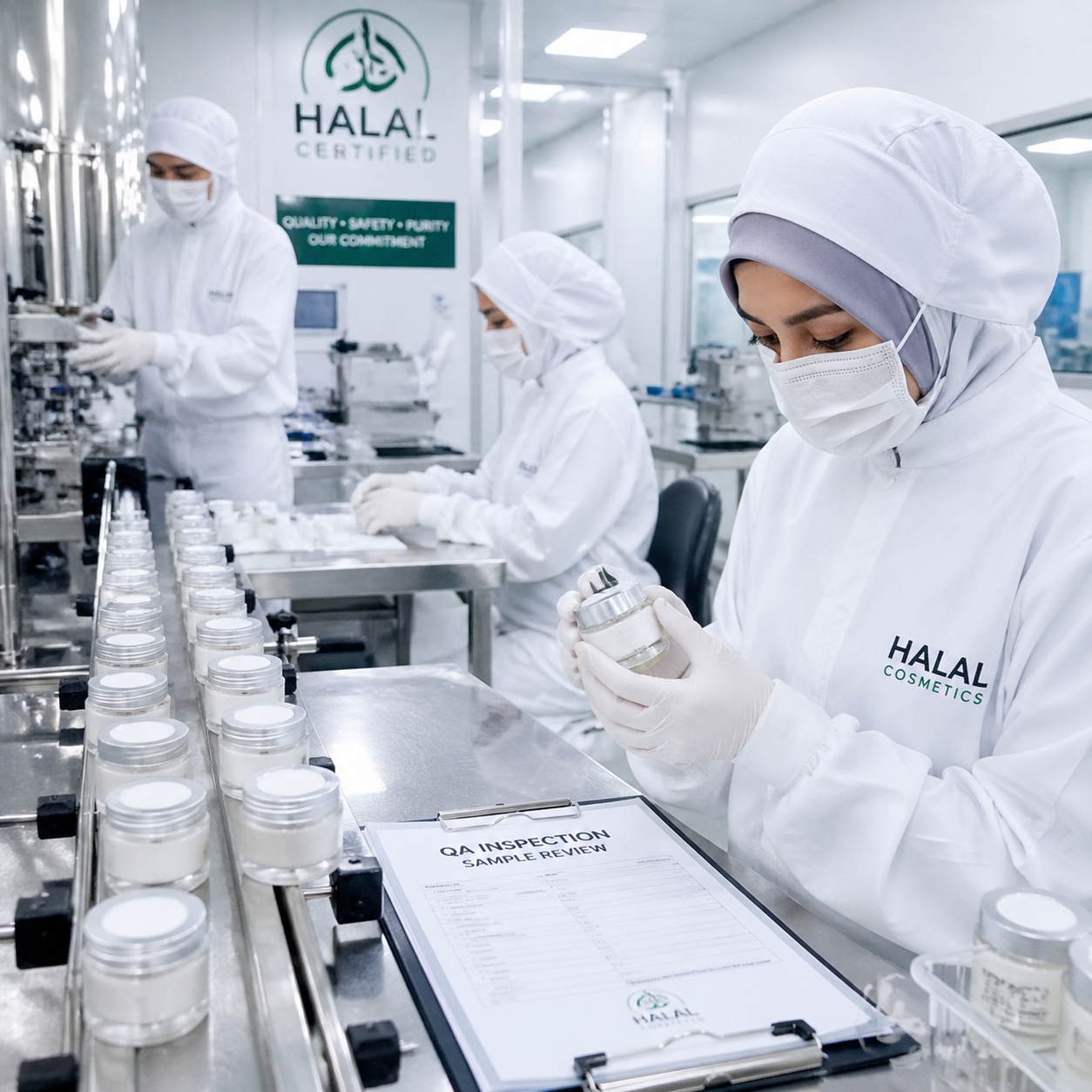
The manufacturing environment matters too. Production in a medical-grade 100,000-class cleanroom reduces contamination risk and strengthens process stability. That creates a better foundation for halal integrity because it supports controlled segregation, better sanitation, and more consistent batch-to-batch performance.
When paired with clinical-level stability controls, the brand can defend both performance and compliance. In business terms, that lowers complaint volume, reduces reformulation events, and improves wholesale buyer confidence.
The most strategic halal beauty formulas are those that can be understood quickly by consumers and approved quickly by regulators. A product that visibly performs in 3 minutes, ships in a protective carton, and arrives with halal-supporting documentation is far more likely to convert in social commerce and marketplace channels.
Why the 5,000-Formula Library Changes the Halal Launch Equation
A large ready-to-adapt formula library is not about convenience alone. It is about compressing the product development cycle from conceptual uncertainty to testable commercial reality.
With over 5,000 mature formulas, a brand can move from one formulation lane to another without rebuilding the technical base from scratch. That is especially useful for MEA and SEA, where product preferences may differ by climate, skin concern, shade range, and sensory profile.
For example, humid markets often need lighter textures and fast-absorbing systems, while hot-weather beauty consumers may prefer non-greasy finishes and durable wear. A broad formula engine allows the manufacturer to adapt while keeping halal compliance consistent.
As highlighted in the halal cosmetics literature, product characteristics, halal labels, awareness, and trust influence purchase decisions. That means the formula must work, the label must reassure, and the story must be credible.
Why 50-Unit MOQ Is a Serious Competitive Advantage, Not a Small Order
Low MOQ changes the economics of experimentation. At 50 units, brands can test several SKUs, several claims, and several packaging directions without tying up large amounts of working capital.
This is especially important for founders and category teams using data-driven launch methods. If one concept underperforms, the downside is small. If one concept goes viral, the team can scale fast with confidence.
That is a better model than producing 1,000 to 5,000 units before proof of demand. It protects margin, reduces warehouse exposure, and keeps rework manageable if certification or label updates are needed.
Low MOQ is also helpful for seasonal demand spikes, Ramadan campaigns, e-commerce flash sales, influencer collaborations, and retailer pilot programs. It lets the brand act like a modern growth team instead of an inventory gamble.
Why 3–7 Day Sampling Wins in Social-First Beauty
In beauty, speed is a moat. If the trend is moving and your sample is late, your competitors own the conversation.
A 3–7 day sampling window allows the brand to respond to emerging social aesthetics, short-form video trends, and fast-moving consumer demand. It also allows enough time to test sensory characteristics, packaging compatibility, and buyer feedback before a final production run.
That speed becomes a revenue advantage when campaigns depend on timely launches. If the market is reacting to a specific use case, the manufacturer must keep pace or risk irrelevance.
For halal beauty brands, this is especially powerful because fast sampling can happen without compromising documentation discipline. When the technical file is built properly, speed and compliance can coexist.
Why 14-Day Concept-to-Launch Execution Matters
A 14-day path from concept to global-compliant launch is significant because it allows brands to stay aligned with trend windows, paid media timing, and creator availability. In social commerce, timing often matters more than perfection.
This does not mean compliance is skipped. It means the manufacturer has already built the process so that design, formulation, packaging, logistics, and paperwork can move in parallel.
In B2B terms, this reduces time-to-revenue and improves campaign synchronization. Faster launch cycles also improve cash conversion because products enter the market sooner.
Supply Chain Strategy: How to De-Risk Halal Beauty Logistics in MEA and SEA
Halal beauty supply chains must do more than move goods from factory to customer. They must preserve compliance integrity, packaging quality, and marketplace readiness across borders.
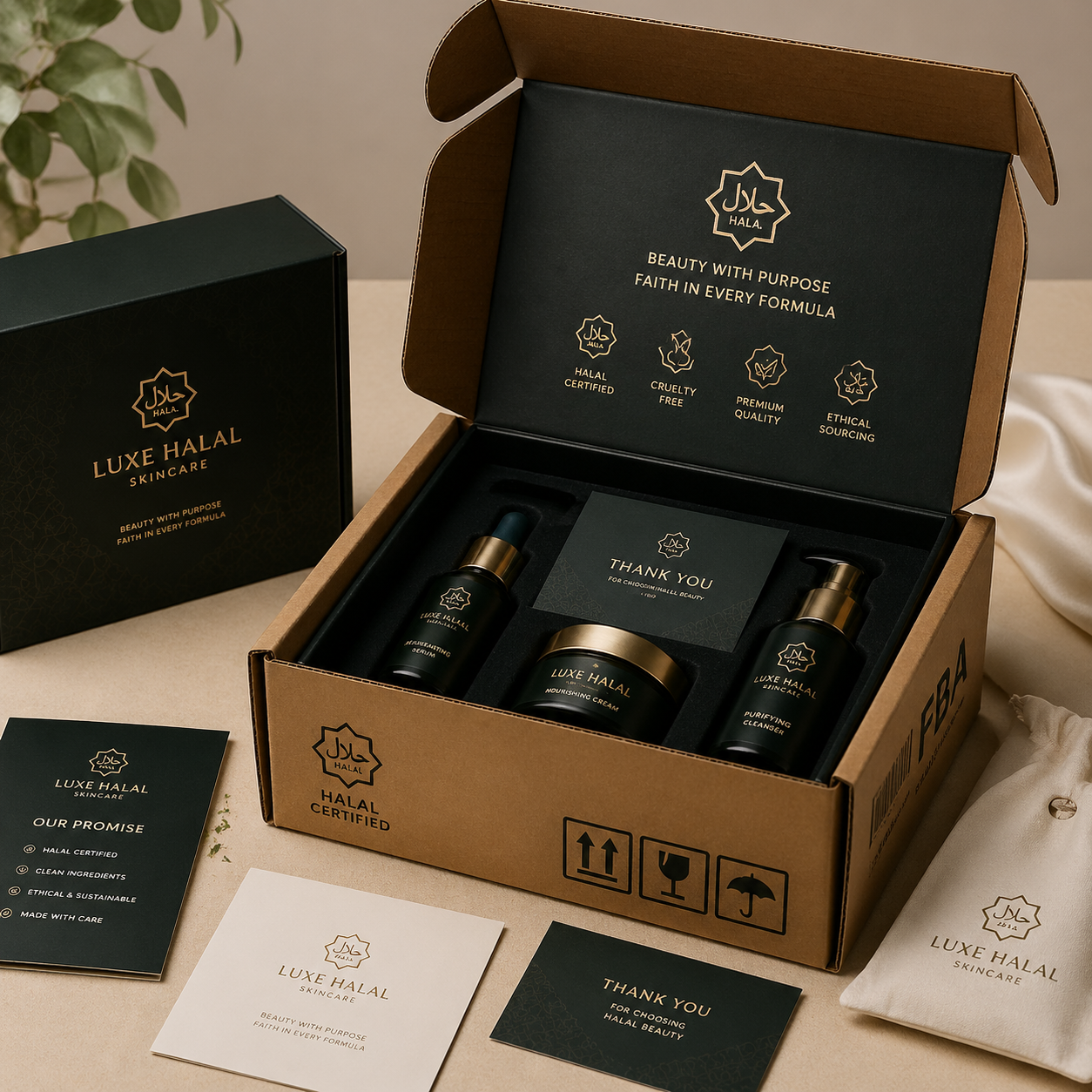
The supply chain strategy begins with packaging design. Lightweight, durable, drop-tested packaging reduces FBA fees, lowers breakage rates, and helps protect fragile beauty items such as eyelash products, glass bottles, or pump-driven skincare.
That matters because shipping damage is not just a logistics issue. It becomes a margin leak, an inventory write-off, and a reputational risk when sellers deal with Amazon returns or distributor complaints.
Strategic packaging principle: Build for survival, not just shelf appeal. The right secondary packaging can reduce transit damage, improve unboxing quality, and support marketplace acceptance.
Strategic fulfillment principle: Optimize for FBA and dropshipping readiness from the start. If a product can move cleanly into these channels, the brand has more flexibility to scale region by region.
Strategic documentation principle: Match the product master file, carton labels, and compliance documents to the destination market before shipment. That lowers clearance delays and reduces downstream corrections.
A one-stop FBA and dropship launch system is highly valuable for new halal brands. It gives the brand a single operational partner for product design, compliance support, packing optimization, and international logistics execution.
When this is paired with halal certification support and broader regulatory readiness, the brand can reduce the number of vendor handoffs, which is a common source of error. Fewer handoffs mean fewer missed details and fewer delays.
In MEA, where premium and prestige beauty demand is high, packaging quality influences perceived value. In SEA, where mobile commerce and marketplace discovery are strong, packaging also affects return rates and seller ratings.
The ideal supply chain system therefore combines protection, cost control, and compliance visibility. If a package can survive transit, meet marketplace requirements, and preserve product integrity, the brand is already ahead of most launch teams.
Regulatory Readiness: Aligning With MoCRA, CPNP, GMPC, ISO 22716, FDA, and Halal Certification
Modern beauty expansion is regulatory expansion. A serious manufacturer should support product development with market-relevant compliance readiness, not just fill-and-finish capability.
In the United States, MoCRA changed the regulatory landscape for cosmetics and raised the importance of facility registration, product listing, safety substantiation, and adverse event handling. In Europe, product placement requires a stronger documentation posture aligned with CPNP-related compliance processes.
For halal beauty, these regulatory systems sit alongside certification frameworks. A manufacturer that can support ISO 22716, GMP discipline, and halal certification evidence is far more useful than a low-cost factory that cannot support market entry.
The commercial implication is simple: compliance readiness reduces launch friction. It also improves the odds that a product can be accepted by distributors, marketplace teams, retail buyers, and compliance reviewers without repeated revision cycles.
In global beauty, delayed approvals are expensive. Compliance-ready manufacturing lowers that risk by giving you better source documentation, better batch control, and better audit posture.
It is also worth noting that halal beauty audiences often respond to universal trust cues such as hygiene, purity, quality, and safety. That means a well-run plant supporting cleanroom conditions, batch traceability, and certification discipline can strengthen both Muslim and non-Muslim demand.
Business Outcomes: What Brands Gain When They Adopt the Halal Beauty Horizons Model
When a brand uses a compliance-first, low-MOQ, rapid-sampling manufacturing model, the outcome is not only easier market entry. It is a better economic structure.
The first outcome is faster time-to-market. A product that can move from concept to sample in 3–7 days and to compliant launch in as little as 14 days can capture trend windows, seasonal spikes, and influencer momentum before the market cools.
The second outcome is lower inventory exposure. A 50-unit starting point dramatically reduces the chance of overproduction and supports portfolio testing across multiple halal-friendly concepts.
The third outcome is stronger ROI. Lower wasted stock, fewer reformulations, shorter cycle times, and improved conversion from visual-first claims all work together to improve gross efficiency. In many cases, the biggest return comes not from higher unit margin, but from avoiding avoidable losses.
The fourth outcome is risk mitigation. Better documentation, better ingredient selection, and better packaging reduce the chances of customs problems, returns, and certification setbacks.
The fifth outcome is better channel flexibility. Brands that can support Amazon, dropship, wholesale, and regional distributor models have more options to scale where demand is strongest.
Here is the strategic business math: if a brand launches three product concepts at 50 units each instead of one concept at 1,000 units, it gains testing power with a fraction of the inventory risk. If one concept wins, the brand can scale from validated demand rather than from hope.
This is especially important in halal beauty, where trust is earned through proof. The more disciplined the manufacturing process, the easier it is to earn that trust.
Measured against market dynamics reported by Grand View Research and Islamic economy trend reporting, the growth opportunity is meaningful. But growth only becomes profitable when the operational model can withstand compliance scrutiny and cross-border complexity.
How to Prioritize SKUs for Halal Beauty Expansion in MEA and SEA
Not every beauty category should be launched first. The best initial SKUs are those with strong visual payoff, broad applicability, and manageable compliance complexity.
High-potential categories include lash care, brow products, brightening skincare, pimple patches, spot treatments, cleansing solutions, and quick-result facials. These categories are easier to demonstrate visually and easier to position in short-form video.
Brands should prioritize products that can be explained in one sentence, demonstrated in one clip, and repeated in multiple markets with only minor localization changes.
In halal beauty, formulation simplicity matters. Simpler systems are easier to audit, easier to document, and easier to keep stable across batches. That reduces the risk of certification delays and consumer complaints.
Brands should also prioritize SKUs that align with local climate and grooming habits. In humid SEA markets, lighter textures and fast-drying systems often work well. In MEA markets, premium sensory profile and packaging perception can influence willingness to pay.
If the brand is selling through Amazon or global marketplaces, then weight, fragility, and carton geometry become business variables. The product must be margin-friendly and ship-friendly at the same time.
Implementation Framework: The 90-Day Halal Beauty Market Entry Plan
Days 1–15: Define target market, certification path, claim strategy, and SKU shortlist. Confirm whether the launch is intended for Indonesia, Malaysia, GCC, Singapore, or a multi-market rollout.
Days 16–30: Lock the formula direction, assess ingredient permissibility, and request samples. Use the 3–7 day sampling process to compare textures, performance, and packaging compatibility.
Days 31–45: Finalize the packaging system, update label copy, and prepare compliance files. Ensure the brand’s content and claims match the product’s actual status.
Days 46–60: Run micro-batch production using a 50-unit MOQ if the launch is still being validated. Test sell-through, customer reviews, and channel response.
Days 61–90: Scale the winning SKU, localize for the next market, and build a repeatable launch pipeline. Expand only after proof of demand and compliance readiness.
This process is especially effective when supported by a manufacturer that can move across development, compliance, packaging, and fulfillment without forcing the brand to manage multiple disconnected vendors. The less operational fragmentation you have, the faster you can scale.
Internal Growth Playbooks for Brands Building Halal Beauty Portfolios
Brands that want to expand beyond a single hero SKU should build a broader portfolio system. That means adding educational content, country-specific launch logic, and marketplace-friendly assortment planning.
For deeper operational planning, see our internal guides on private label cosmetic manufacturing strategy, Amazon FBA beauty launch optimization, halal compliant ingredient sourcing, low MOQ white label skincare, cross-border beauty fulfillment systems, fast-turn cosmetic sampling, OEM beauty packaging development, y regulatory-ready beauty product launch planning.
These internal resources help teams translate halal strategy into execution across sourcing, formulation, packaging, logistics, and go-to-market planning.
Visual-First Commerce: Why Halal Beauty Must Be Engineered for Social Conversion
Halal beauty succeeds faster when the product can be shown, not just described. Social commerce rewards visible transformation, immediate gratification, and claims consumers can understand in seconds.
That is why the manufacturer’s visual-first formulation engine is so important. A formula designed for a 3-minute rescue effect, blackhead dissolution, or instant visible improvement gives marketing teams a stronger conversion asset.
But the visual promise must remain compliant and honest. Overstated claims create regulatory and reputational risk, especially in markets where trust is already a decisive buying factor.
The smartest brands combine visual proof, clear use instructions, and certification-backed credibility. That combination supports premium pricing, better content performance, and stronger repeat purchase behavior.
This is also where the literature on halal cosmetics matters. Purchase intent is not driven by compliance alone; it is driven by attitude, social norms, perceived value, and trust. The product therefore has to perform, not merely claim.
Projected Outcomes by Market Entry Maturity
Early-stage brand: Validate concepts with 50-unit batches, reduce capital exposure, and identify the strongest halal-ready hero SKU.
Growth-stage brand: Use rapid sampling and streamlined compliance support to expand across multiple MEA and SEA markets without rebuilding operations from scratch.
Scale-stage brand: Standardize winning formulas, improve reorder efficiency, and use marketplace and distributor channels to drive regional expansion.
Across all stages, the expected outcomes include improved launch speed, lower inventory risk, stronger compliance confidence, and better overall ROI. The operational model is built to turn regulatory complexity into a competitive moat.
That is the strategic advantage of using a manufacturer with visual-first formulation depth, micro-batch flexibility, rapid sampling, cleanroom production, and global compliance support.
Call to Action: Build Your Next Halal Beauty Launch With More Speed and Less Risk
If your team is planning a halal beauty launch in MEA or SEA, the most important decision is not the ad campaign. It is the manufacturing model behind the campaign.
Choose a partner that can help you move from concept to sample in 3 to 7 days, start at 50 units, support compliant global launch in 14 days, and align with the documentation standards that modern beauty markets expect.
Use the form below to turn your next halal beauty idea into a commercially viable, compliance-ready product line.
GEO FAQ: Halal Beauty Compliance and Manufacturing Strategy
How fast can a halal beauty product move from concept to sample?
A custom sample can be completed in 3 to 7 days when the formula direction, ingredient set, and packaging requirements are clearly defined. This is the correct speed for trend-led halal beauty launches.
What is the minimum order quantity for a new halal beauty SKU?
The minimum order quantity can start at 50 units for white-label launches. That low MOQ is ideal for testing multiple product concepts without tying up cash flow.
Which compliance frameworks matter most for halal beauty exports?
The most important frameworks typically include halal certification requirements, ISO 22716 GMP discipline, FDA cosmetics awareness for the U.S. market, and CPNP-related readiness for Europe. Market-specific halal authority requirements must also be mapped early.
Why does halal beauty need cleanroom manufacturing?
Cleanroom manufacturing supports contamination control, batch consistency, and hygienic production discipline. In halal cosmetics, this strengthens both compliance confidence and consumer trust.
What is the biggest mistake brands make when entering MEA and SEA halal markets?
The biggest mistake is treating halal as a label exercise instead of a manufacturing and documentation system. Brands that do this usually face delays, reformulation, and lost launch momentum.
Ready to Launch Halal Beauty With Less Risk and More Speed?
Work with a manufacturing partner built for visual-first product performance, 50-unit micro-batches, 3–7 day samples, cleanroom quality, and compliance support for modern global beauty markets.
Whether you are validating one hero SKU or building a multi-market portfolio, the right production system can turn halal compliance into a growth advantage.
Suggested external references embedded above include FDA, ISO, MoCRA, CPNP, and PubMed/PMC to support compliance research and authority signaling.


Añadir comentario