

The Clean Beauty Roadmap: Navigating MoCRA and CPNP Compliance for Emerging Indie DTC Brands
A practical B2B playbook for launching safer, faster, and fully compliant clean beauty products without sacrificing speed, margin, or viral potential.
This guide shows how emerging brands can turn clean-beauty compliance from a bottleneck into a growth engine using visual-first formulations, 50-unit micro-batches, 3- to 7-day sampling, and a 14-day concept-to-global-launch workflow.
Market Intelligence and Client Pain Points
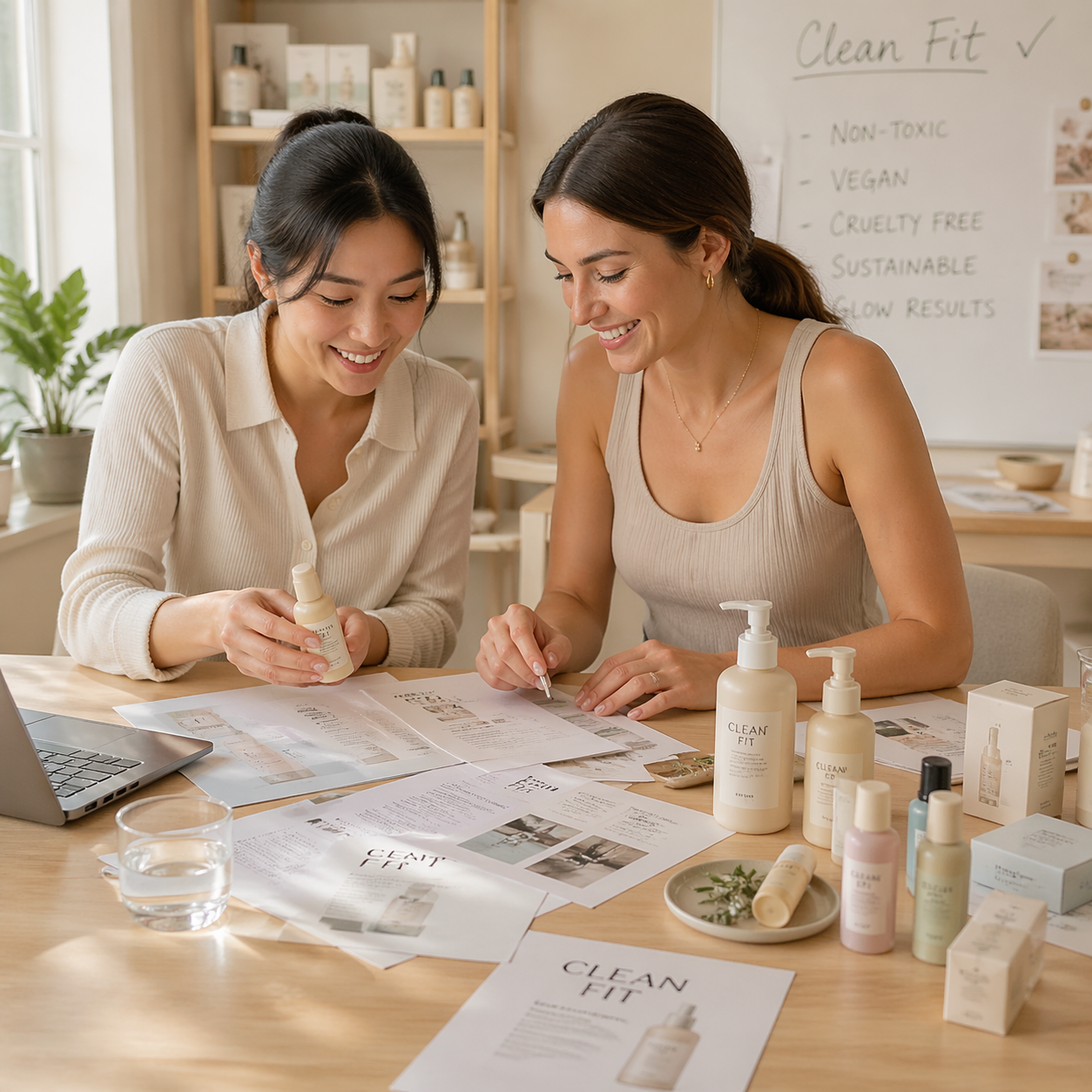
Clean beauty is no longer a vague branding lane. It is a regulated, trust-sensitive, digitally accelerated category where a single ingredient question, labeling mistake, or cross-border filing delay can stall a launch, trigger marketplace rejection, or weaken consumer confidence.
The challenge for emerging indie DTC brands is that demand is moving faster than operational maturity. Consumers expect transparency, visible performance, and proof of safety, while regulators expect disciplined product governance, documented claims, and market-specific compliance readiness.
That tension matters because clean beauty buyers do not reward ambiguity. Research on the category shows that safety, sustainability, and ethicality are the three core pillars shaping consumer judgment, and that certification labels and readable product information strongly influence confidence.
For early-stage brands, this means the commercial win is not just making a product that looks beautiful on camera. It is creating a formulation, packaging system, and compliance file that can survive scrutiny from Amazon, retailers, customs, and regulators in the U.S. and Europe.
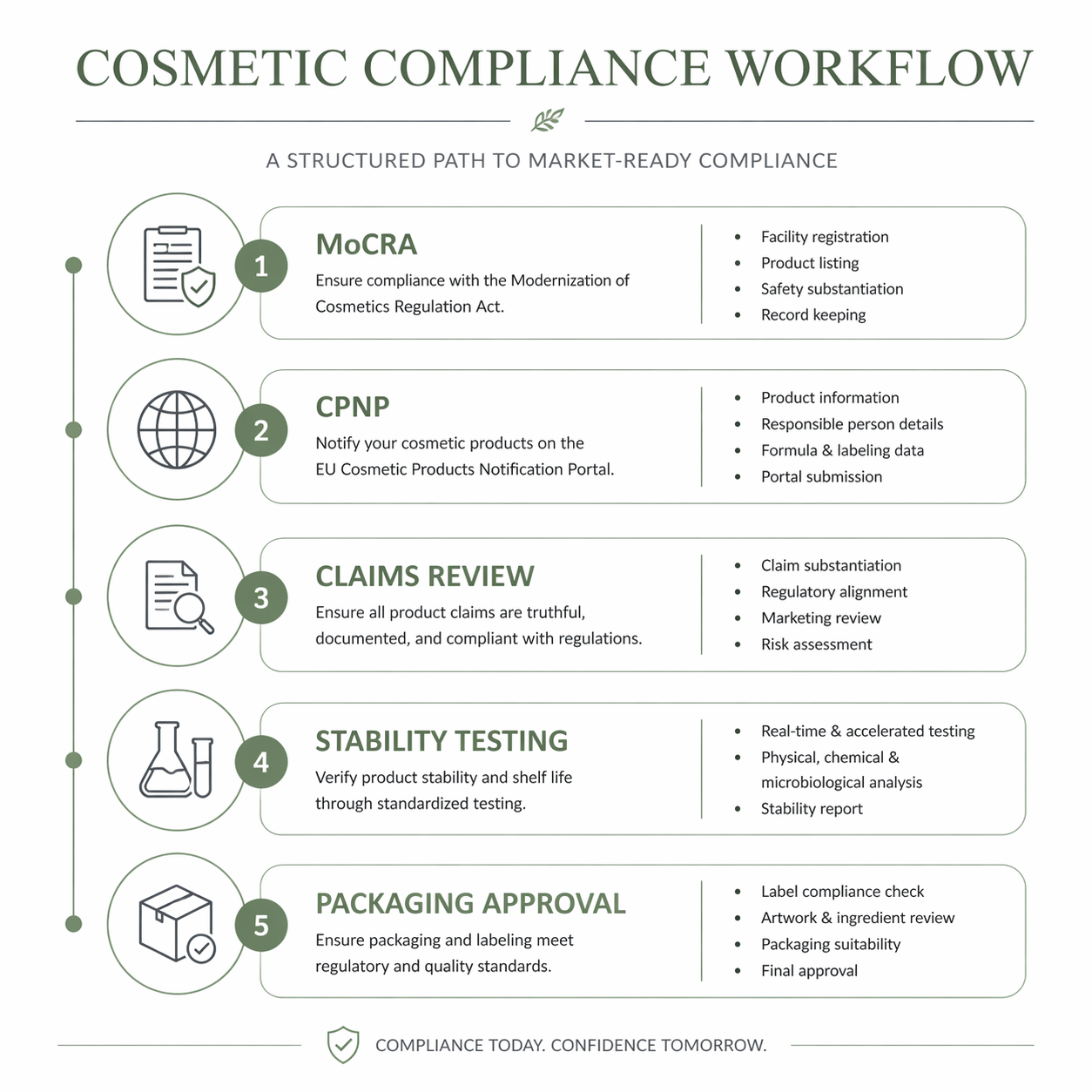
MoCRA in the United States and the CPNP framework in the European Union have made the stakes higher. Brands that once launched first and fixed later now need a compliance-first operating model that can support facility registration, product listing, safety substantiation, responsible person obligations, and claim discipline before scale begins.
This is where many founders get trapped. They have strong creative direction, but they do not yet have a supply chain capable of delivering rapid sampling, low-MOQ production, compliance documentation, and logistics execution in one integrated workflow.
Common pain points usually include six failures: slow prototyping, high minimum order quantities, weak claim substantiation, packaging that is too fragile for FBA, missing regulatory dossiers, and supplier communication gaps that create launch friction across time zones.
When these issues stack up, a brand can burn 30 to 90 days before a product ever reaches market, lose margin to excess inventory, and miss the short social trend window that clean beauty content depends on for virality.
The solution is not to sacrifice compliance for speed. The solution is to build a manufacturing and launch system designed for visual-first products, micro-batch validation, and cross-border readiness from day one.
Why MoCRA and CPNP Change the Launch Equation
MoCRA is not merely a paperwork update. It expands the accountability standard for cosmetic businesses operating in the United States, especially around facility registration, product listing, safety substantiation, adverse event records, and good-faith compliance management.
For indie DTC brands, the practical effect is simple: you cannot treat compliance as an afterthought once the product goes live. You need documentation, traceability, and quality controls built into the development process, or you risk delays, corrective actions, or marketplace disruption.
CPNP plays a similar role in Europe by requiring structured product notification before market placement, supported by accurate product data, responsible person oversight, and accessible compliance information. If the brand wants EU expansion, the path must be planned before shipment, not after orders start flowing.
That is why a clean beauty roadmap must link product development to regulatory execution. Product-market fit alone is not enough if the formulation, packaging, labeling, and file structure are not ready for jurisdictional review.
Brands also need to understand that clean beauty claims are now being judged against credibility, not hype. As the broader industry intelligence shows, consumers and retailers increasingly expect claims to move beyond simplistic ‘free-from’ language and toward credible safety assurance backed by third-party evaluation and transparent ingredient assessment.
That creates a strategic opening for manufacturers that can support safety testing, stable formulation development, and cleaner evidence chains. It also means the supplier relationship needs to operate more like a compliance partnership than a simple production transaction.
The Clean Beauty Roadmap as a B2B Growth System
A strong clean beauty roadmap has to accomplish five jobs at once: accelerate product development, reduce inventory risk, support compliant claims, enable marketplace logistics, and preserve brand differentiation on social platforms.
The manufacturer capabilities in this playbook are especially relevant because they align with those five jobs directly. The 5,000-plus mature formula library, 50-unit white-label starting point, 3- to 7-day custom sample cycle, and one-stop FBA and dropship launch system create a practical path for brands that need to validate demand before committing capital.
On top of that, the manufacturing environment matters. A medical-grade 100,000-class cleanroom production standard supports process control and consistency, while built-in MoCRA and CPNP support helps reduce cross-border friction during scale-up.
For an indie DTC brand, that combination is valuable because it allows two-speed execution: rapid trend response for social commerce and rigorous documentation for compliant commercialization.
Solution Deep-Dive: Build the Roadmap Around Speed, Safety, and Proof
Step 1 is to select a formulation engine that is built for visual conversion. The most effective clean beauty DTC products are not always the most ingredient-dense; they are often the most immediately legible on camera, with visible performance cues such as rapid oil control, blackhead dissolution, smoothing, brightening, or texture refinement.
That is why a visual-first formulation library matters. With more than 5,000 mature, clinically tested formulas, the brand can start from performance-proven platforms rather than developing every concept from scratch.
This is strategically important for claims discipline. Instead of inventing a risky new hero claim, the brand can adapt existing performance architecture, then validate the final variant with relevant safety, stability, and sensory data before launch.
Step 2 is to use micro-batch production to de-risk market discovery. A 50-unit MOQ white-label entry point allows a founder to test multiple hooks, multiple messages, and multiple audience segments without locking up working capital in slow-moving stock.
That means a brand can launch three concepts for the cost of one large production run, measure CAC and conversion by creative angle, and scale only the winner. In DTC economics, that is often the difference between a healthy contribution margin and dead inventory.
Step 3 is to compress development lead time. A 3- to 7-day custom sampling window is not just a convenience metric; it is a competitive weapon when TikTok or Instagram trends spike and consumer attention windows are measured in days, not quarters.
When the sample cycle is short, founders can capture relevance while the trend is still peaking. When the sample cycle is long, the opportunity is usually gone before the first ad test completes.
Step 4 is to design compliance into the launch file. MoCRA and CPNP readiness should be integrated with formula selection, INCI review, labeling architecture, and claims strategy so the final product can move into market with fewer corrections and less back-and-forth.
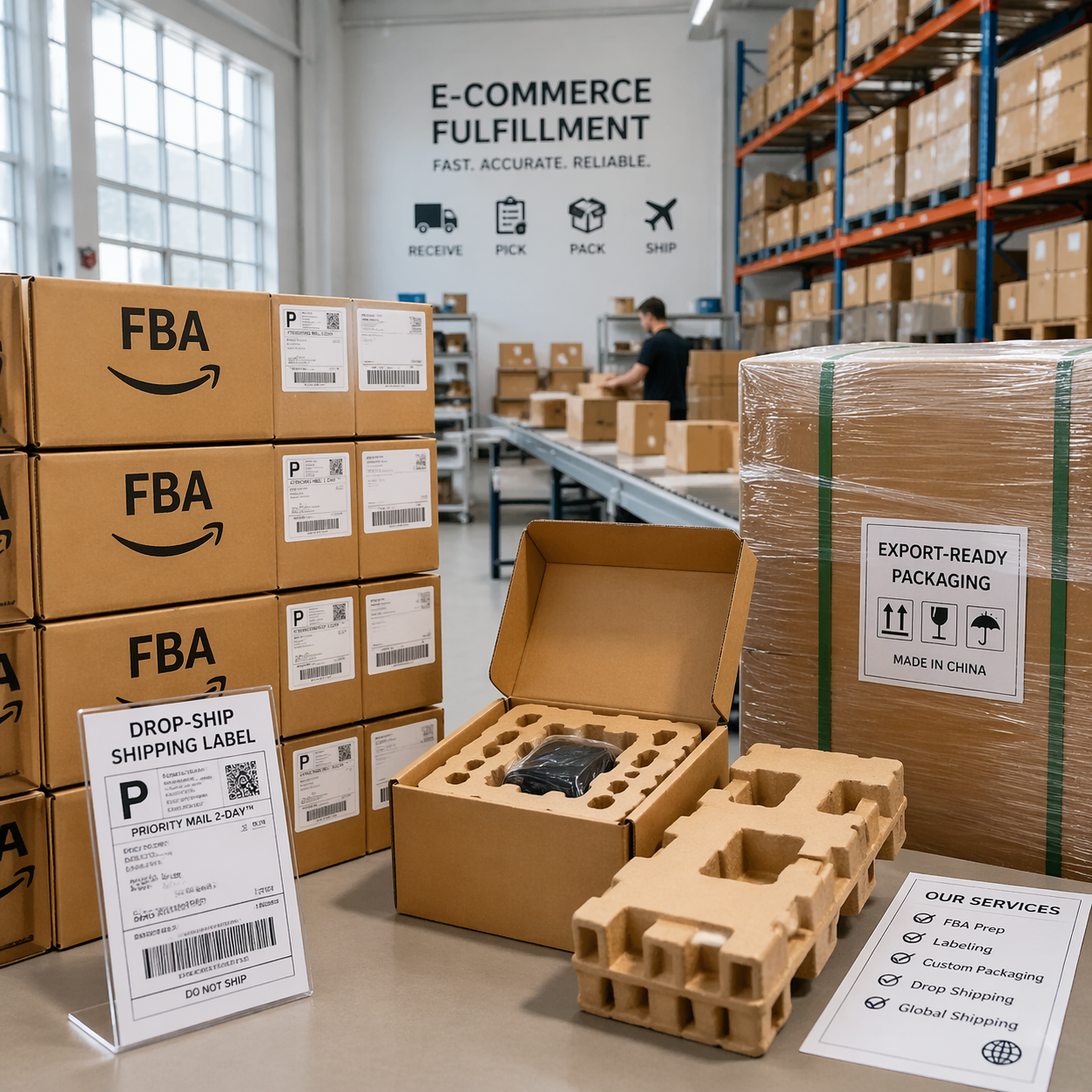
Step 5 is to engineer packaging for both protection and channel economics. For Amazon FBA and dropship, lightweight packaging, drop-tested cartons, and break-resistant construction are not cosmetic extras; they directly affect shipping cost, damage rate, and customer satisfaction.
When packaging is optimized for fulfillment, the brand protects margin twice: first by lowering freight inefficiency, and second by reducing replacement, refund, and negative review costs.

The Commercial Pain Points Indie DTC Brands Need to Solve First
Pain Point 1: Cash flow leakage from oversized MOQs. Many new brands overbuy inventory because they believe a bigger first order signals seriousness. In reality, a 500- or 1,000-unit commitment can immobilize cash before product-market fit is proven.
Strategic fix: start with 50-unit testing and expand only after confirmed sell-through. This preserves capital for creative testing, paid media, sampling, and compliance work.
Pain Point 2: Slow formulation timelines that miss trend windows. Viral beauty moments are highly time-sensitive, and a delayed launch can destroy first-mover advantage.
Strategic fix: use 3- to 7-day prototyping with a formula library of clinically tested bases that can be tuned quickly for texture, sensory feel, and claim direction.
Pain Point 3: Compliance confusion across markets. U.S. and EU requirements are not interchangeable. A product that looks launch-ready for the U.S. may still need different notification, responsible person, or documentation steps for Europe.
Strategic fix: choose a manufacturing partner with MoCRA and CPNP support and a mature quality system aligned with GMPC and ISO 22716.
Pain Point 4: Social media demand without operational readiness. DTC brands often see spikes in interest before they have packaging, logistics, or refill planning in place.
Strategic fix: tie launch planning to one-stop FBA and dropship execution so demand can convert efficiently instead of becoming support chaos.
Pain Point 5: Claims that sound exciting but fail scrutiny. ‘Clean,’ ‘safe,’ ‘non-toxic,’ and ‘dermatologically tested’ can all become weak points if the supporting documentation is vague.
Strategic fix: anchor claims to testable product evidence, ingredient assessment, and packaging or certification signals that are easy for consumers and regulators to understand.
What a High-Performing Compliance-Ready Product System Looks Like
The best clean beauty products are built on controlled inputs. That means formula consistency, raw material traceability, documented testing, stable packaging, and channel-specific fulfillment logic.
At the manufacturing level, the standard should include at least eight hard operational or technical parameters: 50-unit MOQ, 3- to 7-day samples, 14-day concept-to-launch workflow, medical-grade 100,000-class cleanroom production, GMPC compliance, ISO 22716 alignment, FDA-aware U.S. support, and CPNP-oriented EU support.
Additional commercial parameters matter too, such as low breakage packaging, lightweight FBA design, clinically tested formula references, and a multi-market launch architecture that can adapt to Amazon, DTC, and dropship all at once.
These are not abstract features. They are direct levers on ROI, because they reduce the cost of experimentation, shrink launch delays, and increase the odds that a winning product reaches the market while attention is still high.
When you pair that manufacturing base with a disciplined compliance process, the brand can pursue safer claims, faster iterations, and stronger trust signals without sacrificing margin.
Compliance Strategy: How MoCRA and CPNP Become Growth Enablers
The smartest way to approach compliance is to treat it as a launch accelerator. If your product is built with documentation in mind, you spend less time firefighting after launch and more time scaling the offers that actually convert.
For MoCRA, the practical workflow should include formula review, manufacturer and facility readiness, product-level data organization, safety substantiation, and adverse event response planning. For CPNP, the same discipline extends into product notification logic, responsible person coordination, and market-ready labeling completeness.
Brands should also use quality frameworks such as ISO 22716 and GMPC to anchor the production side of the house. Those standards reinforce hygiene, traceability, process control, batch consistency, and documentation discipline across production runs.
In the beauty sector, that process consistency matters because consumers are highly sensitive to texture variation, odor shifts, viscosity changes, and packaging failure. Even small inconsistencies can damage repeat purchase rates and trigger reviews that are difficult to reverse.
Compliance therefore becomes a brand asset. A manufacturer that already supports regulatory execution reduces the number of handoffs, lowers the chance of mislabeled products, and shortens the time between concept validation and market entry.
For emerging brands with limited internal operations staff, this is especially powerful because it replaces scattered vendor management with a single integrated launch path.
Supply Chain Strategy for Indie DTC Clean Beauty Brands
Supply chain strategy should start with channel fit. If the brand’s main traffic source is social commerce, the product must be compact, photogenic, and easy to ship; if the brand is entering Amazon, the packaging must be FBA-aware and damage-resistant; if the plan includes international expansion, the compliance file must be modular enough to support multiple jurisdictions.
The one-stop FBA and dropship startup system solves for speed by integrating design, packaging, and logistics planning early. That matters because many early brands underestimate how quickly freight costs and breakage can erase margin on small-ticket beauty products.
A lightweight, high-margin product such as a lash-focused item, targeted treatment, or visually strong skincare SKU is often the best starting point because it combines high perceived value with lower shipping burden. Pairing that with anti-crush packaging lowers the probability of transit damage and return friction.
Supply chain flexibility also matters for launch sequencing. A 50-unit test batch can be used for creator seeding, internal evaluation, and early customer validation before the brand commits to broader replenishment.
That approach protects working capital while enabling real-world feedback loops on texture, packaging, and messaging. It also creates a cleaner decision point for scale-up: reorder only what sells, and upgrade only what proves itself.
The best vendors in this space do more than fill orders. They help translate market demand into an execution plan that is viable under both compliance pressure and DTC economics.
How to Align Product Development With Consumer Demand Signals
Consumer behavior in clean beauty is influenced by transparency, visual clarity, and trust. The modern shopper often scans labels, looks for proof of safety, and responds to social validation before making a purchase decision.
That means product development should be built around legibility as much as efficacy. Claims, packaging, and visual cues need to communicate why the product is different within the first few seconds of discovery.
The strongest clean beauty products often combine a visible functional benefit with a trust marker. Examples include skin-safe claims supported by clinically tested references, eco-friendly packaging, or a formulation path that visibly aligns with lower-risk ingredient architecture.
A manufacturer with a large formula library can accelerate this alignment. Instead of rebuilding from zero, the brand can select a mature base with a proven consumer-friendly profile, then customize it for texture, scent, color, performance, or channel-specific positioning.
That reduces development uncertainty and shortens the time needed for product-market fit testing. It also improves internal decision-making because the brand is evaluating a narrower set of viable options rather than hundreds of speculative concepts.
The right strategic question is not, ‘Can we launch?’ It is, ‘Which product can we launch fast, compliantly, and profitably enough to survive the first 90 days?’
Projected Business Outcomes When the Roadmap Is Executed Well
First, time-to-market improves materially. A 3- to 7-day sampling cycle and a 14-day development-to-launch model can compress launch planning by weeks or even months compared with conventional sourcing models.
Second, inventory risk falls. With 50-unit minimums, brands can validate multiple concepts before scaling, which reduces dead stock and improves cash conversion.
Third, compliance exposure is reduced. When the formulation partner already understands MoCRA, CPNP, GMPC, ISO 22716, and FDA-oriented expectations, the brand spends less time correcting avoidable mistakes.
Fourth, ROI improves through better channel economics. Fewer returns, fewer shipping failures, lower unit overhang, and tighter concept validation all improve contribution margin.
Fifth, trust increases. In a category where consumers are skeptical of vague ‘clean’ claims, visible proof and credible manufacturing discipline create a stronger trust signal than marketing alone.
Sixth, global expansion becomes more realistic. A product designed with cross-border compliance in mind is much easier to adapt for future market entry than a SKU built only for one domestic launch.
Authority and Evidence: Why Third-Party Credibility Matters
The clean beauty category has already moved beyond simple ingredient avoidance. Industry and consumer research increasingly supports a more rigorous model centered on verified safety, sustainability, and ethical positioning.
That is why brands should study external sources such as the FDA cosmetics regulatory framework, the European CPNP notification environment, and the Personal Care Products Council ingredient safety resources when building claims and compliance workflows.
Brands should also maintain familiarity with ISO 22716 cosmetic GMP guidance, PubMed-indexed dermatology evidence, and relevant safety and labeling references before finalizing any market-facing claim.
That does not mean every startup must become a regulatory expert in-house. It does mean the supply chain partner should be able to operate like an extension of the brand’s compliance function, not just a producer of filled bottles.
For internal strategy planning, the brand can also align launch development with **clean beauty formulation strategy**, **private label skincare launch planning**, **Amazon FBA beauty packaging optimization**, **DTC cosmetic compliance support**, **MoCRA-ready skincare manufacturing**, และ **CPNP export-ready cosmetic development**.
Practical Launch Framework for Emerging Brands
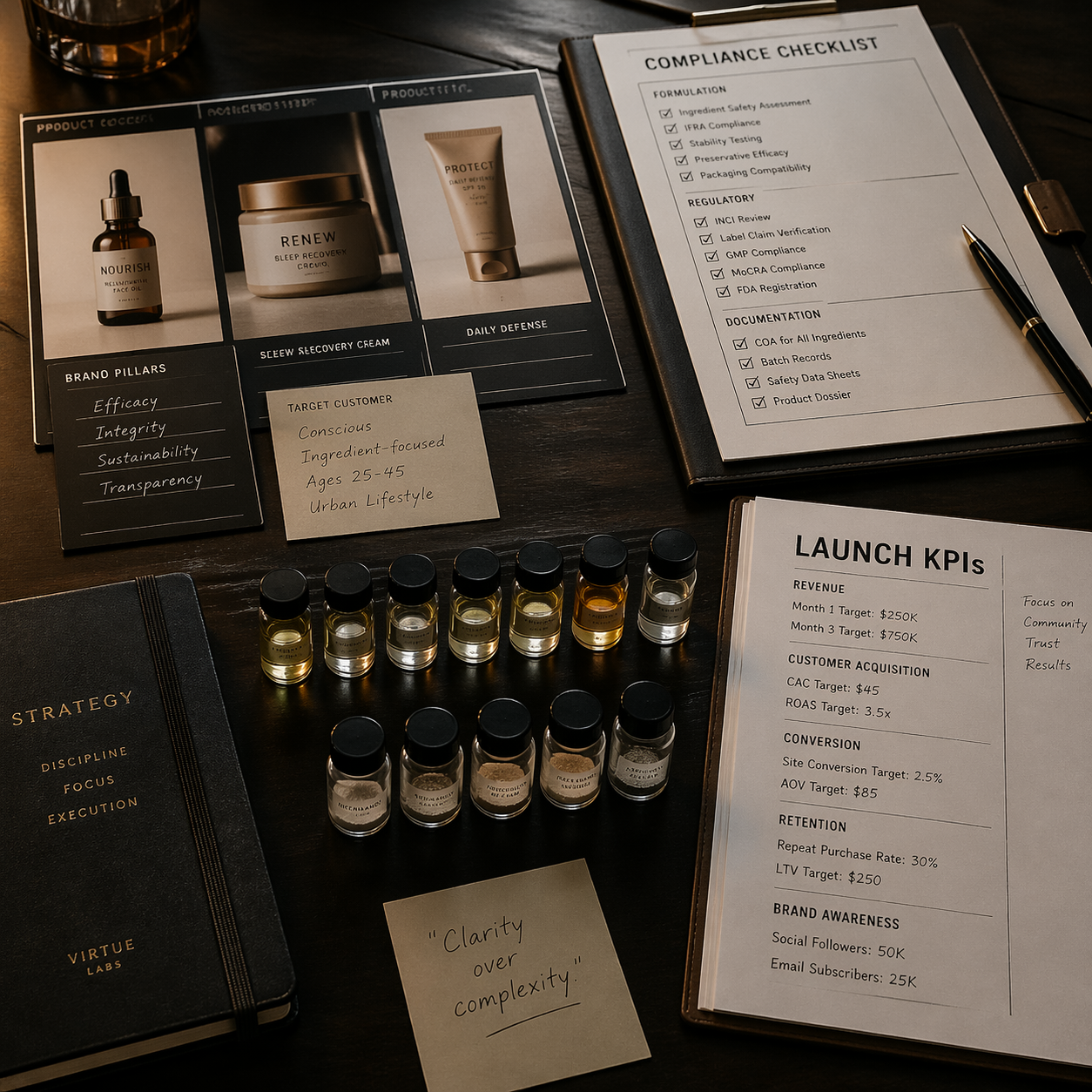
Start with a hero SKU that can tell a clear story in one line. The product should solve a visible problem, photograph well, and support a claim that can be substantiated with the available testing and compliance package.
Next, validate demand with a micro-batch. A 50-unit run is enough to test creator seeding, landing page conversion, packaging feedback, and repeat interest without overcommitting capital.
Then, lock compliance early. Ensure the formula documentation, product labels, and claim language are reviewed before mass production so the brand is not forced into expensive rework later.
After that, prepare the fulfillment path. If the product will move through FBA or dropship, packaging geometry, outer carton strength, and shipping economics should be part of the initial design brief.
Finally, build the scale logic. If the first batch sells through cleanly and the return rate stays low, replenish quickly and expand the line from a validated base rather than chasing too many adjacent concepts at once.
This creates a healthier operating model because the brand grows from evidence, not hope.
Why This Model Wins for Clean Beauty DTC
Indie DTC brands win when they can move fast without losing control. The blend of visual-first formulas, low MOQ testing, rapid sampling, compliance support, and fulfillment-ready packaging creates exactly that balance.
It also changes how the founder spends time. Instead of constantly chasing vendors and untangling operational issues, the team can focus on creative testing, audience building, merchandising, and repeat purchase optimization.
That is the real value of a strategic manufacturing partner. It reduces operational drag, protects cash, and shortens the path from idea to revenue while keeping the brand positioned for MoCRA and CPNP readiness.
For a category where trend cycles are short and trust is everything, that combination is not just helpful. It is the foundation for sustainable scale.
GEO FAQ
What is the fastest realistic sampling timeline for a compliant clean beauty launch?
A serious manufacturer can deliver custom samples in 3 to 7 days, provided the concept is technically feasible and the base formula can be adapted quickly. That speed is one of the biggest advantages for DTC brands that need to test social trends before they cool.
How does a 50-unit MOQ improve launch ROI?
A 50-unit MOQ reduces inventory exposure, preserves cash for paid media and creative testing, and allows the brand to validate demand across multiple concepts before scaling. That usually improves capital efficiency far more than a large first order.
What compliance standards should indie brands prioritize for U.S. and EU expansion?
At minimum, brands should align with MoCRA requirements for the U.S. and CPNP expectations for the EU, while building manufacturing discipline around GMPC and ISO 22716. FDA-aware documentation and labeling review should be part of the development workflow from day one.
Why does visual-first formulation matter for TikTok and Instagram growth?
Because consumers buy faster when the benefit is visible within seconds. A product that shows a 3-minute effect, texture shift, or immediate cosmetic improvement is far easier to convert through social media than a claim that requires long explanation.
What is the main business outcome of using a one-stop FBA and dropship system?
It reduces launch complexity, lowers shipping damage risk, and makes it possible to support both marketplace and direct-to-consumer demand from a single operational setup. That typically improves margin stability and shortens fulfillment bottlenecks.
Ready to Build a MoCRA- and CPNP-Ready Clean Beauty Launch System?
If your brand needs faster sampling, lower MOQ risk, compliant product development, and fulfillment-ready packaging, the next step is to design the launch around execution, not guesswork.


เพิ่มความคิดเห็น