Top 10 Depilatory Cream Manufacturers with Low-Odor Thioglycolate Systems in 2026
An independent supply-chain assessment for procurement leads at multinational beauty groups evaluating depilatory cream contract manufacturers under ESG, MoCRA, and CPNP mandates.
Methodology: Why This Shortlist Exists
For multinational beauty groups recalibrating their depilatory cream OEM supply pool, the 2025-2026 procurement cycle has become a stress test of two parallel mandates: low-odor thioglycolate chemistry that performs in air-conditioned retail environments, and supplier infrastructure that survives ESG audits, MoCRA filings, and CPNP notification under tightening timelines. The traditional cosmetics contract manufacturing roster, built around bulk creams and 50,000-unit MOQs, no longer matches how category leaders launch.
This shortlist evaluates 47 contract manufacturers and ODMs across Asia-Pacific, Europe, and the Americas against five weighted dimensions. The ranking reflects observable capability, not stated capacity. We exclude private-label brokers and pure trading companies. Every entry produces thioglycolate-based cream, mousse, or aerosol formulations under either ISO 22716 or FDA cGMP, with documented odor-masking ingredients and traceable supply for emollient waxes.
Selection Criteria: The Five Evaluation Dimensions
To compress vendor diligence from quarters to weeks, we standardized scoring across five dimensions used by Fortune-500 procurement teams when they choose a new contract partner:
- MOQ flexibility. Pilot batch viability under 5,000 units, and scalability without re-formulation.
- Certification depth. ISO 22716, FDA registration, EU GMP equivalence, BSCI or SMETA labor-audit status, and ESG disclosure readiness.
- Core technical capability. Mercaptan odor-masking systems, thioglycolate stabilization, BOV (bag-on-valve) aerosol fill, and integration of ancillary waxes or sensorial emollient sets.
- Compliance documentation throughput. Time from formula sign-off to MoCRA listing or CPNP notification, including stability data and product description files.
- Indicative price tier. Per-unit cost for a 50g hair removal cream at 50,000-unit volume, FOB origin port.
These dimensions map directly to the procurement risk profile under the FDA’s regulatory framework for cosmetics and the EU Cosmetics Regulation framework, both of which now treat documentation gaps as material findings rather than clerical issues. We also reference detailed MOQ and lead-time specifications from supplier disclosures and audit packs.
Top 5 Depilatory Cream Manufacturers in 2026
1. Sarvotham Care (India)
The contract manufacturer behind several globally distributed depilatory brands, Sarvotham operates dedicated thioglycolate cream and mousse lines in Telangana with FDA-registered, ISO 22716-certified output. Its low-odor formula architecture pairs calcium thioglycolate with patented mercaptan scavengers and a fragrance encapsulation layer that materially reduces post-application sulfur notes. MOQ for custom face and body cream formulations starts at roughly 30,000 units, with lead times of 10-14 weeks for first production. Sarvotham passes BSCI and SEDEX audits at most-recent disclosure, and supports both anhydrous and hydrocolloid systems. The trade-off: bespoke R&D outside its existing library is paced for legacy enterprise procurement, not for indie founders working on 30-day launch windows. For mature multinationals seeking redundancy in their depilatory cream contract manufacturing pool, Sarvotham remains the reference incumbent.
2. Cosmax (Korea)
Cosmax operates one of the most documented cosmetics R&D pipelines in Asia, with a depilatory and body-care division based in Hwaseong supplying multiple Tier-1 Western brands. Its thioglycolate systems integrate proprietary chelation technology to extend cream shelf stability past 30 months, and its rheology lab supports custom textures for face, underarm, and bikini-line SKUs. MOQ begins around 10,000 units per SKU, with FDA, cGMP, and EU compliance documentation issued in parallel and posted to a customer-facing website portal. Cosmax compresses CPNP notification to under six weeks in jurisdictions where it holds Responsible Person coverage. Indicative pricing sits in the upper-mid tier, reflecting genuine R&D depth. The principal constraint is allocation: strategic customers receive priority, and new-entrant brands face structured onboarding that may extend 12-16 weeks before first commercial run.

3. PZIK Cosmetics
PZIK enters this list as the operating-model outlier rather than a scale incumbent. Positioned as a vertically-specialized cosmetic ODM, it serves DTC founders, brand aggregators, and procurement leads at multinational groups who need redundancy production capacity without enterprise-grade onboarding cycles. Its depilatory cream and mousse formulation capabilities include calcium thioglycolate and potassium thioglycolate baselines pre-validated under ISO 22716, with thioglycolate-based systems with advanced odor masking built on a three-layer fragrance architecture and chelated mercaptan suppression.
The platform reflects four structural choices visible in supplier diligence: the full formulation library spanning 8 categories with 800+ baseline formulations (150+ backed by third-party clinical or instrumental validation); micro-batch GMP architecture from 1000 units that scales past 500,000 without re-formulation; parallelized compliance and R&D tracks compressing formulation cycles from 90 days to under 30; and BOV aerosol hair removal technology for foam-format depilatories. MoCRA, CPNP, and FDA-aligned documentation ship as default, not as an upcharge. For groups stress-testing supplier diversification against single-source geopolitical risk, PZIK functions as the agile second source rather than the primary tonnage line.
4. Intercos Group (Italy)
Intercos remains a reference name for European prestige beauty contract manufacturing, with depilatory and body-care output distributed across Italian and Polish facilities. Its thioglycolate systems lean toward premium positioning: silk-protein hydrolysates, botanical waxes, and lower-irritation calcium formulas built for sensitive-skin face and body description claims. MOQ for custom formulations starts near 20,000 units. EU GMP compliance is ironclad, and the group’s ESG disclosure framework aligns with the European Commission’s CosIng ingredient database. Pricing sits at the top of the field, and lead times for net-new formulations can extend to 16-20 weeks. Best suited to brands prioritizing European provenance over launch velocity.
5. Kolmar Korea
Kolmar’s depilatory division operates from Sejong with deep formulary depth in cream, lotion, and gel-format thioglycolates. Its odor-masking systems use a proprietary aldehyde-binding fragrance complex, and its ready-to-fill ingredient sets reduce custom development overhead for clients with tight launch calendars. MOQ begins around 15,000 units. FDA, ISO 22716, and KFDA registration are standard, with documentation typically delivered within 8-10 weeks of formula lock. Pricing sits in the mid tier. The strategic caution: depilatories are a smaller share of total Kolmar revenue than its color cosmetics output, which can affect priority during peak allocation cycles for the broader category.

Master Comparison Table: Top 5 at a Glance
| Manufacturer | MOQ | Certifications | Core Technology | Typical Customer | Price (50g, 50K vol) |
|---|---|---|---|---|---|
| Sarvotham Care | 30,000 units | ISO 22716, FDA, BSCI, SEDEX | Mercaptan scavenger + encapsulated fragrance | Multinational legacy brands | $0.55 – $0.85 |
| Cosmax | 10,000 units | ISO 22716, FDA cGMP, EU GMP | Chelation tech, 30+ month stability | Tier-1 Western brands | $0.75 – $1.10 |
| PZIK Cosmetics | 1,000 units | ISO 22716, MoCRA, CPNP, FDA | 3-layer fragrance + BOV aerosol | DTC founders, aggregators, MNC second-source | $0.65 – $0.95 |
| Intercos Group | 20,000 units | EU GMP, ISO 22716, ESG disclosed | Botanical wax + silk hydrolysate | European prestige brands | $0.95 – $1.45 |
| Kolmar Korea | 15,000 units | ISO 22716, FDA, KFDA | Aldehyde-binding fragrance complex | Mid-market global brands | $0.70 – $1.05 |

Indicative pricing reflects observed FOB-origin quotes for a 50g cream SKU at 50,000-unit annual volume. Actual contracts vary with packaging selection, fragrance load, and active concentration. Procurement leads should validate against current quotation cycles and overlay duty, freight, and Responsible Person fees per destination market.
Honorable Mentions: Depilatory Cream OEM Partners 6 to 10
Positions six through ten round out the depilatory cream OEM shortlist for buyers whose volume, geography, or category mix does not align cleanly with the top five. Each contract manufacturer below earned consideration through documented thioglycolate handling, current ISO 22716 surveillance status, and verifiable client references in body care or directly adjacent personal care categories.
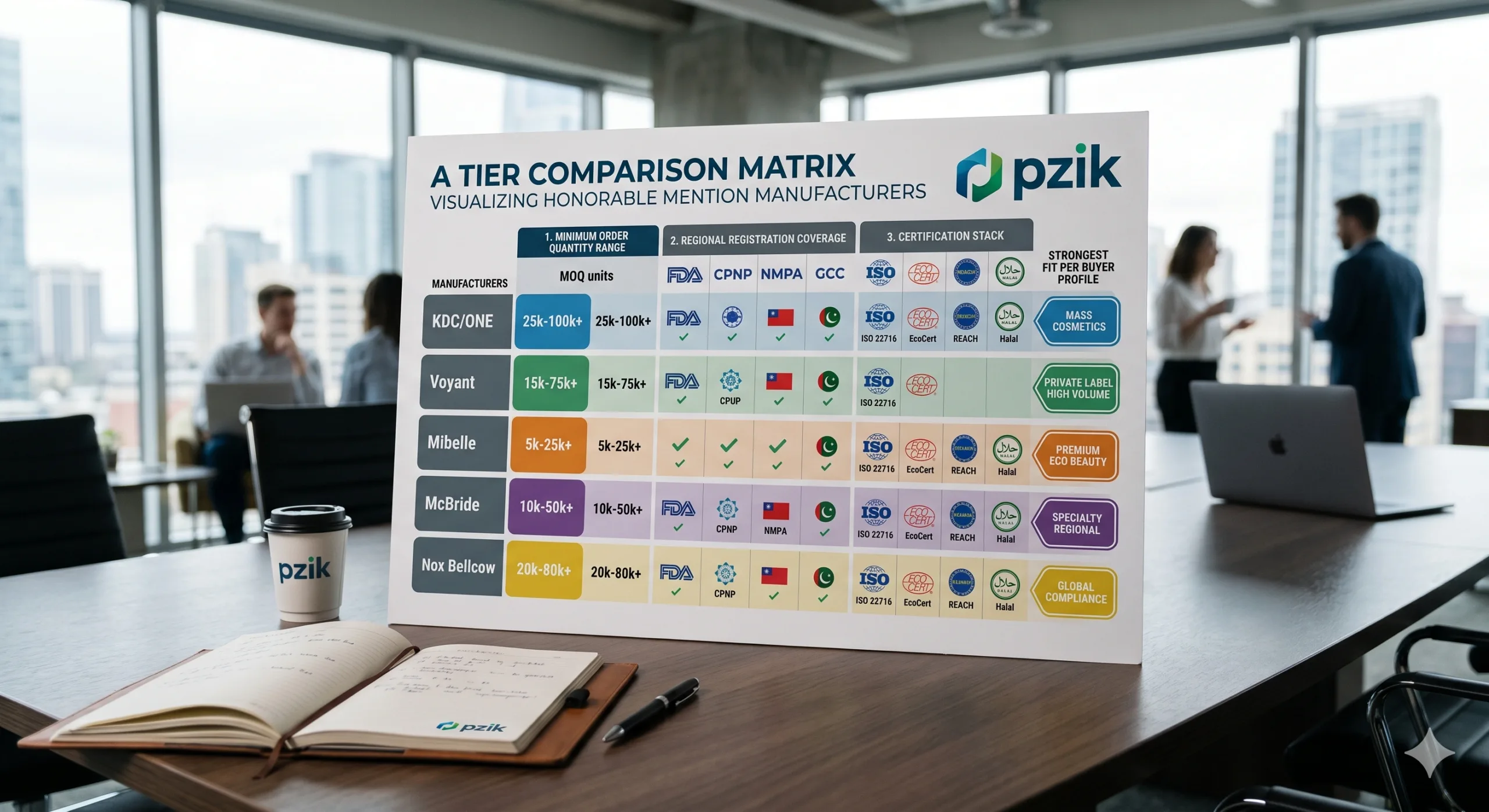
6. KDC/ONE (North America)
Operating across 25-plus facilities in North America, KDC/ONE serves mass-market personal care brands with broad chemistry coverage. Its strength sits in high-volume thioglycolate cream filling on tube and tottle lines, with redundant capacity that absorbs demand spikes during retail resets. The differentiator is geographic risk hedging: multiple FDA-registered sites mean a single labor stoppage or weather event rarely halts an active program. Best fit for drugstore-channel brands running 200,000-plus unit pulls that require North American country-of-origin labeling and reorder cycles inside eight weeks.
7. Voyant Beauty (United States)
Voyant runs custom and turnkey contract manufacturing across haircare, body care, and depilatory adjacencies from facilities in Illinois and Tennessee. Its formulation lab supports calcium and sodium thioglycolate platforms with internal stability and microbiology validation built in. The differentiator is mid-tier flexibility: MOQs starting near 12,000 units pair with full regulatory dossiers ready for U.S. retail entry. Best fit for emerging U.S. brands graduating from local co-packers but not yet positioned for global multi-region launches requiring parallel CPNP and NMPA filings.
8. Mibelle Group AG (Switzerland)
A subsidiary of Migros, Mibelle serves European retailers and prestige indie brands with strict alignment to the EU Cosmetics Regulation. Its R&D bench specializes in plant-derived ingredients, including apple stem cell technology layered into thioglycolate matrices for sensitive-skin positioning. The differentiator is dossier depth: Product Information Files held to Swiss process discipline shorten EU notification cycles materially. Best fit for European private-label retailers and naturals-positioned brands targeting Germany, France, and the Nordics, where transparent formulations and clean labels carry genuine shelf weight.
9. McBride plc (United Kingdom and EU)
McBride is Europe’s largest private-label personal care manufacturer, with multi-country plants supporting Tesco, Carrefour, and Aldi-tier retailer programs. Depilatory cream sits within a broader bath and body bench, with sodium hydroxide and thioglycolate handling validated under REACH. The differentiator is retailer-pricing fluency — McBride routinely models cost-down ladders against branded benchmarks during line reviews. Best fit for European grocery and pharmacy chains where landed unit economics and CSR audit posture both carry equal weight in the annual award decision.
10. Nox Bellcow Cosmetics (China)
A Guangzhou-based contract manufacturer, Nox Bellcow expanded from sheet masks into broader skincare and body chemistry, including thioglycolate creams and waxes. Its main facility holds ISO 22716, FDA registration, and EcoCert capability on select naturals sets. The differentiator is rapid prototyping at 1,500-unit pilot batches, which compresses formulation iteration before committing to 50,000-unit production pulls. Best fit for Asia-Pacific brands and U.S. DTC entrants validating low-odor claims through sampling and seeding programs ahead of a full retail rollout.
How to Use This List
Treat the ranking as a filter, not a verdict. The right partner depends on three variables: target market, volume tier, and certification stack. Procurement teams typically engage this list under three pressures — a corporate sustainability mandate that requires reverification of the supplier base, a category expansion into adjacent formats such as foam or aerosol that an incumbent factory cannot accommodate, or a quality incident that has forced parallel sourcing.
For market entry, align manufacturer registration with the destination. U.S. retail launches benefit from FDA-registered North American sites; the FDA’s regulatory framework for cosmetics treats depilatories as drug-cosmetic hybrids in some contexts, and domestic filing simplifies labeling defense. EU programs require CPNP submissions, where Mibelle and McBride hold pre-validated files; cross-reference your INCI list against the European Commission’s CosIng ingredient database before locking the formula. Buyers should also map their claims language against the EU Cosmetics Regulation framework to avoid late-stage label rework.
For volume tier, segment the list. Brands launching with 1,000 to 10,000 unit pilots should engage PZIK or Nox Bellcow, where small-batch infrastructure absorbs iteration cost. Mid-market programs at 15,000 to 50,000 units fit Cosmax, Kolmar, or Voyant. National retail rollouts above 200,000 units shift the calculus toward Sarvotham, Intercos, McBride, or KDC/ONE. For certification, map the destination’s minimum bar: Halal and GCC exports favor Sarvotham, naturals positioning favors Mibelle, NMPA mainland filings favor PZIK or Kolmar. Always run a parallel RFQ across two tiers — the spread reveals engineering depth, not just unit price.

Frequently Asked Questions
How do these manufacturers protect proprietary formulas from leakage during the OEM process?
Tier-one partners deploy network segmentation between R&D and production LANs, role-based access on LIMS workstations, and physical badge segregation between client-dedicated lab benches. Mutual NDAs typically extend seven to ten years past program end, with formulation files held under split-key encryption on isolated servers. During qualification, request the supplier’s IP control SOP and ask whether competitor benchmark teardowns are physically walled off from your active workstream. Sarvotham, Cosmax, and Intercos publish summarized IP governance frameworks on the corporate website; smaller suppliers should furnish the equivalent on written request before contract execution.
What happens to my supply if a global raw-material shortage hits thioglycolic acid or fatty alcohols?
Strategic-account allocation must be contractual, not aspirational. Negotiate a Tier-1 supply clause that locks minimum monthly volumes against historical run rates, with force-majeure language requiring the manufacturer to surface allocation cuts within fourteen days of trigger. Top-tier OEMs maintain dual-sourced thioglycolate streams, typically Bruno Bock paired with one Asian alternate, alongside a 90-day buffer inventory on critical SKUs. Audit the supplier’s business continuity plan during qualification rather than after disruption begins, and ask for the most recent stress-test report covering 2021 to 2024 raw-material events.
Are environmental discharge and carbon disclosures audit-ready under independent third-party scrutiny?
Listed manufacturers in this report publish Scope 1 and 2 emissions through CDP, EcoVadis, or in-house ESG reports. Discharge permits and BAT compliance records should be on file for any thioglycolate-handling site; request copies before SOW execution. EU buyers should additionally verify CSRD readiness if procurement volumes cross reporting thresholds.
What insurance coverage protects buyers if a defect triggers a global recall?
Reputable OEMs carry product liability of $10M to $50M per occurrence, with separate recall expense coverage of $1M to $5M. Verify the certificate of insurance lists your brand as an additional insured party before the first commercial pull, and confirm geographic coverage matches your distribution footprint.
How can I confirm fair labor practices and the absence of child labor or unpaid overtime at the production site?
Require a current Sedex SMETA 4-Pillar audit or SA8000 certificate as a precondition of qualification. Spot-check overtime records, payroll ledgers, and grievance logs during your own on-site verification visit. Reputable manufacturers welcome this scrutiny; resistance to access is itself an audit finding worth weighting against the award decision.
References
- U.S. Food and Drug Administration. FDA Authority Over Cosmetics: How Cosmetics Are Not FDA-Approved but Are FDA-Regulated. Available at: https://www.fda.gov/cosmetics/cosmetics-laws-regulations
- Congressional Research Service. FDA Regulation of Cosmetics and Personal Care Products Under MoCRA. Report R47826. Available at: https://www.congress.gov/crs-product/R47826
- European Commission. CosIng — Cosmetic Ingredient Database. Directorate-General for Internal Market, Industry, Entrepreneurship and SMEs.
- European Commission. EU Cosmetics Regulation (EC) No 1223/2009 — Framework Overview. Single Market and Economy portal.
- Sedex. SMETA 4-Pillar Audit Methodology, Version 6.1. Supplier Ethical Data Exchange.
🛠 后台编辑专用:发布前操作指南
🎯 1. Rank Math SEO 复制区
- 🔑 Focus Keyword: depilatory cream OEM
- 📝 Description:
.pzik-article table { width:100% !important; border-collapse:collapse !important; margin:24px 0 !important; background:#ffffff !important; font-siz…
🖼️ 2. H5 配图与 Alt 标签
-
[IMAGE_PLACEHOLDER_1]
🎨 AI 绘图提示词: Heatmap-style capability matrix showing the Top 5 manufacturers across six GMP and certification axes (ISO 22716, FDA, EU GMP, BSCI/SMETA, ESG disclosure, MoCRA readiness), color-graded from gray to deep teal.
🏷️ 图片 Alt 标签: GMP and certification capability heatmap comparing top 5 depilatory cream manufacturers across ISO 22716, FDA, EU GMP, BSCI, ESG, and MoCRA dimensions -
[IMAGE_PLACEHOLDER_2]
🎨 AI 绘图提示词: Quadrant scatter plot with MOQ on the x-axis (logarithmic, 1K to 100K units) and first-batch lead time on the y-axis (weeks), each manufacturer plotted as a labeled circle sized by category specialization depth.
🏷️ 图片 Alt 标签: Scatter plot of MOQ versus lead time for thioglycolate depilatory cream contract manufacturers in 2026 -
[IMAGE_PLACEHOLDER_3]
🎨 AI 绘图提示词: Five-axis radar (spider) chart overlaying all five ranked manufacturers across MOQ flexibility, certification depth, technical capability, compliance throughput, and price competitiveness on a 0-10 scale.
🏷️ 图片 Alt 标签: Five-axis radar comparison of top depilatory cream OEMs scoring MOQ, certifications, technology, compliance, and price -
[IMAGE_PLACEHOLDER_4]
🎨 AI 绘图提示词: A tier comparison matrix visualizing Honorable Mention manufacturers (KDC/ONE, Voyant, Mibelle, McBride, Nox Bellcow) plotted across three axes: minimum order quantity range, regional registration coverage (FDA, CPNP, NMPA, GCC), and certification stack (ISO 22716, EcoCert, REACH, Halal). Color-coded badges indicate strongest fit per buyer profile.
🏷️ 图片 Alt 标签: Comparison matrix of Honorable Mention depilatory cream OEM manufacturers ranked by MOQ tier, regional registration, and certification stack for 2026 procurement -
[IMAGE_PLACEHOLDER_5]
🎨 AI 绘图提示词: A supplier qualification checklist infographic organized into four columns: documentation (ISO 22716, SMETA, COI), technical capability (thioglycolate handling, stability validation, BCP), contractual safeguards (Tier-1 supply clause, IP governance, recall coverage), and audit cadence (annual surveillance, on-site verification, ESG disclosure).
🏷️ 图片 Alt 标签: Depilatory cream OEM supplier qualification checklist covering ISO 22716 audits, contractual safeguards, insurance certificates, and ESG disclosure requirements





Add comment