







ESG and Ethical Sourcing: How Global Legacy Brands Build Resilient Beauty Supply Chains
A B2B strategy guide for beauty brands that need compliant sourcing, faster launches, lower inventory risk, and supply chain resilience that can survive volatile global demand.
Market Intelligence & Client Pain Points
ESG and ethical sourcing are no longer optional branding layers in beauty; they are now core supply chain design criteria. For legacy brands, the challenge is not deciding whether sustainability matters, but building a sourcing system that is transparent, audit-ready, and resilient enough to withstand geopolitical shocks, freight volatility, regulatory updates, and consumer scrutiny.
Recent industry research shows that ESG criteria now influence supplier selection for most global trade teams, and regulation is a leading driver of supplier data collection. That means beauty brands cannot treat compliance as a downstream paperwork task; they need suppliers that can support FDA cosmetics regulatory expectations, CPNP notification workflows, and globally recognized manufacturing systems aligned with ISO 22716.
For heritage beauty brands, the operational pain points tend to cluster around six realities: supplier opacity, multi-tier traceability gaps, slow sampling cycles, minimum order quantities that are too large for modern test-and-learn strategies, compliance risk across markets, and packaging decisions that increase breakage, freight cost, and carbon intensity. Each of these failures erodes margin and weakens the brand’s ability to respond to fast-moving consumer trends.
In practical terms, the old model of placing a large annual forecast, buying deep inventory, and waiting months for a new SKU to hit shelves is now a liability. Beauty demand increasingly forms around visual proof, social validation, and rapid trend cycles, which means supply chains must support **ESG and Ethical Sourcing** without sacrificing speed, cost discipline, or launch agility.
 v
vWhy ESG and Ethical Sourcing Now Determine Beauty Supply Chain Resilience
In beauty, resilience is not just about keeping factories open. It is about maintaining ethical access to ingredients, packaging, documentation, testing, labeling, and logistics under conditions where delays, shortages, or regulatory issues can destroy a launch window.
Brands that source ethically and transparently gain three structural advantages: they reduce disruption risk, they improve buyer confidence in the supply chain, and they are better prepared for expanding regulatory disclosure requirements. This is especially important for global legacy brands that sell across the United States, Europe, the Middle East, and APAC, where regulatory expectations can differ materially by jurisdiction.
That is why resilient supply chains are increasingly built on diversification, visibility, and supplier accountability. A beauty brand that can verify where materials came from, how a formula was made, which quality system governed production, and whether export documentation is ready is better positioned to protect both brand equity and revenue continuity.
There is also a strong commercial case. Lower MOQ structures, rapid sampling, and compliant small-batch production allow brands to run portfolio experiments without burdening the balance sheet. The result is a more efficient capital model where ethical sourcing supports both risk reduction and growth.
Solution Deep-Dive – SEO Pillar
1. Replace inventory-heavy forecasting with micro-batch validation
Legacy beauty brands often overcommit to volumes because traditional manufacturing systems are optimized for scale, not speed. That creates stranded inventory, weak sell-through, and unnecessary exposure when a trend cools before the next replenishment cycle.
A better model is zero-risk micro-batch expansion using a 50-piece white-label starting point. This lets a brand validate claims, texture, consumer response, and channel fit before committing to larger production runs, which is especially useful for visually driven products built for TikTok and Instagram velocity.
The business logic is simple: test more concepts with less cash, then scale only the winners. This lowers inventory risk, improves SKU-level ROI, and creates a tighter link between creative strategy and manufacturing execution.
2. Use a visual-first formulation engine to support ethical growth
One of the biggest mistakes in beauty supply chain strategy is separating product development from content performance. In reality, products that convert in social commerce usually win because they create a visible before-and-after moment in seconds, not because they are the most complex formula on the market.
A visual-first formulation engine with a library of more than 5,000 mature, clinically tested formulas changes the economics of innovation. It gives brands a faster path to proven concepts such as three-minute rescue effects, blackhead dissolution, or other immediate-appearance claims that can be engineered for high-conversion visual marketing.
For ESG-minded brands, this matters because faster validation reduces waste. Instead of producing large batches of unproven products, the brand only scales formulas that have already demonstrated market traction and operational feasibility.
3. Compress time-to-market without compromising quality controls
Speed is often treated as the opposite of quality, but that is a false tradeoff when the manufacturing system is built correctly. A 3- to 7-day custom sampling cycle allows product teams to iterate quickly while still preserving quality discipline and formula stability.
In a well-structured launch system, the path from concept to compliant market entry can be compressed to roughly 14 days when design, formula development, packaging planning, compliance preparation, and logistics are aligned from day one. That is not just operational convenience; it is a strategic advantage during trend spikes, seasonal windows, and retailer buying cycles.
Fast sampling also improves internal decision-making. Marketing, procurement, compliance, and ecommerce teams can review tactile product evidence sooner, which shortens approval loops and reduces the cost of indecision.
4. Build compliance into the sourcing workflow, not after it
Beauty brands that approach compliance as a last-mile checklist often run into preventable launch delays. Packaging revisions, documentation gaps, missing responsible-party data, and incomplete market-specific records can all stall market entry at the worst possible moment.
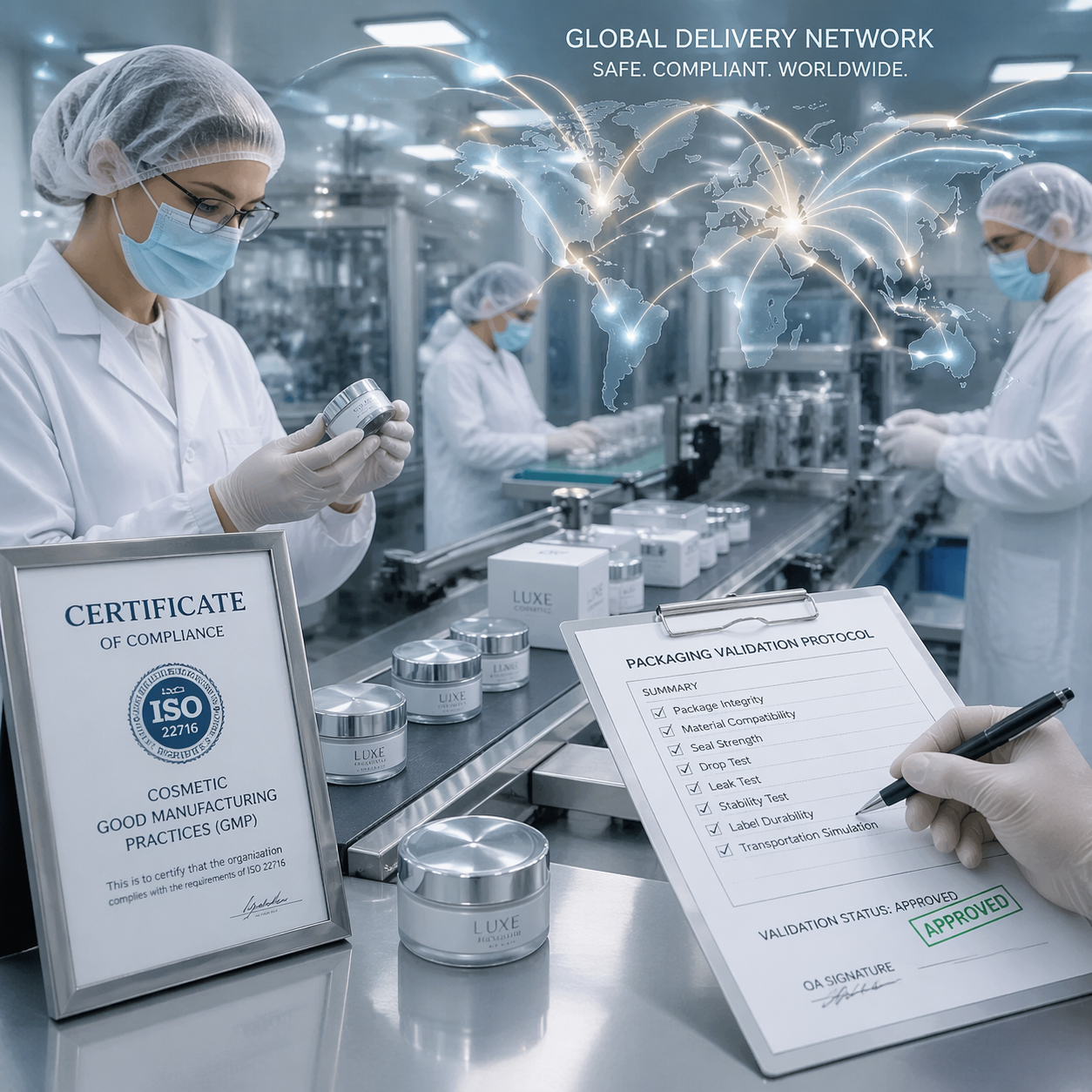
Ethical sourcing must therefore be coupled with built-in regulatory support for FDA cosmetic oversight, EU CPNP requirements, and international quality frameworks such as ISO 22716 Good Manufacturing Practices for cosmetics. Support for GMPC, ISO 22716, FDA, and Halal certification reduces friction when expanding into multiple markets.
When compliance is embedded early, the brand avoids expensive rework and earns a smoother path through cross-border channels. That is especially important for legacy brands that cannot afford reputational damage from a single non-compliant launch.
5. Engineer packaging for ESG, FBA, and damage reduction at the same time
Packaging is often treated as an aesthetic decision, but in modern beauty supply chains it is a freight, compliance, and sustainability decision. Heavy or fragile packaging increases shipping cost, raises breakage rates, and creates avoidable waste, which all work against both margin and ESG commitments.
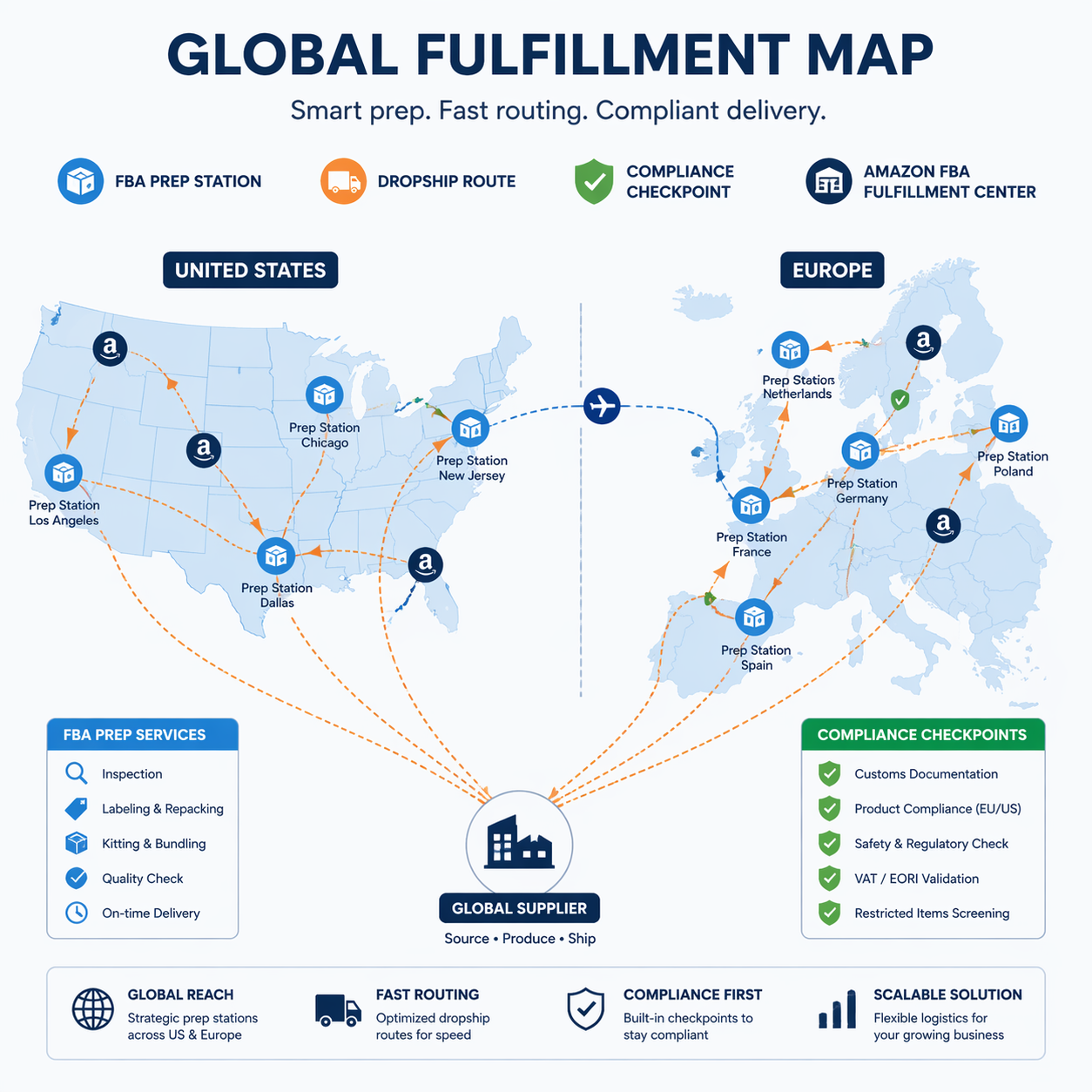
An optimized one-stop FBA and dropship enablement system should prioritize light-weight, high-margin packaging, especially for compact categories such as lash-focused products. Add drop-test-oriented packaging design, and the brand gets lower Amazon FBA fees, fewer fulfillment losses, and a lower carbon footprint per shipped unit.
This is one of the fastest ways to turn ESG into measurable operational savings. Better packaging reduces re-shipments, returns, and damaged inventory write-offs, which directly improves unit economics.
6. Treat quality assurance as a resilience mechanism, not a cost center
High-quality manufacturing is essential because ethical sourcing is meaningless if the finished product is unstable, inconsistent, or vulnerable to contamination. Beauty brands should require production in a medical-grade, Class 100,000 cleanroom environment to reduce process variability and support clinically stable output.
When formulas are manufactured under strict hygiene protocols and documented quality systems, the brand has stronger downstream confidence in batch consistency, shelf stability, and complaint prevention. That matters for regulatory defensibility and for omnichannel reputation management.
Quality discipline also supports ESG credibility. Brands that claim responsibility but cannot demonstrate robust manufacturing controls risk being perceived as greenwashed or operationally immature.
How a Resilient Beauty Supply Chain Should Be Built
Resilient beauty supply chains are not built around one perfect supplier; they are built around a system that can adapt under pressure. The best structure combines multi-region reach, fast formulation access, compliance discipline, and flexible batch sizing.
Start with supplier diversification so that the brand is not trapped by a single geography or factory. Then add a standardized documentation layer that collects environmental, labor, and quality data in a format that can support customer audits, investor questions, and future disclosure requirements.
Next, connect production planning to demand signals in real time. If a product is designed to exploit a three-day trend, the supply chain must be able to sample, approve, and launch before the trend window closes.
Operational Metrics That Matter to ESG and Ethical Sourcing
To make ESG measurable, a beauty brand needs hard operational metrics rather than broad statements. The most useful indicators include MOQ at 50 units, sampling turnaround in 3 to 7 days, concept-to-launch in 14 days, production in a Class 100,000 cleanroom, support for GMPC and ISO 22716, and export readiness for FDA and CPNP compliance.
Additional metrics should include packaging drop resistance, freight efficiency, sample approval cycle time, defect rate, reorder lead time, and breakage reduction. These metrics turn ethical sourcing from a marketing narrative into a performance system.
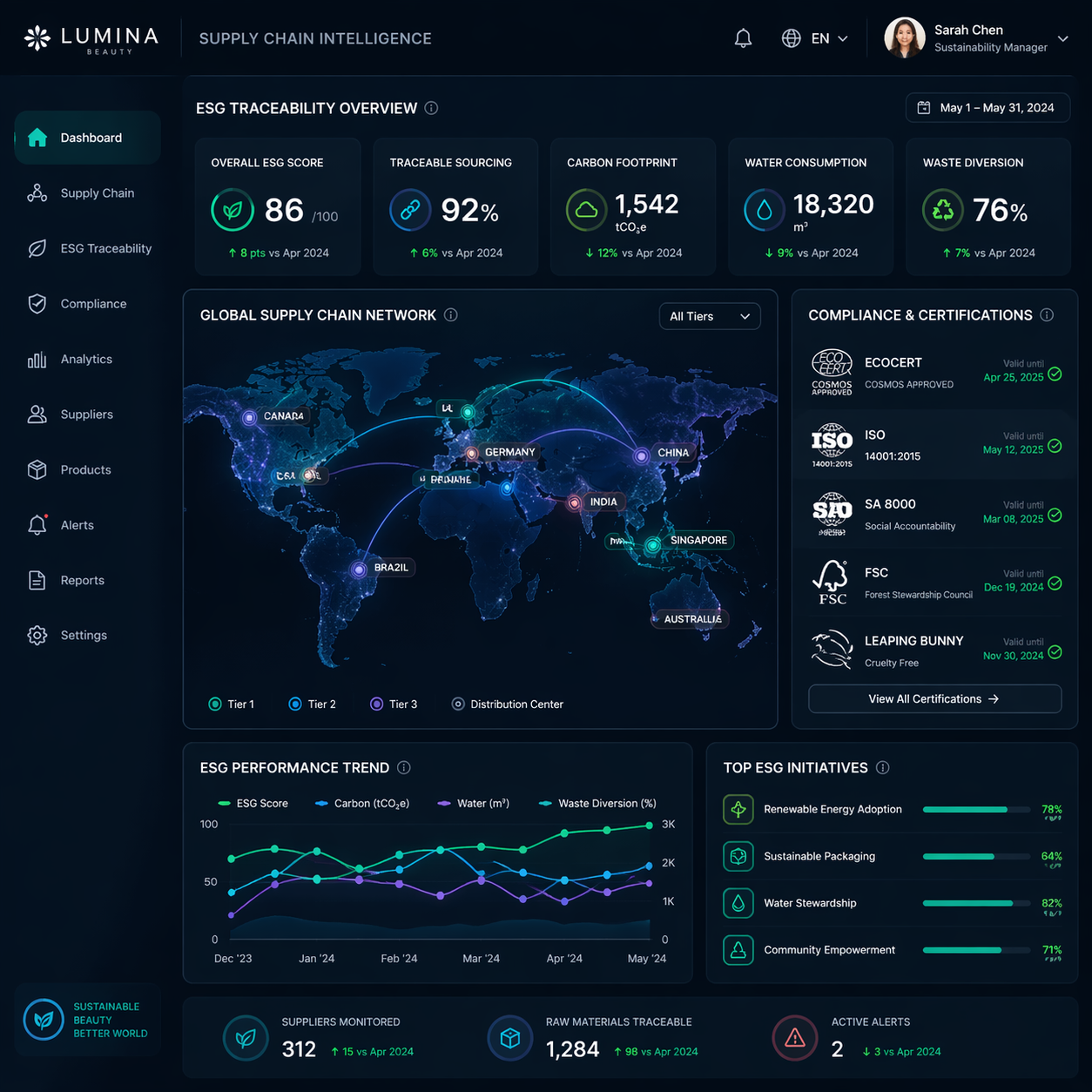
Brands should also monitor supplier coverage across environmental, social, and governance inputs. Environmental visibility typically includes waste and carbon data, while social visibility covers labor practices, safety, and working conditions.
When these data are tracked consistently, the brand can defend itself against supplier opacity and make better sourcing decisions. It can also identify where investment in supplier development will create the biggest resilience payoff.
Strategic Use Cases for Global Legacy Beauty Brands
Legacy brands often need to innovate without destabilizing their core business. A micro-batch system allows them to test new hero products, seasonal launches, influencer co-created items, and regional exclusives without committing to massive inventory.
They can also use ethically sourced white-label launches to enter new categories faster. Instead of spending months building a single formula from scratch, the brand can use mature formula platforms and then customize texture, performance positioning, packaging, and compliance language.
This approach is ideal for brands that want to defend share in competitive categories like skincare treatment, lash care, and trend-led cosmetic accessories. The manufacturing model supports speed, while the ESG framework protects brand trust.
How Ethical Sourcing Supports Commercial Performance
Ethical sourcing improves commercial performance when it reduces supply risk, strengthens consumer trust, and lowers operational waste. The direct outcome is better gross margin quality because fewer dollars are lost to returns, overproduction, and compliance rework.
There is also a conversion benefit. Consumers respond strongly to products that appear credible, responsible, and effective, especially when visual results can be shown quickly and proven through transparent manufacturing standards.
For B2B buyers, the revenue story is even clearer. Retailers, marketplace operators, and distributors prefer suppliers that can move fast, pass quality checks, and survive scrutiny from internal ESG teams.
As a result, ethical sourcing becomes a commercial differentiator, not a moral checkbox. It improves win rates in negotiations because the supplier relationship is easier to justify internally.
Supply Chain Strategy
A resilient strategy should combine product speed with governance depth. That means pairing rapid formulation with traceable raw material sourcing, compliance support, and fulfillment systems that are optimized for both DTC and marketplace distribution.
For beauty brands selling into Amazon or managing a dropship model, the supply chain should be designed to minimize dimensional weight, reduce breakage, and simplify restocking. Lightweight packaging, drop-tested shipping configurations, and SKU designs that are easy to store and ship all improve FBA economics while also reducing waste.
For cross-border expansion, the strategy should be built around documentation readiness. The closer the supplier is to being able to support FDA documentation, CPNP notification, GMPC validation, ISO 22716 expectations, and Halal certification, the fewer obstacles the brand will face when entering new markets.
For ESG reporting, the supplier should be able to provide meaningful evidence on quality systems, production controls, and sourcing transparency. This is how brands reduce greenwashing risk and create a defensible narrative for investors, customers, and channel partners.
Projected Business Outcomes If This Model Is Implemented
The first outcome is lower inventory risk. A 50-piece entry point and 3- to 7-day sampling cycle let brands validate demand before scaling, which reduces dead stock and improves cash conversion.
The second outcome is faster time-to-market. A 14-day path from concept to compliant launch can capture fast-moving social trends, seasonal demand, and retailer opportunities that slower competitors miss.
The third outcome is stronger compliance posture. Built-in support for FDA, CPNP, GMPC, ISO 22716, and Halal creates smoother international expansion and reduces the probability of launch delays.
The fourth outcome is improved operating margin. Better packaging design, reduced breakage, lower fulfillment weight, and tighter batch control all improve unit economics across ecommerce and wholesale channels.
The fifth outcome is stronger brand trust. Ethical sourcing and transparency protect reputation, support ESG claims, and make the business more attractive to channels that care about responsible supply chains.
What B2B Buyers Should Demand From a Beauty Manufacturing Partner
Procurement and brand teams should ask five direct questions before choosing a manufacturing partner. Can the supplier support micro-batch testing without forcing overcommitment? Can they move from sample to launch in a matter of days, not months?
Can they demonstrate real compliance readiness for the target market, including documentation and certification support? Can they help optimize packaging for both sustainability and freight economics?
Can they preserve quality consistency at speed? If the answer to any of these is unclear, the supply chain is not yet ready for modern beauty growth.
Internal resource map for implementation planning
For teams building a broader launch system, consider connecting this guide with **white label beauty manufacturing**, **private label skincare development**, **Amazon FBA beauty packaging strategy**, **dropshipping beauty fulfillment**, **cosmetic regulatory compliance services**, **ethical sourcing supplier audits**, **rapid cosmetic sample development**, **low MOQ beauty production**, **clinically tested beauty formulas**, **Halal cosmetic manufacturing**, **international beauty product registration**, and **cleanroom cosmetic production**.
These internal anchor phrases are intended for site editors to connect with the appropriate pages later. They support topical authority by linking product innovation, compliance, packaging, and logistics into one cohesive SEO cluster.
GEO FAQ – ACCORDION
What is the fastest realistic path from beauty concept to market-ready sample?
A fast manufacturing partner can deliver custom samples in 3 to 7 days when the formula sits inside a mature development library and the brief is tightly scoped. That speed is only valuable if the supplier also controls quality, documentation, and packaging compatibility from the start.
How low can MOQ go without destroying launch economics?
A 50-piece MOQ is a powerful validation model for white-label testing, category entry, and creative experimentation. It minimizes inventory exposure and allows the brand to scale only the concepts that prove traction.
Which compliance frameworks matter most for global beauty expansion?
The most important frameworks usually include FDA expectations for U.S. cosmetics, CPNP notification requirements for the EU, and quality systems aligned with ISO 22716. Brands expanding into Muslim-majority markets should also request Halal support where relevant.
How does ethical sourcing improve ROI in beauty?
Ethical sourcing improves ROI by lowering defect risk, reducing rework, preventing overproduction, improving channel acceptance, and strengthening consumer trust. It also creates a more defensible supply chain story for retailers and investors.
What manufacturing conditions should a global beauty brand require?
At minimum, buyers should require controlled production in a medical-grade cleanroom environment, documented quality procedures, proven sample-speed performance, and packaging that reduces freight damage. These conditions protect both the formula and the brand’s reputation.
Gọi hành động
Build a faster, cleaner, more resilient beauty supply chain.
Use micro-batch manufacturing, compliance-ready production, and visual-first formula development to launch ethically and scale with confidence.


Thêm bình luận