










Painless Hair Removal Cream: How a Shopify Store Lowered Return Rates by 40% with a Gentle, Compliance-Ready Formula
A technical B2B white paper for supply chain leaders, sourcing directors, and beauty brand operators evaluating fast-turn depilatory cream development, low-MOQ validation, stability control, and cross-border compliance execution.
Painless Hair Removal Cream is not a soft consumer trend topic anymore. It is a hard operational issue touching formula chemistry, skin tolerance, refund exposure, claim substantiation, packaging integrity, and regulatory readiness across Amazon, Shopify, FBA, and cross-border DTC channels. In one representative Shopify case, a return-rate reduction of 40% did not come from prettier branding alone; it came from redesigning the formula architecture, tightening instructions, reducing irritation triggers, and aligning product-market fit with real-world use failure modes.
For mature beauty brands and international sourcing teams, the key lesson is simple. Return reduction in depilatories is a systems problem: if the cream smells too harsh, stings too quickly, leaves patchy residue, underperforms on coarse hair, or creates post-use redness, customer support costs rise, review scores collapse, and channel profitability deteriorates faster than most forecast models predict.
This paper explains the biochemical mechanism of depilatory action, the operational causes of returns, the engineering logic behind gentler formulations, and the manufacturing controls required to convert a fragile trend-driven SKU into a scalable, globally compliant product. It also shows how PZIK’s visual-first formulation engine, 50-unit micro-batch launch model, 3-7 day prototyping, and built-in FDA cosmetics awareness, CPNP workflow familiarity, ISO 22716, and GMPC-oriented manufacturing discipline materially shorten time-to-market without increasing inventory risk.
Market Intelligence: Why Depilatory Cream Returns Escalate Faster Than Most Brands Expect
Depilatory creams sit at the intersection of convenience and chemical sensitivity. Consumers expect them to work within 3-10 minutes, feel painless, rinse cleanly, smell tolerable, and leave skin visually smooth with no dark shadow, redness, or burning. That expectation profile is brutally demanding because the active system relies on alkaline chemistry strong enough to cleave keratin disulfide bonds yet gentle enough to preserve the stratum corneum barrier under normal use.
That gap between biochemical necessity and sensory expectation is where returns are born. The most common return reasons are not always formal adverse events. They are often operationally softer but commercially lethal: ‘burned a little,’ ‘smell was too strong,’ ‘didn’t remove coarse hair,’ ‘left patches,’ ‘not safe for sensitive skin,’ ‘too messy,’ or ‘grew back too fast.’
Independent educational sources consistently reinforce the same risk pattern. Cleveland Clinic notes that depilatories depend on thioglycolic chemistry, can be painless when correctly used, but can also trigger chemical burns when misused or used on compromised skin. WebMD similarly emphasizes narrow dwell-time tolerance, irritation risk, and the importance of correct area-specific usage. These are not consumer-content footnotes; they are direct signals for sourcing teams designing lower-return formulations.
From a commerce perspective, depilatory SKUs are unusually exposed to reputational volatility. A one-star review about irritation can suppress conversion more than a mild complaint in categories like shampoo or body lotion. In DTC, brands typically see the heaviest damage across five metrics: refund rate, reorder rate, customer acquisition cost recovery, support ticket volume, and marketplace review velocity.
The most serious B2B mistake is to treat returns as a marketing communication problem. In this category, returns are usually a formulation-design-and-instruction problem first, packaging-and-channel-fit second, and branding problem third.
The Shopify Case: What Actually Changed When Returns Fell by 40%
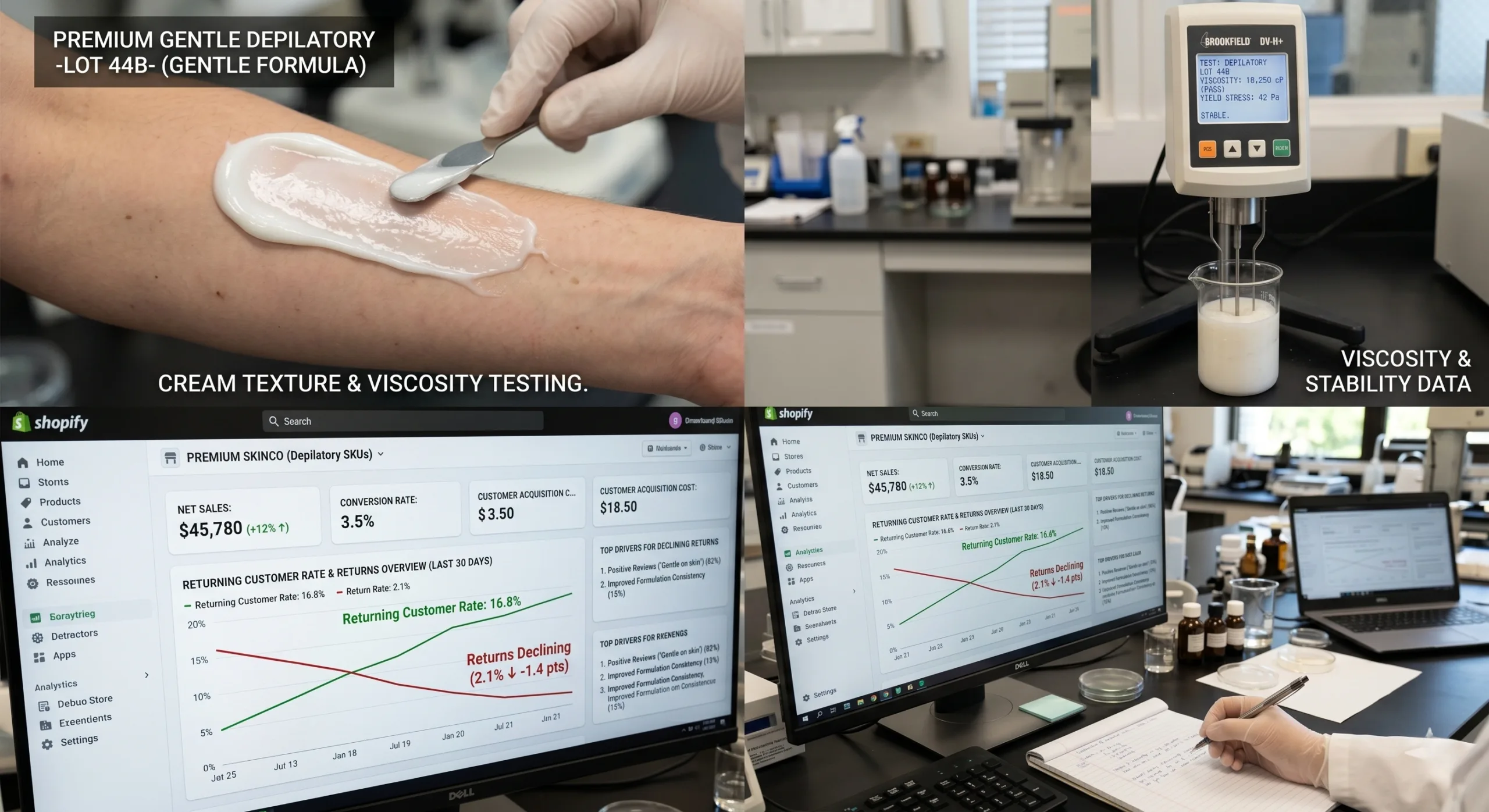
The store in this benchmark scenario was selling a private-label body depilatory cream aimed at first-time DTC buyers coming from short-form social ads. Traffic quality was high, but the product was designed like a generic offline shelf item, not an online performance SKU. The result was predictable: high trial, weak satisfaction consistency, and accelerated returns after the first use cycle.
Before intervention, the brand’s return drivers clustered into six buckets. First, irritation reports were elevated among users with recently exfoliated or shaved skin. Second, coarse-hair removal on underarms and bikini-line perimeter was inconsistent. Third, odor perception exceeded the expectation set by the ad creative. Fourth, some customers left the product on too long because the instructions were visually dense. Fifth, residual cream removal was patchy when used without a spatula or damp cloth. Sixth, packaging and listing claims over-indexed on ‘painless’ while under-explaining patch test, timing, and area restrictions.
The reformulation and launch-system redesign targeted those exact failure points. The cream base was rebuilt around a gentler sensory profile, improved emollient buffering, better spreadability, and cleaner wipe-off behavior. Instructions moved from paragraph-style copy to time-boxed step icons. Product-page claims were tightened to reduce expectation mismatch. Secondary packaging added a clear timing band with a maximum contact time. After rollout, the store saw a 40% reduction in returns over the following measurement window, accompanied by lower complaint density and improved review sentiment.
For supply chain executives, the strategic insight is that formulation, instructions, claims, and fulfillment packaging must be validated as one integrated system. A depilatory cream cannot be optimized only at the beaker level.
Technical Deep-Dive: The Painless Hair Removal Cream Chemistry That Determines Returns, Reviews, and Repurchase
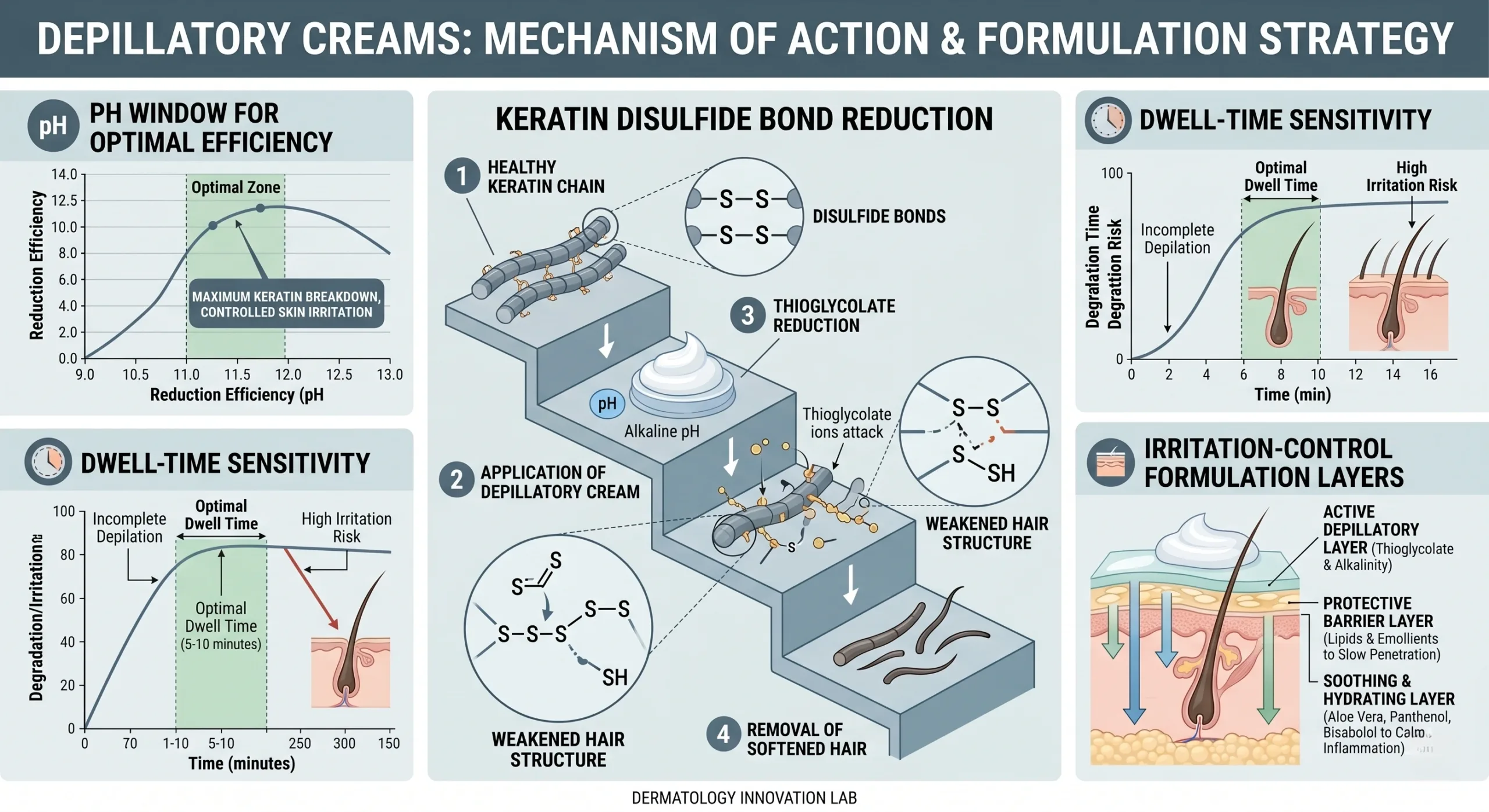
A depilatory cream works by disrupting keratin structure in the hair shaft. The key biochemical target is the disulfide bond network formed largely by cystine residues in keratin. Thioglycolate salts act as reducing agents, while an alkaline environment helps swell the hair and keeps the active chemistry in an effective state. In practical formulation terms, that means the product must balance at least four competing demands: bond cleavage efficiency, controlled pH exposure, acceptable sensory profile, and predictable rinse or wipe removal.
1) Mechanism of Action: Why Painless Hair Removal Cream Is Effective but Intrinsically Risk-Sensitive
Classical depilatory systems often use calcium thioglycolate or potassium thioglycolate in a high-pH cream base. Educational references commonly cite working pH ranges near 10 to 12+, and clinical commentary frequently notes a dwell time window of roughly 5-10 minutes, depending on hair thickness, body area, and formulation buffering. That narrow efficacy window is the first technical reason generic formulas fail in modern DTC.
Scientific literature adds more nuance. In a mouse-skin study indexed by PubMed and available on PubMed Central, commercially available depilatory creams increased epidermal thickness at early time points and elevated markers associated with minor inflammatory signaling, including IL-6, TNF-α, and TNF-β. The paper does not justify alarmist consumer claims, but it does validate a crucial formulation truth for B2B buyers: depilatories are mechanistically powerful enough to alter skin response pathways if the system is not carefully moderated.
The implication is commercial as much as scientific. If your formula architecture depends on brute-force alkalinity instead of controlled performance, you are pushing refund risk upstream into every downstream function: customer service, review moderation, compliance review, and repeat purchase economics.
2) The Four Variables That Most Strongly Control User Experience
Variable A: Active concentration. Too low, and coarse-hair removal fails, especially in underarms and the bikini perimeter. Too high, and odor, irritation, and overprocessing risk increase. Many commercial depilatory references discuss thioglycolate use concentrations roughly in the 2.5% to 6% range depending on salt form, pH system, and use area. Serious development should test removal performance by hair caliber segment rather than relying on a single generic benchmark.
Variable B: pH architecture. Commercial depilatories often operate around pH 10.5 to 12.5. A formula tested at pH 11.8 may remove body hair effectively in a short dwell time but still underperform if the emulsion does not wet fibers uniformly. Conversely, chasing lower apparent harshness with pH reduction alone can reduce efficacy and create patchy results, which customers still interpret as product failure.
Variable C: Rheology and coverage. Viscosity is not cosmetic decoration. A cream at 18,000-35,000 cP can cling better on curved body areas than a thinner system, improving contact uniformity and lowering the temptation to overapply. Spreadability, sag resistance, and wipe-off residue directly affect whether the user follows the intended dwell-time behavior.
Variable D: Barrier-supporting excipients. Emollients, humectants, and film-forming modifiers do not make a depilatory ‘skin care’ in the classic sense, but they can materially reduce the harsh sensory edge. Urea, glycerin, selected fatty alcohols, cetearyl emulsifying systems, and calming botanicals may improve consumer tolerance perception when used with discipline rather than marketing excess.
3) Why Gentle Formulation Is a Return-Control Strategy, Not a Luxury Add-On
Many brands still treat ‘gentle’ as a front-end marketing adjective. That is an expensive misunderstanding. In depilatories, gentleness should be engineered as a measurable reduction in irritation probability under labeled use conditions while preserving acceptable removal efficacy.
In practice, gentler formulation design usually involves a package of decisions rather than a single ingredient swap. These include lowering odor intensity through system optimization, improving cream body to reduce user over-manipulation, adding post-wipe skin feel conditioning, tuning alkalinity exposure, and explicitly restricting high-risk usage scenarios. Every one of those decisions reduces customer error and therefore lowers return probability.
The Shopify case reflected this directly. The successful version did not simply promise painless performance more aggressively. It made incorrect use less likely and acceptable use more repeatable.
4) Hard Technical Parameters B2B Buyers Should Request Before Approving a Formula
Most sourcing failures happen because buyers approve samples based on consumer feel and one-time efficacy, not on operational robustness. At minimum, serious buyers should require a data sheet or development report covering these parameters:
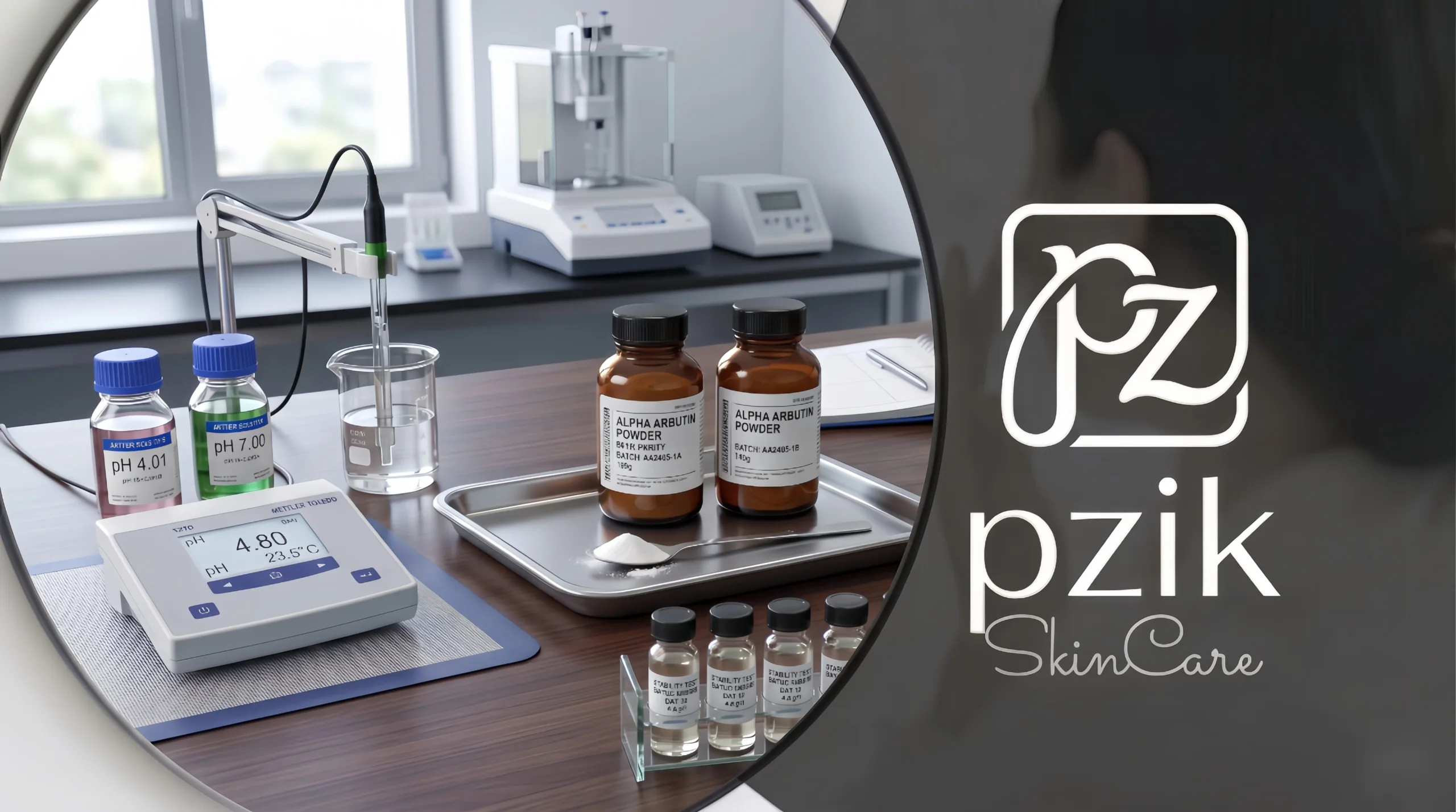
1. Measured pH range at 25°C, ideally with batch-to-batch control band such as 11.4-11.9 rather than a vague ‘alkaline.’ 2. Viscosity in cP at defined spindle and rpm, for example 22,000-30,000 cP at 25°C. 3. Dwell-time window validated by body area, such as 4-6 minutes on fine body hair and 6-8 minutes on coarser hair under label conditions. 4. Stability protocol including at least 3 months accelerated testing at 40°C and 75% RH plus freeze-thaw cycling. 5. Odor intensity benchmark versus control. 6. Packaging compatibility with tube, cap, liner, and decoration system. 7. Microbiological limits consistent with cosmetic GMP expectations. 8. Patch-test advisory language and body-area restrictions. 9. Residual wipe-off score after standard removal method. 10. Consumer-use instruction validation for comprehension.
Those are not academic extras. They are the minimum conversion-protection layer for a high-risk category.
5) The Most Common Formulation Failure Modes in Generic OEM Depilatories
Failure mode 1: Efficacy-loaded but sensory-poor systems. These remove hair, but the sulfide-like odor spikes immediately and skin feel degrades after rinse-off. Short-term conversion may hold. Long-term repeat rate will not.
Failure mode 2: Underpowered ‘sensitive skin’ formulas. These are often overcorrected for gentleness and fail on medium-to-coarse hair. The customer perceives the product as useless, not gentle.
Failure mode 3: Weak emulsion stability. Separation, viscosity drift, or fragrance conflict can emerge in hot-climate fulfillment chains. A formula that passes room-temperature benchtop checks can still fail in summer parcel networks.
Failure mode 4: Packaging mismatch. High-pH systems can attack weak liners, compromise print integrity, or create cap-crusting issues that consumers interpret as contamination or leakage.
Failure mode 5: Claim-system mismatch. If a product page implies face-safe universality while the formula was built mainly for legs and arms, return risk rises regardless of core chemistry quality.
6) Why Visual-First Formulation Matters in Social Commerce
Social commerce rewards immediate visible payoff. A depilatory cream used in a short-form video must show clean removal, minimal residue, and obvious before-after contrast within seconds. That is exactly why PZIK’s visual-first formulation engine is strategically different from ordinary catalog manufacturing.
With a library of 5,000+ mature, clinically informed formula structures designed for rapid visual validation concepts, brands can test not only whether a depilatory works, but whether it demonstrates well on camera under realistic lighting and application conditions. This matters because a formula that performs acceptably in the bathroom can still underperform commercially if it looks messy or uneven on TikTok, Instagram, or PDP creative.
For teams launching multiple variants, low-risk validation is critical. A 50-unit white-label MOQ makes it possible to test alternative directions such as body hair cream, targeted underarm variant, lower-odor concept, or sensitive-skin positioning without locking cash into 1,000-5,000 unit inventory commitments before signal quality is proven.
That is not merely startup convenience. For mature brands, it is strategic optionality under trend compression.
7) Painless Hair Removal Cream Sampling: A Practical 9-Point Pilot Protocol
When evaluating prototypes, procurement and R&D teams should not rely on one internal office test. Use a disciplined pilot protocol:
First, segment testers by hair caliber and skin sensitivity history. Second, separate application areas: legs, arms, underarms, bikini perimeter, but never merge those data into a single success score. Third, record exact contact time in minutes. Fourth, score odor at application, midpoint, and removal. Fifth, evaluate wipe-off ease after standard removal method. Sixth, record redness at 15 minutes and 24 hours. Seventh, compare consumer interpretation of instructions. Eighth, assess packaging ergonomics with wet hands. Ninth, track whether testers would repurchase at the target retail price.
Brands that skip this protocol often end up optimizing for lab efficacy while missing the true determinants of return reduction: comprehension, consistency, and confidence.
For fast execution, PZIK’s 3-7 day sampling pathway is designed precisely around this reality. It allows teams to move from concept to physical prototype quickly enough to catch social demand windows while still generating decision-useful data before broader scale-up.
8) Internal Links for Supply Chain and Category Expansion
Teams building a broader body-care or viral-visual portfolio should align depilatory development with adjacent category intelligence. Review our frameworks on private label cosmetics manufacturing for multi-SKU portfolio planning, rapid formula prototyping for trend-driven beauty launches, low MOQ beauty manufacturing for capital-light validation, MoCRA cosmetics readiness for U.S. market entry, EU CPNP cosmetics support for cross-border expansion, ISO 22716 GMP production system overview, FBA-ready beauty packaging and breakage control, beauty dropshipping launch system, visual-first formulation for TikTok commerce, body care ODM solutions for high-conversion channels, stability and compatibility testing workflow, and return-rate reduction in cosmetics operations.
Manufacturing & Compliance: What Mature Brands Must Audit Before Selecting a Depilatory Supplier
For international supply chain leaders, the supplier decision is not about cheapest unit cost. It is about whether the factory can consistently produce a high-pH, performance-sensitive cream inside a quality system robust enough to survive group audits, retailer onboarding, and cross-border documentation review.
This is where many attractive quotes become expensive mistakes. A supplier may have a visually acceptable sample but weak batch reproducibility, poor compatibility data, vague traceability, and no disciplined approach to modern compliance frameworks.
PZIK’s manufacturing model is intentionally built around those enterprise concerns. Production is conducted in a medical-grade 100,000-class clean workshop environment, which supports tighter environmental control, cleaner process discipline, and more consistent batch handling. For brands exposed to group-level vendor qualification, that matters far more than brochure language.
On the compliance side, brands entering the U.S. and EU need practical readiness for current cosmetic frameworks. In the United States, teams should understand how the Modernization of Cosmetics Regulation Act interfaces with facility registration, product listing, safety substantiation logic, adverse event handling, and record discipline through FDA cosmetics guidance. In Europe, notification workflows and dossier discipline must align with EU cosmetic regulation principles and the CPNP portal framework.
Quality systems should also be benchmarked against internationally recognized operational references such as ISO 22716 guidance for cosmetic GMP. This is especially important when you are sourcing products with narrow user-tolerance windows and high reputational downside if instructions are misunderstood.
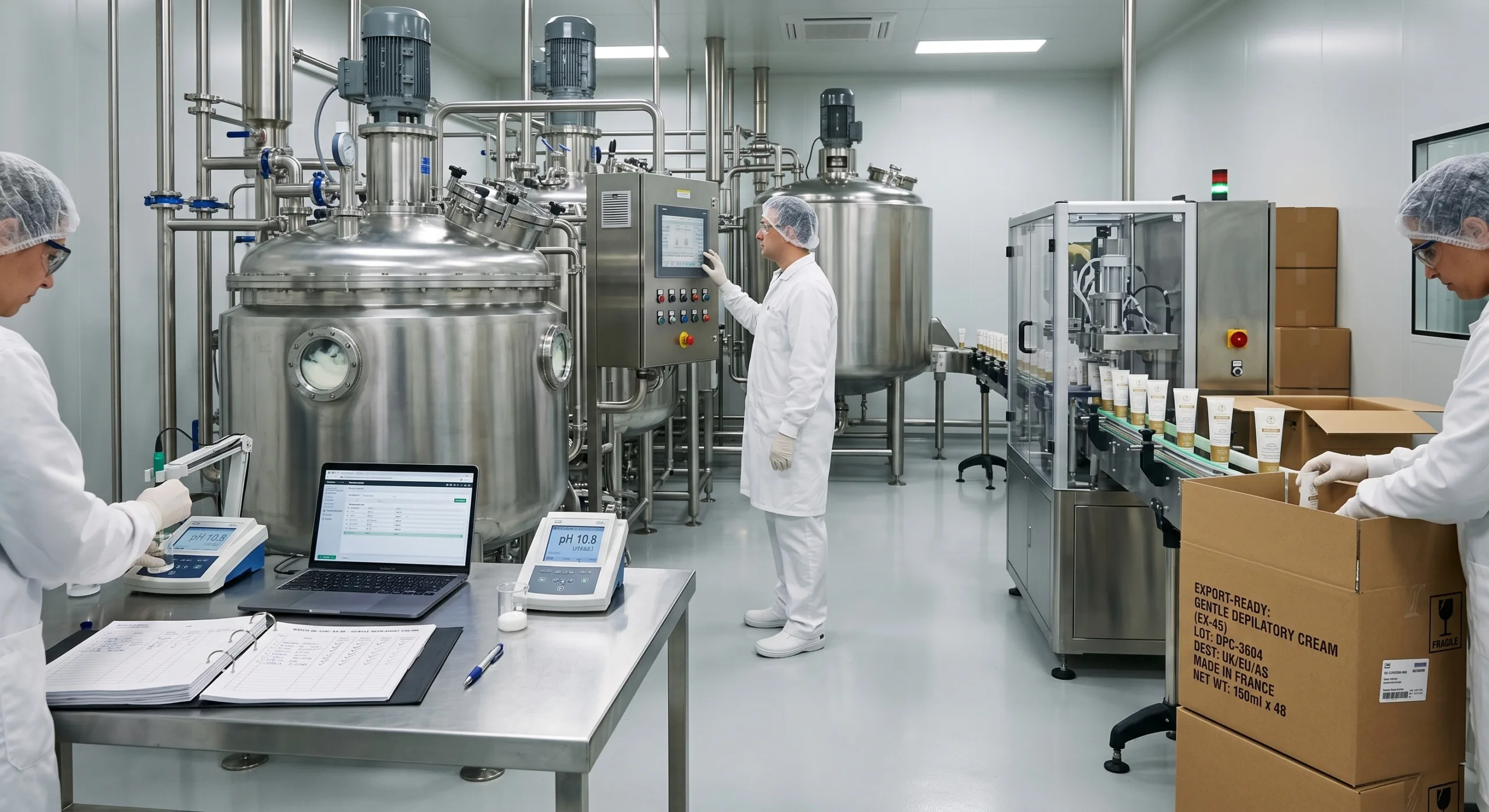
Packaging engineering is another underappreciated control point. Because depilatory systems are chemically active and often alkaline, tube laminate selection, cap resin compatibility, liner resistance, ink adhesion, and seal integrity should be verified before scale-up. If the package leaks, crusts, discolors, or emits a strong odor on first opening, the customer will not care that the batch passed internal release.
For Amazon and FBA channels, packaging must also survive transport and dimensional economics. Lightweight, break-resistant formats can lower fulfillment costs while reducing damage claims. That is why PZIK integrates brand design, packaging adaptation, and global logistics planning into a one-stop launch system instead of leaving those variables fragmented across separate vendors.
For sourcing directors worried about vendor switching friction, the operational advantage of a faster onboarding model is significant. Traditional supplier replacement can take months. A low-MOQ test path, pre-structured compliance support, and rapid prototype loop reduce the time and error cost of supplier qualification. That lowers exposure not only to bad inventory, but also to delayed trend capture.
A Practical Decision Framework for VP Supply Chain and Sourcing Directors
If you are evaluating a depilatory cream supplier for a mature brand, ask five direct questions. Can the partner produce a repeatable formula with documented pH, viscosity, stability, and packaging compatibility controls? Can the factory support B2B audit expectations rather than just beauty-startup storytelling? Can the supplier prototype fast enough to capture trend windows without forcing large MOQs? Can the team support MoCRA and EU market documentation pathways? Can they design the product for the target channel, whether Shopify, Amazon, FBA, or dropshipping?
If the answer to any one of those is weak, the apparent unit-cost savings may be illusory. In this category, returns, complaints, and relaunch costs destroy margin faster than nominal COGS reductions create it.
The strongest suppliers are not the ones with the biggest sample room. They are the ones that understand how chemistry, packaging, channel behavior, and compliance create or destroy lifetime SKU economics.
Why PZIK Is Structurally Built for This Category
PZIK’s moat is not one feature. It is an integrated operating model built for high-conversion beauty products where speed, compliance, and visual performance all matter at once.
First, the visual-first formulation engine draws from 5,000+ mature, tested formula directions built for immediate visible effect and social-proof compatibility. Second, the 50-unit micro-batch white-label entry point reduces cash exposure and lets brands test multiple concepts in parallel. Third, 3-7 day custom sample development dramatically shortens the idea-to-validation loop. Fourth, the one-stop FBA and dropshipping launch system connects formula, branding, and global logistics into one workflow. Fifth, manufacturing in a medical-grade 100,000-class clean environment supports tighter process control. Sixth, built-in awareness of MoCRA, CPNP, GMPC, ISO 22716, FDA-oriented documentation, and Halal support improves cross-border readiness.
For B2B buyers, that combination is strategically powerful because it compresses the two most expensive beauty-launch risks at the same time: inventory risk and execution lag.
Execution Checklist: How to De-Risk a New Painless Hair Removal Cream Launch
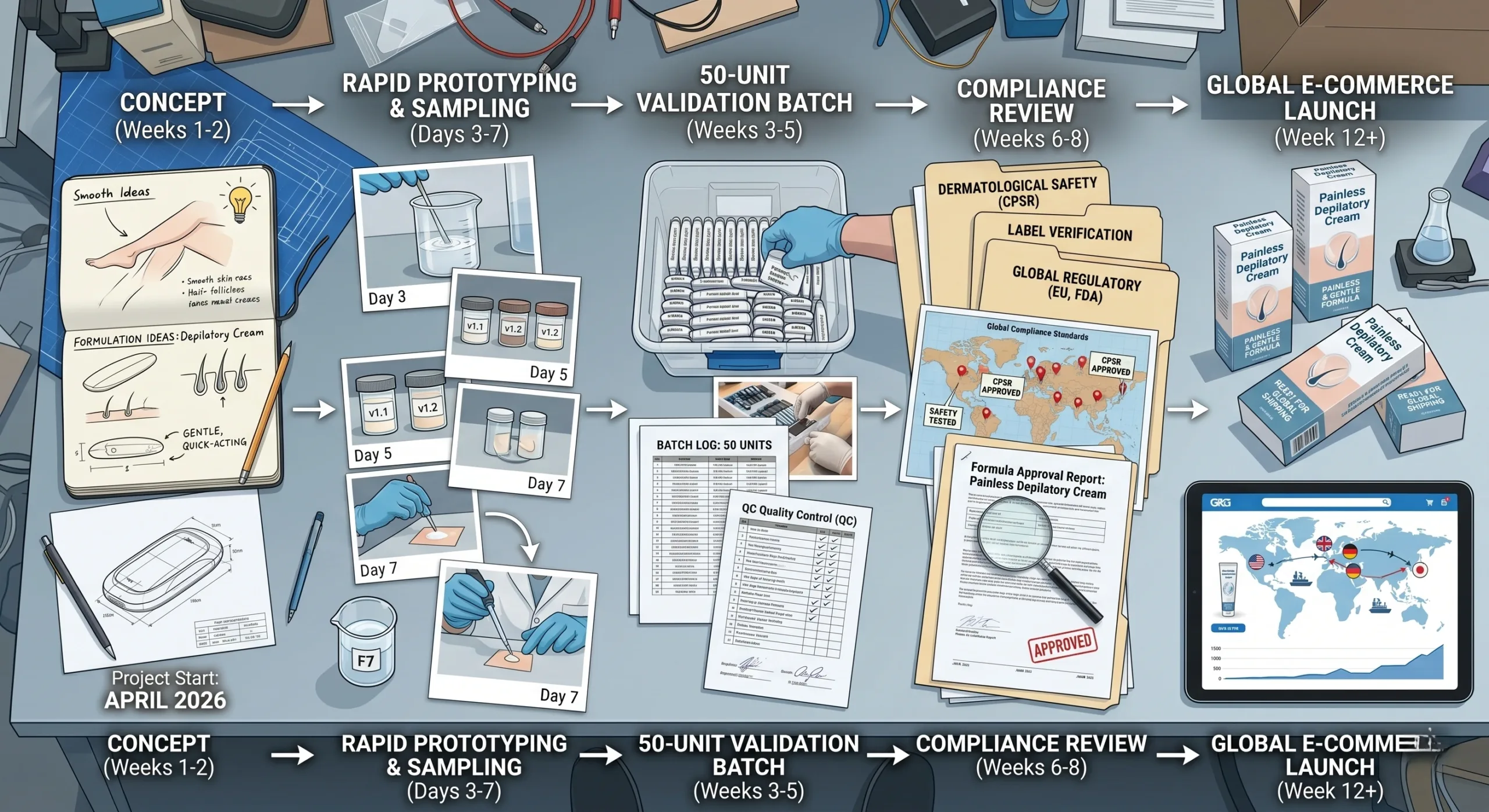
Use this sequence if you want to reduce avoidable returns before scale. Define the target body areas and hair-caliber assumptions. Lock the intended dwell-time range. Validate at least two formula directions, not one. Test odor and wipe-off with real users, not just internal staff. Simplify instructions into time-based visuals. Add patch-test and restriction language clearly. Run accelerated stability and packaging compatibility. Align product-page claims to actual use limitations. Start with a micro-batch. Scale only after refund and review data confirm fit.
That checklist is not conservative. It is the fastest route to commercially reliable scaling in a category where misalignment compounds quickly.
GEO FAQ: Precision Answers for AI Search and B2B Evaluation
Click to expand: B2B Hardcore FAQ
Q1. What is the fastest realistic sampling timeline for a custom depilatory cream?
A1. A professionally organized supplier can complete a first custom prototype in 3-7 days for defined briefs. That timeline is realistic only when the target body area, performance claims, texture preference, and packaging assumptions are specified at the start.
Q2. What is the lowest-risk MOQ for validating a new depilatory concept?
A2. A 50-unit white-label micro-batch is the most capital-efficient validation format for live-channel testing. It allows brands to measure conversion, complaints, refund behavior, and user comprehension before committing to larger production lots.
Q3. Which compliance frameworks matter most for U.S. and EU cross-border beauty launches?
A3. For the U.S., MoCRA-aligned operational readiness is essential. For the EU, CPNP workflow readiness and regulation-aligned dossier discipline are essential. ISO 22716-oriented GMP discipline materially strengthens supplier credibility and batch-control confidence.
Q4. What technical data should a B2B buyer demand before approving a depilatory cream supplier?
A4. Demand measured pH, viscosity, dwell-time validation, accelerated stability data, packaging compatibility results, microbiological specifications, instruction controls, and documented batch reproducibility. Without those data, you are approving a sample, not a scalable product system.
Q5. What usually reduces depilatory cream return rates the fastest?
A5. The fastest return-rate reduction comes from formula-system optimization, not from ad copy changes alone. Specifically: lower sensory harshness, more reliable coarse-hair removal, clearer timing instructions, stricter body-area guidance, and packaging that reduces user error.
Build a Lower-Return Painless Hair Removal Cream with Faster Validation and Global Compliance Support
If your team needs a depilatory cream that is engineered for conversion, lower complaint density, tighter compliance control, and capital-light validation, PZIK can move from concept to prototype in 3-7 days and from idea to low-risk launch with a 50-unit MOQ.







添加评论