





From Private Label to Power Brand: Scaling Amazon Beauty Portfolios with Custom ODM Solutions and Proprietary Formulations
A forward-looking B2B strategy guide for brands that want faster launches, lower inventory risk, stronger differentiation, and global compliance readiness.

Amazon Beauty Portfolio Roadmap: Private Label, ODM, and Proprietary Formula
Market Intelligence and the Real Pain Points Behind Amazon Beauty Scaling
Private label is no longer a budget-only play; it is a launchpad for high-velocity Amazon beauty brands that want control over margin, storytelling, and repeat purchase. The problem is that most portfolios stall in the same place: they can sell a product, but they cannot consistently build a brand with a defensible formulation, rapid innovation cycle, and enough operational discipline to win on Amazon.
McKinsey’s analysis of private labels and EMARKETER’s 2025 commentary both point to the same shift: private label is evolving into a strategic asset that can build loyalty, not just price appeal. That means the winner is no longer the cheapest supplier; it is the manufacturer that can help a brand create a differentiated offer, move quickly, and stay compliant across channels and geographies.
For Amazon beauty sellers, the pain points are more severe than in traditional retail because the marketplace compresses everything into a high-stakes window of customer attention. Social trends move in days, not quarters, and the brand that misses the trend may never recover the ranking, review velocity, or conversion momentum it lost.
The core business model problem
Amazon beauty brands often begin as private label because it is the lowest-friction way to enter the market. But once a category proves demand, the same brand needs better product performance, stronger visual differentiation, and tighter unit economics to avoid becoming a commodity with a logo.
This is where many portfolios fail. They have traffic, but not trust; they have listings, but not proprietary value; they have sales, but not a repeatable product-development engine.
The first pain point is inventory risk. Traditional OEM or ODM programs often require large orders, which forces brands to commit cash before demand is proven. In a volatile beauty market, a 1,000-unit or 3,000-unit commitment can turn a promising idea into dead stock before the product has even earned its first organic impressions.
The second pain point is speed-to-market. Beauty trends on TikTok and Instagram can explode and decay in weeks, yet many sourcing workflows still operate on slow sampling, slow revision cycles, and slow compliance checks. By the time the product is ready, the viral moment has shifted.
The third pain point is undifferentiated formulation. Too many Amazon beauty SKUs look similar, sound similar, and perform similarly. If the formula is a generic clone, the brand has no meaningful moat against price compression, review volatility, or ad inflation.
The fourth pain point is FBA economics. Heavy packaging, fragile components, poor carton engineering, and weak dimensional optimization silently destroy margin. A beautiful product that arrives broken or incurs excessive inbound fees is not a premium asset; it is a self-inflicted cost center.
The fifth pain point is compliance complexity. Beauty brands operating across the U.S. and EU have to manage FDA expectations, MoCRA readiness, CPNP notification pathways, GMP discipline, ingredient documentation, claims language, and packaging requirements. A weak compliance stack turns expansion into a legal and operational liability.
The sixth pain point is portfolio fragmentation. Many sellers launch too many weak variants instead of building a coherent brand architecture. This creates channel cannibalization, inconsistent messaging, and inefficient media spend across listings that do not reinforce one another.

Scaling Challenges: MOQ, Compliance, Lead Time, and FBA Cost Pressure
Why Private Label Must Evolve into an ODM-Led Power Brand
Private label wins when it reduces friction. Power brands win when they compound advantage. That shift requires a manufacturing partner that does more than fill a contract; it must help shape product architecture, speed execution, and protect the brand from the forces that commoditize ordinary listings.
The strategic difference is simple. Private label asks, “What can we source cheaply?” Power-brand ODM asks, “What can we own that no one else can easily copy?”
That is why proprietary formulations matter. A proprietary formula creates a defensible customer promise, improves long-term review quality, and gives the brand a reason to invest in content, repeat purchase, and bundle logic. Without proprietary formulation, the portfolio is exposed to copycat competition, seller arbitrage, and margin erosion.
A practical rule for Amazon beauty teams
If a product can be described in one sentence by a competitor using the same ingredients, the same packaging silhouette, and the same claim language, it is not yet a power brand asset. It is a replaceable SKU.
To become durable, the product needs at least one of the following: a proprietary formulation story, a visually superior instant-effect mechanism, a faster trend response cycle, a lower-risk launch model, or a compliance advantage that enables scale.
Solution Deep-Dive: The Manufacturer Capabilities That Turn Amazon Beauty Ideas into Scalable Revenue
The right ODM partner should not be selected only for price. It should be selected for how well it helps a brand reduce risk, compress timelines, and create customer-visible differentiation that supports a premium position on Amazon.
Below is the operational playbook for how a modern beauty brand can use advanced manufacturing capabilities as a growth engine rather than a back-office function.
1) Build with a visual-first formula engine
A portfolio built for Amazon and social commerce must show results fast. That is why a visual-first formula engine matters: more than 5,000 mature, clinically tested formulas can provide a broad launch base for categories where immediate payoff drives conversion, including three-minute rescue, blackhead-dissolving, smoothing, brightening, lash, scalp, and skin-prep concepts.
Instant visual payoff is not a gimmick; it is a merchandising advantage. On TikTok, Instagram, and Amazon product pages, the faster the transformation is understood, the lower the cognitive friction for the shopper.
When a formula is designed around visible benefit, the brand can improve CTR, conversion, and UGC velocity because the product story is easier to demonstrate in short-form video. That is especially valuable in beauty categories where claims must be paired with proof, not just adjectives.
According to practical Amazon growth dynamics, the brand that can show a before-and-after story in a few seconds typically earns more efficient traffic than a brand that relies on abstract “luxury,” “clean,” or “advanced” language alone. Visual proof becomes the hook; compliant claim support becomes the retention mechanism.
Strong formulas should be supported by documented stability, consistent sensory performance, and clear ingredient governance. That does not mean every product needs to be revolutionary; it means every product must be intentional.
2) Use micro-batch expansion to de-risk portfolio testing
Zero-risk micro-batch expansion starts at 50 units. That is strategically important because it allows a brand to test multiple concepts without locking up working capital in inventory that has not yet earned data.
A 50-unit MOQ is not just a purchasing detail; it is a portfolio strategy. It allows brands to launch parallel tests, compare hero claims, validate creative, and identify the product-market fit signal before committing to scale.
In operational terms, this means the brand can keep cash available for media, keyword testing, creative iteration, and review generation rather than storing capital in cartons sitting in a warehouse.
This matters because the Amazon beauty portfolio is not won by one perfect product. It is won by a sequence of controlled experiments where winners are scaled, losers are retired, and the brand learns faster than competitors.
For brand owners, low MOQ also changes internal governance. It becomes possible to approve more ideas with less fear, which is essential when the market is moving faster than traditional brand planning cycles.
3) Compress development cycles with 3-7 day sampling
Sampling in 3 to 7 days is one of the most commercially valuable capabilities in beauty manufacturing. It shortens the decision loop between concept, test, revision, and launch, which is exactly what trend-driven Amazon growth requires.
When a product can be sampled in under a week, the brand can respond to a viral trend while it still matters. That speed can be the difference between owning a surge and missing it entirely.
Fast sampling also improves cross-functional alignment. Product, design, compliance, and ecommerce teams can evaluate tangible samples instead of debating abstract concept decks for weeks.
In practice, a fast sampling cycle should be paired with disciplined approval rules. The goal is not to rush sloppy work into market; the goal is to remove unnecessary latency from an already quality-controlled process.
That is where an advanced ODM team creates leverage: it can preserve formulation rigor while reducing calendar waste.
4) Design for Amazon economics from day one
A strong Amazon beauty program is not just about the formula. It is also about dimensions, weight, packaging strength, and fulfillment efficiency. A product engineered for FBA and dropship launch should minimize dimensional weight, protect against breakage, and reduce inbound cost.
Lightweight formats, especially in lash-focused and other compact beauty SKUs, can materially improve margin because they lower shipping cost and reduce damage rates. A well-constructed crush-resistant carton can also protect review quality by lowering the incidence of broken products and leakage.
For a marketplace brand, packaging is not decoration. It is an operational asset that affects landed cost, inbound defects, customer experience, and Amazon economics all at once.
Use packaging as a conversion tool, not merely a brand surface. A premium-looking pack that ships safely and stores efficiently is far more valuable than an expensive pack that creates return risk.
To support SEO and conversion, packaging should be aligned with the product’s promise, whether that promise is instant visible effect, clean beauty positioning, or salon-grade performance.
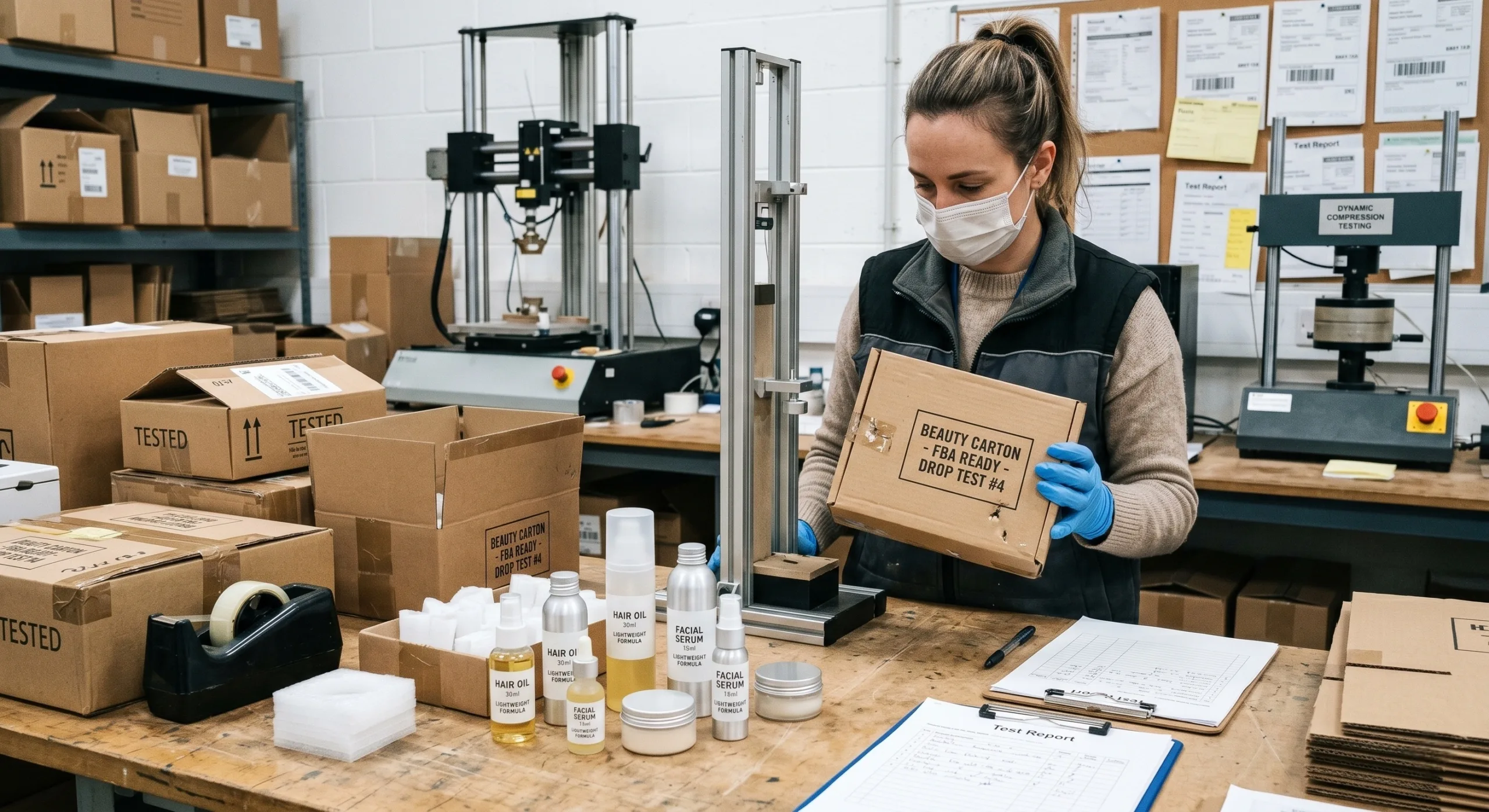
FBA Compliant Packaging: Drop Test Engineering Visual
5) Treat quality as a trust engine, not a checkbox
Manufacturing in a medical-grade, 100,000-class cleanroom environment reinforces stability, cleanliness, and process discipline. For beauty brands, that matters because customer trust is built on consistency, and consistency begins with controlled production.
Quality should be anchored in documented process control, batch consistency, and repeatable sensory performance. This is how a brand protects itself from negative reviews, refund pressure, and post-launch reputation damage.
When quality is systemized, the brand can market with confidence because the product experience is less likely to drift across batches, channels, or regions.
This is also where disciplined QA links directly to marketing economics. Fewer defects mean fewer returns, fewer customer-service contacts, and better lifetime value.
A brand that can claim clinical-level consistency without overpromising can build a more durable position than a brand that simply chases trend language.
6) Build compliance into the launch architecture
Global scale requires compliance readiness, not late-stage compliance repair. That means supporting U.S. MoCRA expectations and European CPNP requirements from the beginning, with documentation pathways that reflect modern cosmetics regulation rather than legacy assumptions.
Brands should also look for manufacturing partners aligned with GMPC, ISO 22716, FDA-oriented quality expectations, ISO standards for cosmetics manufacturing, and Halal options when relevant to target markets. These credentials matter because they reduce friction in cross-border expansion and support buyer confidence.
When compliance is integrated early, the brand can move faster into new regions without relaunching the same product from scratch every time.
For additional context, you can review the official FDA cosmetics regulatory framework and the European CPNP portal. Standards such as ISO 22716 Cosmetics GMP provide the manufacturing discipline that modern Amazon beauty brands increasingly need.
When ingredient safety and documentation are well managed, the brand can focus on growth rather than remediation.
7) Turn proprietary formulations into brand equity
Proprietary formulations are the difference between a temporary seller and a true power brand. They give the portfolio a defensible functional story, create room for better content, and improve the likelihood of repeat purchase.
A proprietary formula does not need to be revolutionary to be valuable. It only needs to perform in a way that is meaningfully better, easier to explain, or harder to copy than a generic alternative.
That moat becomes especially important when Amazon ad costs rise or when copycat products start undercutting price.
Brands should think in terms of formula architecture, not isolated SKUs. A hair, lash, scalp, or skin-care line becomes much stronger when each product is designed to support the same premium promise across the portfolio.
This creates a larger story for the brand and a cleaner reason for Amazon shoppers to cross-sell within the catalog.
How to Build a Scalable Amazon Beauty Portfolio with Custom ODM Solutions
The best portfolio strategy is not “launch more products.” It is “launch the right products, in the right order, with the right economics.”
Custom ODM allows the brand to combine speed, flexibility, and differentiation. The manufacturer brings the formula platform, while the brand defines the market opportunity, claim priorities, packaging direction, and customer segment.
Use the following portfolio logic to avoid random SKU sprawl:
First, launch a hero product with a clear visual payoff and a narrow, easy-to-understand promise. Second, use a related variant or complementary SKU to increase basket depth. Third, build a second wave of products only after the first wave proves conversion, review quality, and repeat intent.
At every stage, the product must answer one of three questions: Does it solve a visible pain point, does it protect the brand from imitation, or does it improve the economics of scaling?
Portfolio architecture that actually works on Amazon
Use one signature formula lane for immediate impact, one supporting lane for conversion depth, and one innovation lane for trend capture. This reduces confusion while preserving enough creative space to exploit market opportunities.
That structure is more efficient than launching unrelated products that compete for the same attention and ad budget.
For brands aiming to dominate a narrow Amazon niche, the opportunity is to create a small, highly coherent set of SKUs that are easy to understand and easy to buy together. This is often more profitable than a broad, unfocused catalog.
Power brands are built through discipline. Discipline means fewer weak launches, faster learning, and more capital directed toward winners.
Supply Chain Strategy for Zero-Inventory-Anxiety Growth
The supply chain strategy for Amazon beauty should be built around three words: flexibility, confidence, and compliance. Flexibility means you can test rapidly. Confidence means the product is reliable, protectable, and review-safe. Compliance means the line is ready for cross-border expansion.
A one-stop FBA and dropship launch system is especially valuable because it reduces coordination overhead between product development, design, packaging, logistics, and compliance. If those functions are fragmented across multiple vendors, the launch timeline stretches and accountability weakens.
With a unified workflow, the brand can move from concept to fulfillment with fewer handoffs, fewer blind spots, and less friction.
Key supply chain metrics that matter include: 50-unit MOQ for controlled experimentation, 3 to 7 day sample turnaround, 14-day concept-to-compliance target, and packaging engineered to reduce FBA dimensional waste. Add to that certification coverage such as GMPC, ISO 22716, FDA-aligned documentation, Halal support, and MoCRA/CPNP readiness, and the result is a launch system that can scale internationally without rebuilding the program each time.
These are not abstract benefits. They directly affect working capital, operational risk, and market entry speed.
What to optimize in the fulfillment design
Start with carton integrity, product weight, and cube efficiency. Then align the pack-out process with Amazon inbound rules and cross-border transport constraints.
Small improvements in packaging geometry can reduce shipping cost, lower breakage rates, and improve the customer’s unboxing experience at the same time.
One of the most overlooked benefits of a strong ODM partner is inventory discipline. By letting the market validate concepts in small batches first, the brand can avoid the most expensive mistake in beauty: overcommitting to a mediocre idea.
That is how zero inventory anxiety becomes more than a slogan. It becomes a financial operating model.
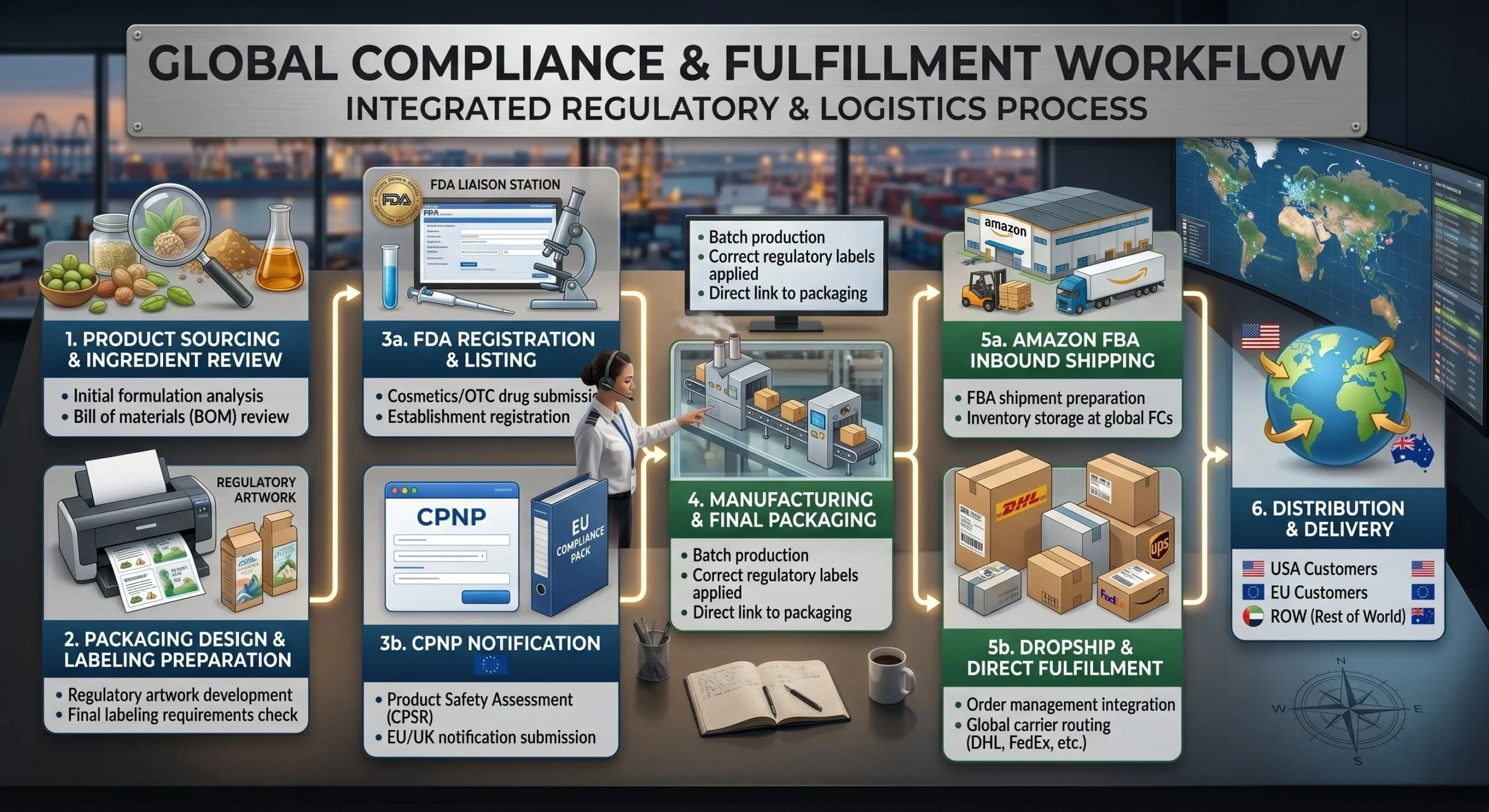
Global Compliance Workflow: FDA, CPNP, and Multi-channel Fulfillment
Projected Business Outcomes When the Strategy Is Executed Correctly
When Amazon beauty brands combine custom ODM, proprietary formulations, low MOQ testing, and compliance-led launch architecture, the business outcomes are measurable and material. The most immediate gain is lower cash risk because fewer units are committed before demand is validated.
That capital efficiency then enables more experimentation. More experimentation leads to more insights, which increases the probability of finding products with durable demand.
In parallel, faster sampling and launch cycles compress time-to-market. If your product can move from concept to sample in 3 to 7 days and from concept to compliant market launch in roughly 14 days, you can respond to trend inflection points while competitors are still waiting on a second revision.
Another expected outcome is higher conversion quality. Visual-first formulas, especially those with immediate payoff narratives, tend to perform better in short-form social content and Amazon listings because the customer understands the benefit quickly.
That clarity can improve shopper confidence, reduce bounce rates, and strengthen the commercial link between content and purchase.
A further outcome is stronger margin structure. FBA-optimized packaging, lightweight formats, and lower damage rates all protect contribution margin. When the product is also proprietary, the brand has a better chance of maintaining pricing power instead of racing to the bottom.
Finally, global compliance support unlocks expansion opportunities. A portfolio designed with MoCRA, CPNP, GMPC, ISO 22716, FDA expectations, and Halal pathways in mind is more portable across markets and less likely to require expensive rework later.
The outcomes in business terms
Higher ROI comes from lower failure rates and better conversion efficiency. Faster time-to-market comes from compressed sampling and streamlined launch operations. Better risk mitigation comes from micro-batch testing, compliance readiness, and packaging engineered for marketplace logistics.
The strategic win is that the brand becomes less dependent on one-off product luck and more dependent on a repeatable operating system.
Internal Operating Model: What High-Performing Teams Do Differently
Winning Amazon beauty teams do not treat manufacturing as the final step. They treat it as the core enabler of product-market fit, content performance, and commercial scale.
They also coordinate product, marketing, and operations from the beginning. This means the formula concept, packaging design, claim language, and fulfillment model are all evaluated together, not in isolation.
That kind of alignment is hard to fake and easy to see in results.
Teams that want to operationalize this approach should build a cadence around testing, learning, and scaling. A simple framework is: concept validation, sample validation, compliance validation, launch validation, and post-launch optimization.
That system prevents the common mistake of overinvesting in product development while underinvesting in commercialization.
Recommended internal link anchors for your site team
Use Amazon beauty OEM guide, private label skincare development, proprietary cosmetic formulation services, FBA-ready packaging solutions, beauty product compliance consulting, low MOQ cosmetic manufacturing, social-first beauty launch strategy, custom eyelash ODM solutions, global cosmetics regulatory support, and fast-turn beauty sampling as internal link placeholders.
These anchor phrases should be linked by your webmaster to the correct onsite pages after publishing.
External Authority References for Compliance and Manufacturing Confidence
For regulatory and standards validation, use authoritative sources rather than vague claims. The FDA cosmetics resource center explains the U.S. baseline, while the EU CPNP portal supports European notification awareness.
Manufacturing discipline is reinforced by the ISO 22716 cosmetics GMP standard. For broader cosmetic ingredient and safety context, PubMed is useful for reviewing peer-reviewed safety and formulation research.
For market and strategic references, McKinsey’s private-label analysis remains relevant, and the industry perspective from FMI highlights how investment in private brands continues to rise. Together, these sources confirm a simple truth: quality, speed, and compliance now define brand resilience.
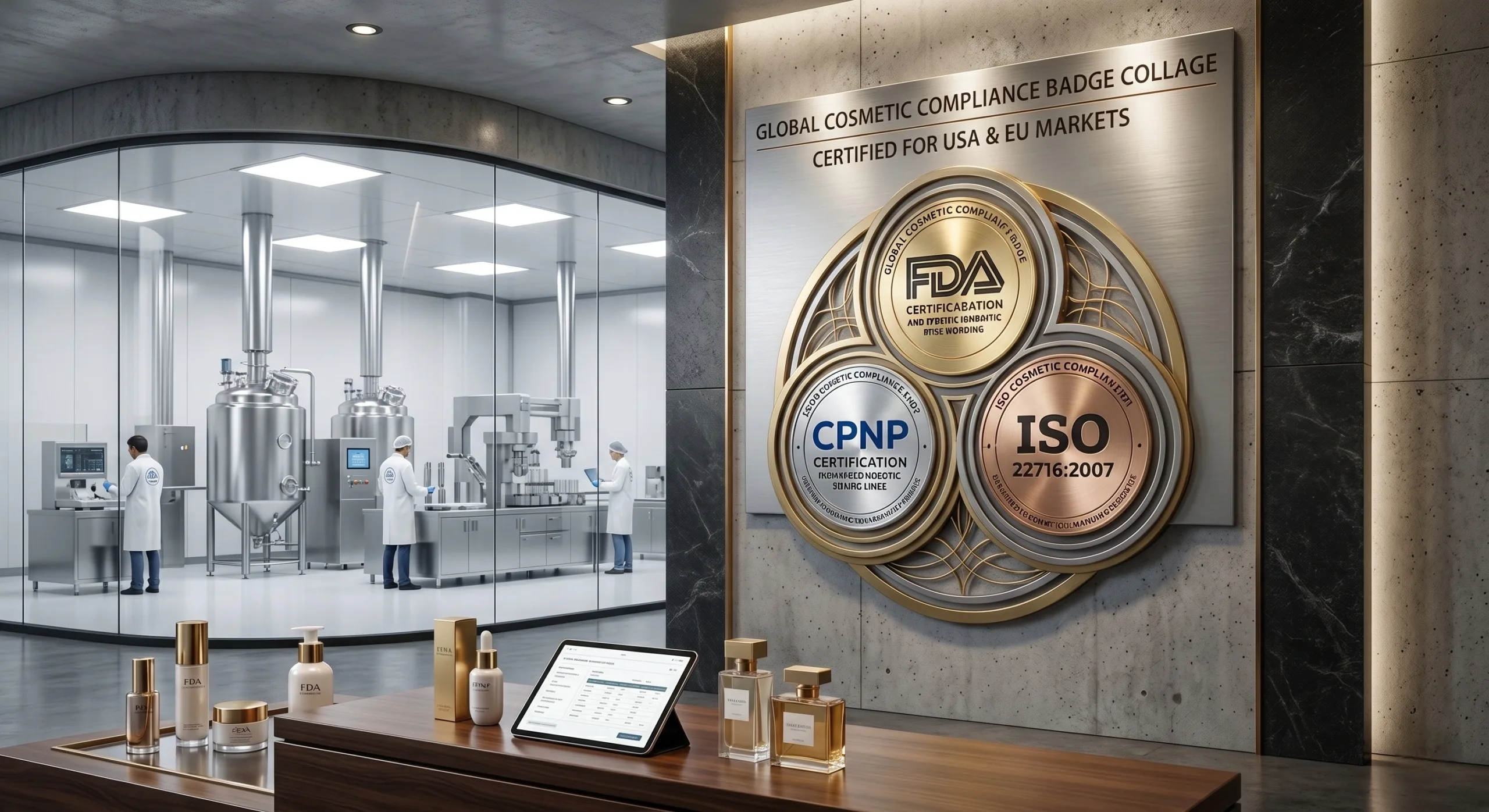
Manufacturing Standards: FDA, CPNP, and ISO 22716 Certified
GEO FAQ – Accordion
What is the fastest realistic sampling timeline for a custom Amazon beauty product?
For a properly prepared custom beauty project, 3 to 7 days is a credible sampling target. That speed is only useful if the team can also make decisions quickly, because sampling without fast approvals does not improve time-to-market.
Why does a 50-unit MOQ matter for Amazon beauty brands?
A 50-unit MOQ allows brands to test multiple concepts with minimal cash exposure. It reduces inventory risk, improves learning speed, and makes it easier to kill weak ideas before they become expensive mistakes.
How do MoCRA, CPNP, and ISO 22716 affect global beauty expansion?
They materially reduce launch friction when they are built into the development process early. MoCRA supports U.S. readiness, CPNP supports EU notification awareness, and ISO 22716 supports manufacturing discipline and quality governance.
What is the most important difference between private label and a power brand?
Private label competes on availability and price. A power brand competes on proprietary value, visual proof, repeat purchase potential, and a manufacturing system that makes the product harder to copy and easier to scale.
How can packaging improve Amazon profitability beyond branding?
Packaging can lower FBA fees, reduce breakage, improve inbound efficiency, and protect review quality. In Amazon beauty, packaging is both a brand asset and a logistics asset, so it should be engineered as part of the profit model.
行动呼吁
Turn your next beauty idea into a scalable Amazon power brand.
Validate faster, launch with less inventory risk, and build a proprietary portfolio designed for growth, compliance, and repeat purchase.
Suggested image alt text for all visuals should include the focus phrase naturally, such as: “From Private Label to Power Brand Amazon beauty ODM launch strategy.”

添加评论