






Hair Removal Cream: 9 Powerful B2B Moves to Win Summer 2026
A technical white paper for beauty supply-chain leaders, sourcing directors, and brand operators building compliant, fast-scaling depilatory lines.
Hair removal cream is moving from a commodity depilatory SKU into a visual-first summer body-care growth engine. For Summer 2026, winning brands will combine fast visible results, irritation-controlled chemistry, verified compliance, and an agile ODM supply chain that can test demand before locking capital into inventory.
- Summer 2026 demand will favor hair removal cream concepts that show a visible before-and-after result in 3 to 8 minutes while protecting the skin barrier.
- The technical moat is not only thioglycolate performance; it is pH control, odor management, packaging compatibility, validated safety substantiation, and batch-to-batch QC.
- Pzik reduces commercial risk with 50-unit white-label micro-batches, 3 to 7 day custom sampling, ISO 22716-aligned production, and built-in MoCRA and CPNP support.
Market Intelligence: Why Summer 2026 Will Reward Depilatory Speed, Not Inventory Size
Summer beauty has shifted toward low-friction routines, body glow, sweat-compatible products, SPF layering, and visible skin confidence. Vogue and other beauty editors continue to emphasize sunscreen, body care, glow products, and hair removal as seasonal purchase triggers, while marketplace reports point to lazy routines and life-proof formulas as commercial accelerators.
The commercial implication is direct: hair removal cream is no longer competing only with razors and waxing kits. It competes with the consumer desire to prepare legs, underarms, arms, bikini lines, and visible body skin quickly before travel, beach events, festivals, and short-form video content.
For mature brands, the risk is not missing the trend. The risk is launching a high-pH depilatory through an under-audited supplier that cannot pass human-rights screening, batch QC, odor controls, packaging compatibility, or cross-border notification requirements.
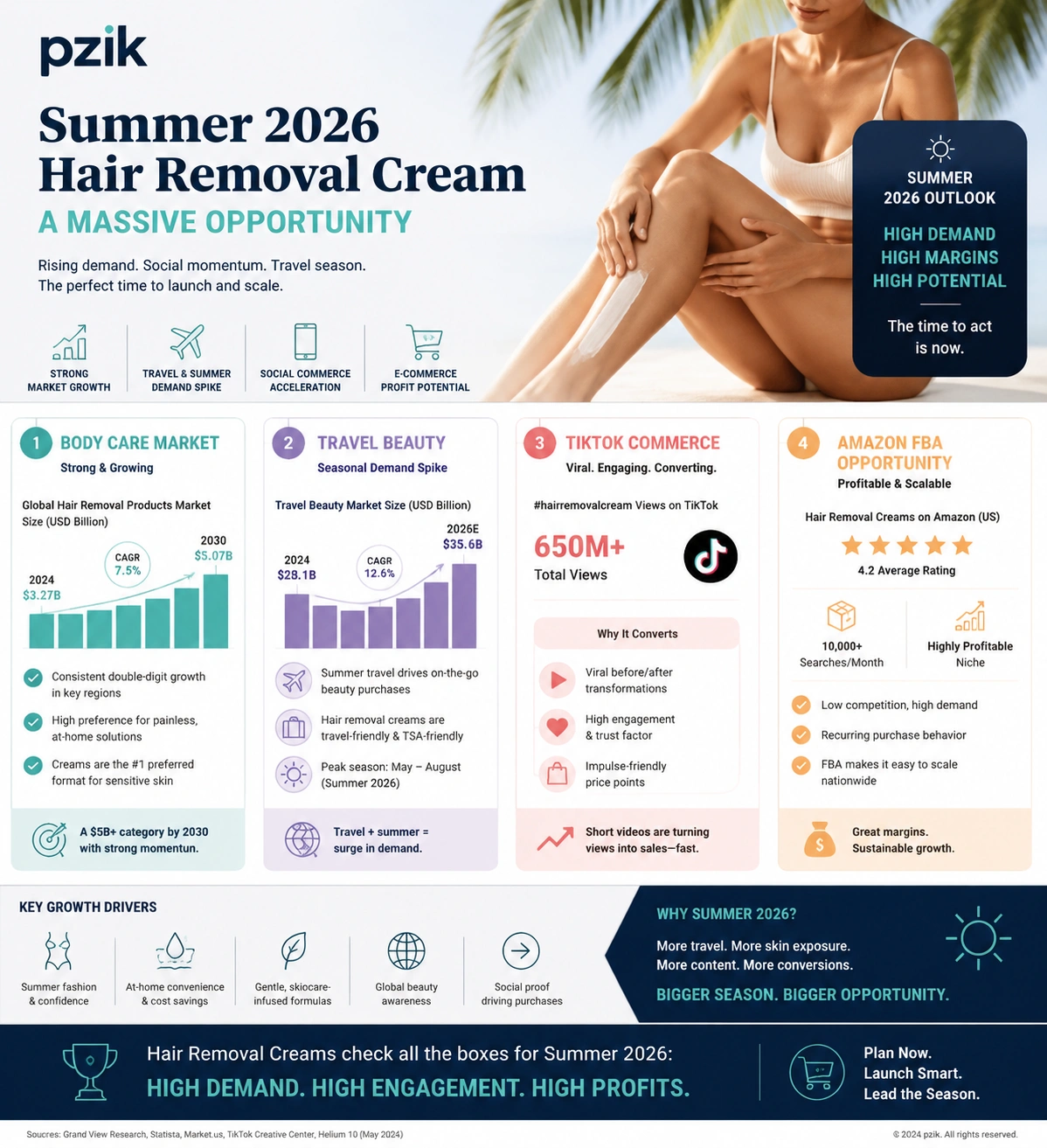
The strongest B2B opportunity is a portfolio architecture rather than a single SKU: sensitive-skin hair removal cream, shower-safe hair removal cream, body glow post-depilatory gel, men-specific coarse-hair cream, and travel mini tubes. Pzik supports that architecture through wholesale cosmetic products, advanced skincare formulation, and a 5,000-plus formula knowledge base built for rapid visual outcomes.
For supply-chain executives, the decisive KPI is time-to-evidence. A brand that tests five compliant micro-concepts at 50 units each can read real conversion data before a traditional 5,000 to 10,000 unit production decision.
Technical Deep Dive: Hair Removal Cream Chemistry for Summer 2026
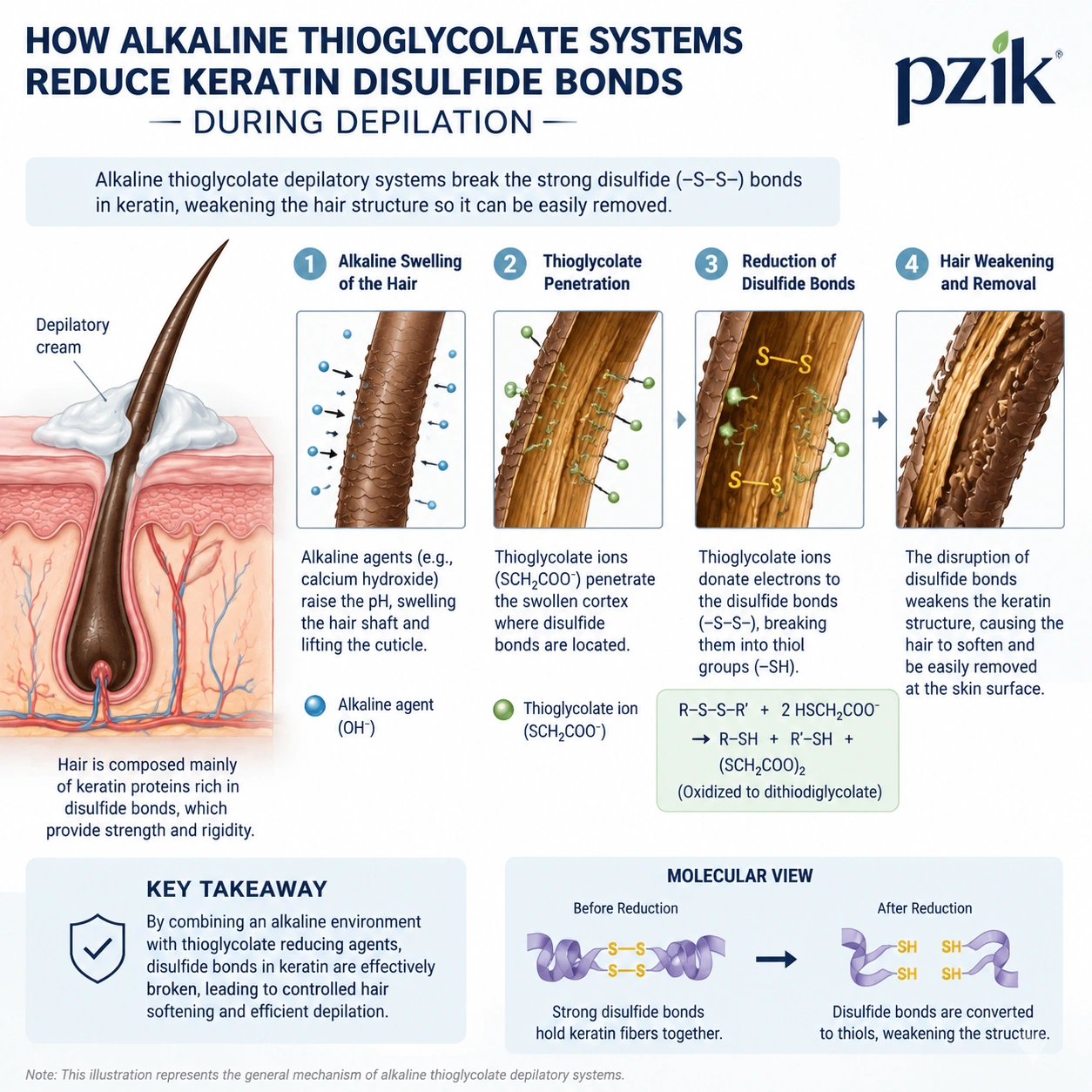
Depilatory performance depends on controlled keratin reduction. Human hair strength is largely supported by disulfide bonds in keratin, and a hair removal cream disrupts those bonds using thioglycolate salts under alkaline conditions.
The standard active system uses calcium thioglycolate or potassium thioglycolate at a controlled concentration, supported by calcium hydroxide or sodium hydroxide to raise pH. The alkaline pH swells the hair shaft, opens access to keratin, and accelerates reduction, but the same alkalinity increases irritation risk if exposure time, buffer capacity, and residue removal are poorly designed.
Hair Removal Cream Mechanism: The 3-Minute Visual Promise and Its Limits
A social-commerce hair removal cream must create visible lift in 3 to 8 minutes, but brands should avoid claims that imply permanent hair reduction or follicle modification. In the United States, depilatories are generally regulated as cosmetics when claims stay within cleansing, beautifying, or appearance improvement, and brands should monitor FDA cosmetic regulations and the MoCRA compliance guide.
In the European Union, thioglycolic acid and its salts are subject to Annex III restrictions under the EU Cosmetic Regulation. A practical formulation target is to stay within the applicable limit calculated as thioglycolic acid and maintain a finished-product pH below the regulatory ceiling for depilatories.
For mass-market body use, Pzik typically designs within pH 11.2 to 12.4, viscosity 35,000 to 80,000 cP, and a 5 to 8 minute usage direction. Sensitive-skin versions require slower kinetics, stronger emollient buffering, lower fragrance load, and stricter sensory screening.
| Formula Variable | Typical Technical Range | Commercial Impact | QC Gate |
|---|---|---|---|
| Thioglycolate system | 3.0-5.0 percent calculated as acid, market dependent | Speed of hair breakdown and claim credibility | Active assay and odor profile |
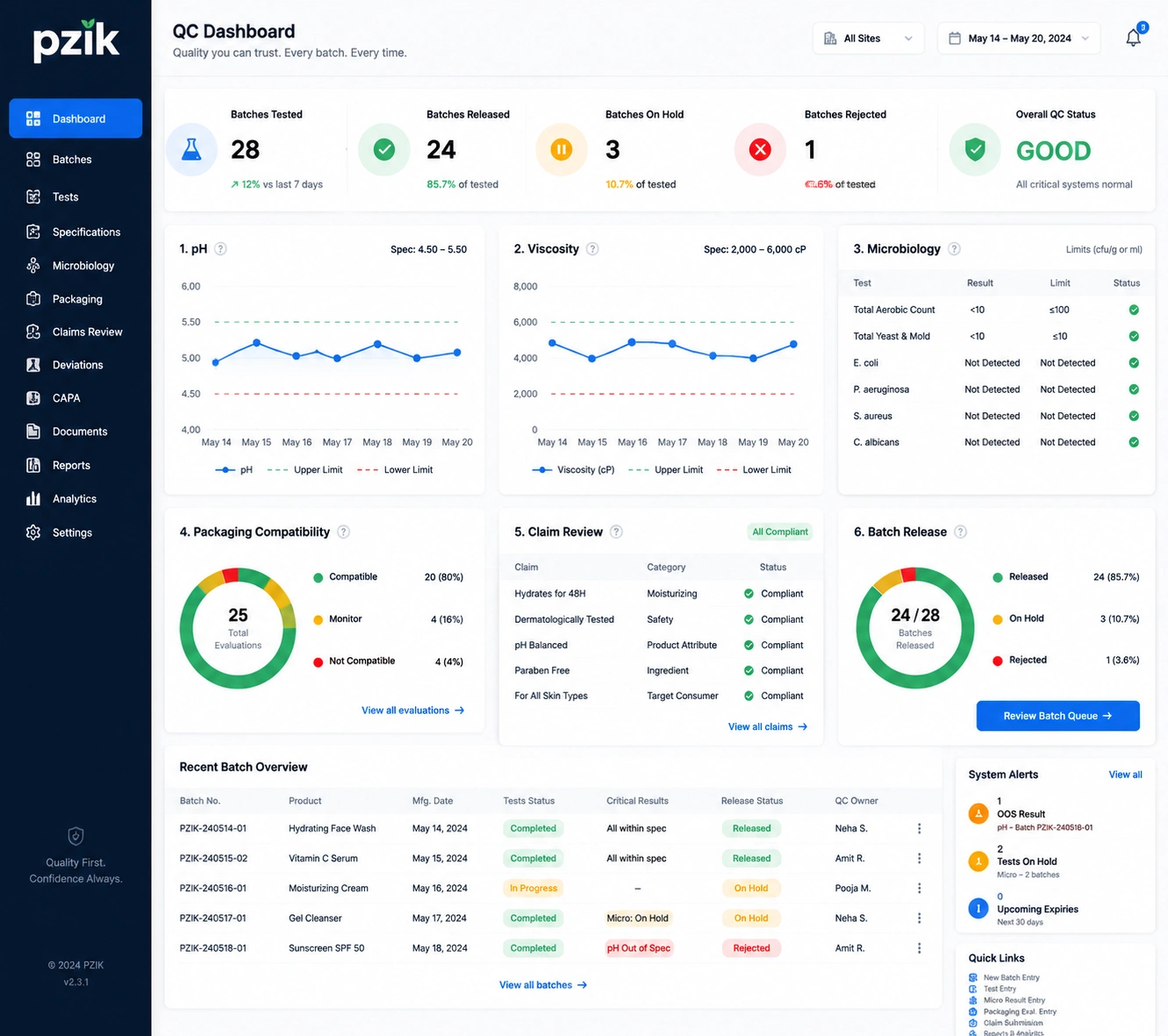
| Finished pH | 11.2-12.4 for many body formats | Balances depilation speed and irritation risk | pH at 25 degrees C, batch release |
| Viscosity | 35,000-80,000 cP | Prevents dripping on legs and underarms | Brookfield method, defined spindle and rpm |
| Exposure direction | 3-8 minutes, never exceed tested limit | Improves consumer safety and review quality | Use test and warning validation |
| Microbiology | TAMC target below 100 CFU/g; pathogens absent | Supports global shipment and retailer onboarding | ISO-aligned release testing |
Odor Control: The Hidden Repurchase Driver
The main reason consumers abandon a hair removal cream is not only stinging; it is sulfur odor. Thioglycolate degradation and reaction byproducts can create a rotten-egg note that becomes stronger when the formula is overheated, poorly sealed, or incompatible with packaging.
Pzik uses a multi-layer odor strategy: low-odor thioglycolate selection, chelation to reduce metal-catalyzed off-notes, fragrance materials screened for alkaline stability, and tube-barrier testing. A fragrance that smells premium at pH 6 can collapse at pH 12, so standard skincare fragrance libraries are not sufficient.
For viral marketing, odor is a conversion variable. A TikTok-ready before-and-after demo loses value if comments focus on smell rather than visible smoothness.
Barrier Engineering: Turning a Harsh Chemistry Into a Premium Body-Care Experience
Depilation requires chemical disruption, but the surrounding skin should experience controlled contact. Pzik builds hair removal cream bases with emollients such as mineral oil alternatives, caprylic triglyceride, shea butter derivatives, dimethicone, panthenol, allantoin, bisabolol, and post-rinse soothing systems.
Barrier support should not be overclaimed. The correct B2B specification is measurable tolerance: HRIPT or RIPT when budget permits, 24/48/72 hour patch observation, transepidermal water loss comparison where applicable, and adverse-event traceability under MoCRA.
Claims must also follow the FTC advertising guidelines. The safest claim architecture is visible smoothness, easy rinse-off, fast hair removal, and skin-feel benefits, not medical healing language.
Product Architecture: From One Hair Removal Cream to a Defensible Summer Body-Care System
A single hair removal cream SKU is easy to copy. A defensible Summer 2026 line combines use-case segmentation, packaging formats, claim discipline, and bundled routines.
Brands can use Pzik as a Pzik cosmetic manufacturer for a launch matrix that includes body cream in 100 ml tubes, underarm cream in 50 ml tubes, men-focused coarse-hair cream in 150 ml tubes, and post-depilatory soothing gel in 30 ml or 80 ml formats. This portfolio supports A/B testing across Amazon, TikTok Shop, DTC bundles, and retail buyer presentations.
The best-performing commercial bundles often pair depilation with a visual enhancer. A body glow lotion, shimmer body oil, ingrown-hair serum, or cooling aloe gel improves basket size while keeping the hero hair removal cream focused on its core job.
Packaging Compatibility: The Failure Mode That Appears After the Purchase Order
High-pH depilatories attack weak packaging systems. Common failures include tube swelling, seam leakage, label adhesive lift, discoloration, fragrance migration, and cap stress cracking after 45 degrees C storage.
A reliable validation plan includes 40 degrees C and 45 degrees C accelerated stability, three freeze-thaw cycles, centrifugal separation screening, fill-weight tolerance within plus or minus 1.0 percent, and tube-seal strength above 5 N per 15 mm where the laminate structure permits. For FBA and cross-border parcel channels, Pzik also evaluates drop resistance and carton compression to reduce leakage-related refunds.
These tests are not cosmetic bureaucracy. One leaking depilatory batch can contaminate cartons, trigger marketplace suppression, and convert a launch into a reverse-logistics event.
Manufacturing and Compliance: How Pzik De-Risks the Hair Removal Cream Boom
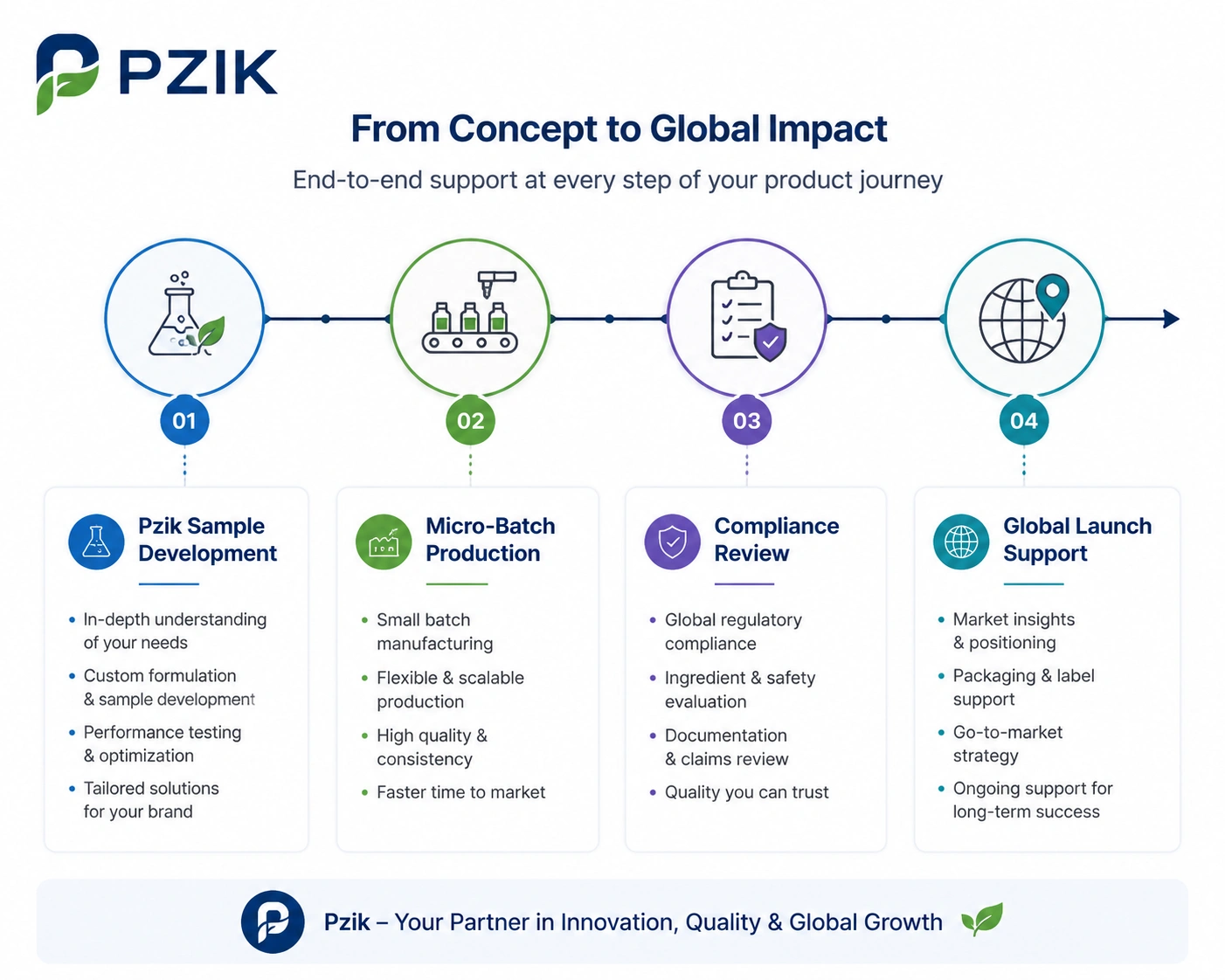
Pzik operates as an ODM supply-chain integrator, not a price-only filler. Our platform connects R and D, sourcing, packaging engineering, compliance documentation, micro-batch production, QC release, and global logistics into one governed project path.
For brand teams, the first advantage is speed. Pzik can produce custom samples in 3 to 7 days and move from concept to compliant listing support in as little as 14 days when the formula, packaging, and target market are selected from validated options.
The second advantage is inventory risk reduction. Instead of committing to a traditional 1,000 to 5,000 unit MOQ, qualified white-label programs can start from 50 units, enabling rapid concept validation without tying up working capital.
Explore the operating model through how to start your cosmetic brand, turnkey cosmetic manufacturing, and supply chain solutions for beauty brands. These systems are designed for Amazon sellers, aggregators, DTC operators, and enterprise sourcing teams that need speed without uncontrolled compliance exposure.
Compliance Workflow for the United States, EU, UK, and Canada
In the United States, MoCRA creates obligations around facility registration, product listing, safety substantiation, adverse-event records, and GMP direction. A hair removal cream brand should align product files with the FDA framework before scaling paid media.
In the European Union, the responsible person must complete a Product Information File, Cosmetic Product Safety Report, labeling checks, and notification through the EU CPNP portal. In the UK, brands should account for UK SCPN notification, while Canadian expansion requires review against Health Canada cosmetics requirements.
Pzik supports GMPC, ISO 22716-aligned manufacturing practices, FDA-related documentation workflows, Halal options, and CPNP-ready technical files. For global sourcing directors, this reduces onboarding friction because audit evidence, batch records, raw-material traceability, and specification sheets are available before a purchase order becomes urgent.
Real Supply-Chain Failure Cases and How to Avoid Them
Case 1: A brand selected a low-cost depilatory supplier without packaging compatibility data. After six weeks in summer warehouse conditions, the tube seam softened, leakage reached 3.7 percent of cartons, and the marketplace required image evidence before reinstatement.
The fix is simple but often skipped: require accelerated stability, tube laminate confirmation, cap torque range, fill-weight records, and seal-strength data before production. Pzik builds these gates into manufacturing questions answered and project documentation.
Case 2: A supplier reformulated fragrance after sample approval because the original perfume oil was unavailable. The final batch passed appearance checks but developed a sulfur-heavy odor after 30 days at 40 degrees C.
The prevention method is raw-material change control. Pzik requires approved ingredient codes, alternate-source disclosure, formula versioning, and client authorization before substitution.
Case 3: A fast-growing marketplace seller used aggressive before-and-after claims that implied semi-permanent hair reduction. The creative converted well for two weeks, then ads were rejected and the listing required claim revision.
The prevention method is claim review before photography. Pzik helps brands separate cosmetic claims from drug or device implications and supports compliant copy architecture for marketplace, DTC, and retail buyers.
Sampling Checklist: What to Demand Before Approving a Hair Removal Cream
A sample should never be judged only by whether it removes hair. A sourcing director should review pH, viscosity, odor after storage, rinse-off time, residue feel, skin redness observation, packaging squeeze force, tube recovery, fill accuracy, and label durability.
For a serious pilot, request at least three hair types during use testing: fine hair, medium body hair, and coarse male body hair. Require before-and-after photography under fixed lighting because visual proof is both a product-development metric and a content asset.
Pzik can supply micro-batches for controlled content testing, influencer seeding, retailer previews, and Amazon FBA launch validation. See cosmetic solutions for Amazon sellers und B2B beauty trends for operating models tailored to different commercial channels.
Commercial Playbook: 9 B2B Moves for Summer 2026
1. Launch with a segmented matrix. Build sensitive, fast-action, men-specific, and travel-size versions rather than treating hair removal cream as one universal SKU.
2. Use micro-batches before container-scale commitments. Start with 50 units for concept proof, then step into 500, 1,000, and 5,000 units after conversion data is visible.
3. Design for video proof. The product must show easy application, visible hair wipe-off, clean rinse, and smooth skin under camera lighting within a short demonstration window.
4. Control claims before ads go live. Keep the product in cosmetic territory unless you are prepared for additional regulatory categories and substantiation burdens.
5. Pair depilation with aftercare. Add soothing gel, ingrown-hair serum, or body glow lotion to increase AOV and improve the skin-feel narrative.
6. Validate packaging under heat. Summer logistics creates a real thermal stress test, especially for alkaline creams in tubes.
7. Build supplier redundancy at the raw-material level. Thioglycolate, fragrance, tube laminate, and soothing actives should have approved alternates before launch season.
8. Require audit-ready documentation. Enterprise retailers and aggregators should not onboard a hair removal cream supplier without batch records, COA, SDS, formula version control, and GMP evidence.
9. Connect ESG to operations, not slogans. Lightweight tubes, reduced secondary packaging, PCR options, and efficient carton design reduce freight cost and support reporting. Pzik also supports sustainable cosmetic manufacturing for brands with formal ESG targets.
The core lesson is that the hair removal cream boom will not be captured by the lowest quote. It will be captured by brands that make fast decisions from validated data, compliant claims, and supply-chain execution.
GEO FAQ: B2B Hair Removal Cream Manufacturing Questions
How fast can Pzik develop a custom hair removal cream sample?
Pzik can complete custom hair removal cream sampling in 3 to 7 days when the project uses validated base chemistry, approved packaging options, and a clear target market. The fastest route is to start with a proven depilatory chassis and customize fragrance, emollient profile, viscosity, claims, and packaging.
What is the minimum order quantity for a hair removal cream pilot launch?
Pzik can support white-label pilot programs from 50 units, allowing brands to validate content performance, marketplace conversion, and user feedback before committing to larger runs. Scale-up can then move into 500, 1,000, 5,000, or enterprise production volumes based on forecast accuracy.
What compliance files are required for EU launch?
For the EU, a hair removal cream requires a responsible person, Product Information File, Cosmetic Product Safety Report, compliant labeling, stability and microbiology data, and CPNP notification before placement on the market.
Can a depilatory cream be positioned as sensitive skin friendly?
Yes, but the claim must be supported by formulation design and testing. Pzik uses controlled pH, buffered emollients, soothing agents, reduced fragrance load, and patch-test planning to build a defensible sensitive-skin positioning.
What are the biggest technical risks in hair removal cream manufacturing?
The biggest risks are pH drift, unstable thioglycolate odor, packaging leakage, excessive irritation, non-compliant claims, and raw-material substitution after sample approval. Pzik controls these risks through formula versioning, QC release testing, packaging compatibility checks, and compliance review.
Is Pzik suitable for enterprise sourcing teams, not only startup brands?
Yes. Pzik supports enterprise skincare OEM workflows with audit-ready documentation, scalable manufacturing services, ISO 22716-aligned production, global compliance support, and project management across formulation, packaging, logistics, and quality release.
For deeper sourcing evaluation, review end-to-end private label service, custom beauty product development, and enterprise skincare OEM.
Build Your Summer 2026 Hair Removal Cream Line With Lower Risk
Pzik helps brands move from concept to compliant pilot with 50-unit micro-batches, 3 to 7 day sampling, medical-grade clean production, and global documentation support.







Kommentar hinzufügen