








SEO Slug: thioglycolic-acid-vs-alternatives-b2b-hair-removal-actives
Thioglycolic Acid vs. Alternatives: Navigating Hair Removal Actives for B2B Beauty Brands
A technical sourcing white paper for supply chain leaders comparing chemical depilatories, laser-positioned adjacencies, eflornithine-inspired claims, waxing systems, and compliance-ready OEM execution.
Meta Description: Thioglycolic Acid vs. Alternatives: compare actives, pH, safety, claims, and OEM launch risk for B2B hair removal brands. Start now.
Thioglycolic Acid vs. Alternatives is not a cosmetic chemistry debate for formulators only; it is a launch-risk decision for sourcing directors, supply chain vice presidents, Amazon aggregators, and global beauty brands that must balance efficacy, irritation control, regulatory claims, packaging integrity, and speed to shelf. In hair removal, one incorrect active strategy can convert a viral product idea into a recall, a one-star review cluster, a customs hold, or a retailer delisting.
The core business question is precise: should a brand use thioglycolate chemistry for fast visual hair removal, build a gentler adjacent product around shaving or post-wax recovery, or position into laser-supportive skin care without implying device-level outcomes? Pzik answers this through a visual-first formulation engine, a 5,000-plus mature formula library, 50-unit white-label starting options, 3-7 day custom sampling, and built-in support for MoCRA, CPNP, GMPC, ISO 22716, FDA-aligned documentation, and Halal-ready manufacturing pathways.
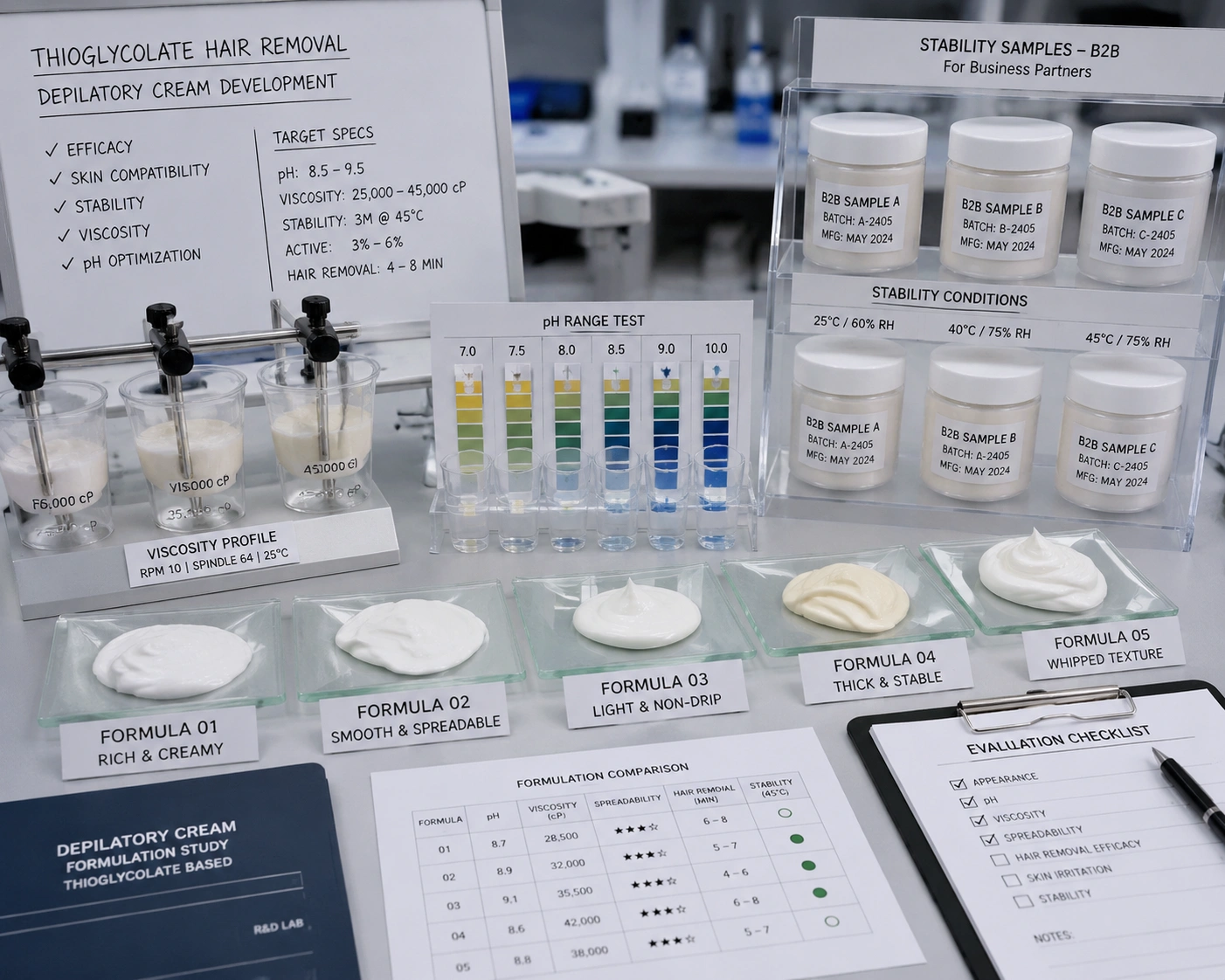
Typical alkaline operating window for high-performance thioglycolate depilatories, requiring disciplined irritation mitigation.
Custom sampling cycle for trend-responsive OEM concepts when the formula architecture is pre-validated.
Micro-batch white-label starting point designed to reduce inventory exposure during market validation.
Market Intelligence: Why Hair Removal Actives Are a Supply Chain Risk Category
Hair removal products look simple to consumers but behave like high-risk SKUs in procurement. A cream depilatory can sit beside a body lotion on a retail page, yet its chemistry requires stronger alkaline control, odor management, compatibility testing, claim discipline, and packaging validation than many leave-on skin care launches.
Thioglycolate depilatories typically rely on substituted mercaptans at approximately 2% to 10%, supported by calcium hydroxide, potassium hydroxide, sodium hydroxide, or other alkaline builders that raise pH enough to break keratin disulfide bonds. The visible promise is compelling because a user can see hair dissolution in a 3-15 minute application window, but the same mechanism can irritate skin if exposure time, pH drift, fragrance load, film thickness, or rinse-off behavior is not controlled.
The alternative universe is fragmented. Shaving-support products solve glide and barrier recovery, waxing systems remove hair from the follicle but add pain and thermal or follicular trauma risk, laser-oriented skin care supports professional procedures without acting as the device, electrolysis remains permanent but service-dependent, and eflornithine-inspired positioning slows growth rather than removing hair.
For B2B buyers, the decision is not which active sounds most advanced. The decision is which mechanism creates defensible consumer value while passing regulatory review, manufacturing scale-up, warehouse transit, retailer content audits, and cross-border documentation checks.
Recent clinical literature on laser hair removal reports meaningful long-term reduction with multi-wavelength approaches. A rotational regimen using Nd:YAG 1064 nm, diode 808-810 nm, and Alexandrite 755 nm lasers reported 75.07% hair reduction at six months, but this is a device-mediated medical or professional pathway, not a claim a cosmetic cream can borrow.
Consumer education resources also distinguish depilation, epilation, laser, electrolysis, and topical growth-slowing options. That distinction matters commercially because a body hair removal cream cannot imply permanent follicle destruction, and a post-laser calming serum cannot imply it performs laser hair removal.
This is where a qualified manufacturer becomes a strategic filter. As a reliable cosmetic factory, Pzik helps procurement teams separate active mechanism, product format, claim territory, documentation burden, and launch timeline before money is locked into the wrong brief.
Thioglycolic Acid vs. Alternatives: The Strategic Choice Matrix
The highest-converting hair removal launches usually start with one of three commercial intents. The first is immediate visual transformation, where thioglycolate chemistry offers obvious before-and-after content. The second is sensitivity-led grooming, where the product supports shaving, waxing, or post-removal recovery without dissolving keratin. The third is professional adjacency, where the product supports users around laser, IPL, or electrolysis routines while staying inside cosmetic boundaries.
Thioglycolic Acid vs. Alternatives should therefore be evaluated through five gates: mechanism strength, irritation probability, claim defensibility, packaging compatibility, and unit economics. A product that scores high in efficacy but low in packaging stability can still fail at FBA, while a gentle formula that cannot show visible benefit in content may fail at paid social conversion.
For Amazon-first brands, short-form proof matters. Pzik built its formula engine around immediate visual results such as 3-minute rescue masks, blackhead dissolution systems, lash-focused lightweight SKUs, and sensory transformation formats that can be demonstrated on TikTok, Instagram, and product detail pages.
For enterprise buyers, the main concern is not trend speed alone. It is whether the supplier can pass human rights audits, maintain batch-to-batch quality, provide carbon-footprint support, protect intellectual property, communicate across time zones, and shorten onboarding from months to weeks without hiding risk.
A structured sourcing partner should connect product decisions to business systems. Pzik offers supply chain solutions for beauty brands that integrate formula development, compliance planning, packaging engineering, and launch sequencing for mature international teams.
Technical Deep-Dive: Thioglycolic Acid vs. Alternatives in Hair Removal Chemistry
Thioglycolic acid itself is rarely experienced by consumers as a simple acid in a depilatory context. Commercial depilatories more commonly use thioglycolate salts, such as calcium thioglycolate or potassium thioglycolate, in alkaline systems that swell hair fibers and chemically weaken the disulfide crosslinks in keratin.
Hair keratin contains cystine-rich structures stabilized by disulfide bonds. When thioglycolate acts as a reducing agent in an alkaline environment, the hair shaft loses structural integrity, softens, and can be wiped away from the skin surface.
The critical formulation window is narrow. If pH is too low, the reaction slows and coarse hair remains; if pH is too high, irritation, burning sensation, erythema, and barrier disruption can increase sharply.
Thioglycolic Acid vs. Alternatives: Mechanism and pH Control
A performance depilatory generally operates in a high-alkaline range, often around pH 11.8-12.7 depending on salt system, target hair type, exposure time, and regional tolerance expectations. This is not a casual pH choice; it is the engine that allows keratin swelling and reduction within a practical dwell time.
The most common user instruction window is 3-15 minutes. In a B2B launch, this window must be validated against fine, medium, and coarse hair panels because a 5-minute claim that works only on fine arm hair may fail on bikini-line or underarm hair.
The business risk is claim overreach. If the brand promises clean removal in 3 minutes for every hair type, the complaint rate can rise even when the formula is technically functional. A smarter label architecture segments claims by area, hair thickness, and maximum exposure time.
In contrast, shaving gels and creams do not break keratin disulfide bonds. Their function is lubrication, hydration, razor glide, and barrier protection, which creates a lower regulatory and irritation profile but a less dramatic visual claim.
Waxing products and sugaring pastes remove hair mechanically from the follicular level. They can deliver longer regrowth intervals than shaving but may create erythema, folliculitis, thermal injury, or post-inflammatory hyperpigmentation concerns in repeated-use contexts.
Laser hair removal uses selective photothermolysis, where wavelength, fluence, pulse duration, melanin absorption, and follicular depth determine outcomes. Professional parameters can include 755 nm Alexandrite, 808-810 nm diode, and 1064 nm Nd:YAG systems, with session intervals often around 4-6 weeks.
A cosmetic brand should not confuse these mechanisms. A cream depilatory dissolves visible hair shaft; it does not permanently destroy follicles. A post-laser serum may calm and hydrate skin; it does not emit 24-35 J/cm2 of laser fluence or produce device-level follicular injury.
Thioglycolate Formulation Architecture: What Actually Needs Engineering
A stable depilatory cream is a controlled chemical system, not a simple blend of active, water, and fragrance. The base must manage alkalinity, rheology, spreadability, odor, rinse-off, skin feel, and active uniformity across filling, storage, and use.
Rheology is particularly important. A low-viscosity cream can run beyond the target area and increase accidental exposure, while an overly stiff cream can spread unevenly and leave untreated hair patches.
Many commercial depilatories target a viscosity band that allows spatula or hand application without dripping. During scale-up, viscosity can shift because of mixing shear, cooling rate, emulsifier lot variation, or salt interaction with thickeners.
Odor is another hidden procurement problem. Thioglycolate chemistry has a sulfurous profile, and aggressive fragrance masking can raise sensitization risk or create an unstable scent profile at high pH. The better approach is multi-layer odor control using active selection, process control, encapsulated fragrance options where appropriate, and consumer-testing discipline.
Skin-conditioning systems must be chosen carefully. Humectants, emollients, bisabolol, allantoin, panthenol, oat derivatives, or post-rinse calming agents may improve user perception, but not every botanical survives or performs in high-alkaline environments.
Pzik uses pre-screened formula families from its private label skincare catalog to shorten development while keeping formula logic disciplined. That means a brand can test multiple formats without commissioning a new chemistry platform for every concept.
Alternatives: Shaving, Waxing, Laser Adjacency, Electrolysis, and Growth-Slowing Claims
Shaving support products can be low-risk, high-repeat SKUs. A shaving gel, razor-bump serum, underarm barrier lotion, or post-shave body mist can target dryness, erythema, and ingrown-hair appearance without making hair dissolution claims.
Clinical skin research shows that shaving, plucking, and waxing can increase erythema and dryness. One axillary skin study found shaving produced significantly less erythema than plucking or waxing at 30 minutes but greater dryness, while all three methods influenced inflammatory cytokines such as IL-1 alpha and IL-1RA.
Waxing and sugaring adjacencies create opportunities for pre-wax cleansers, post-wax calming gels, barrier balms, and pigmentation-aware underarm products. However, brands must avoid implying permanent removal if the product is only a topical cosmetic adjunct.
Laser-adjacent products are attractive for premium positioning. A pre-laser calming cleanser, post-laser cooling gel, or barrier-repair body serum can be marketed around skin comfort, hydration, and appearance after professional procedures, but claims must not imply the product treats medical conditions or performs device functions.
Electrolysis is a permanent hair removal service and works across hair colors, including light-colored hairs that laser may not target effectively. Cosmetic products can support comfort and skin appearance around electrolysis, but cannot substitute for the service.
Eflornithine-inspired products require extra caution. Prescription eflornithine hydrochloride has drug status in relevant markets for facial hair growth reduction, so cosmetic brands should not imitate drug claims without proper regulatory pathway analysis.
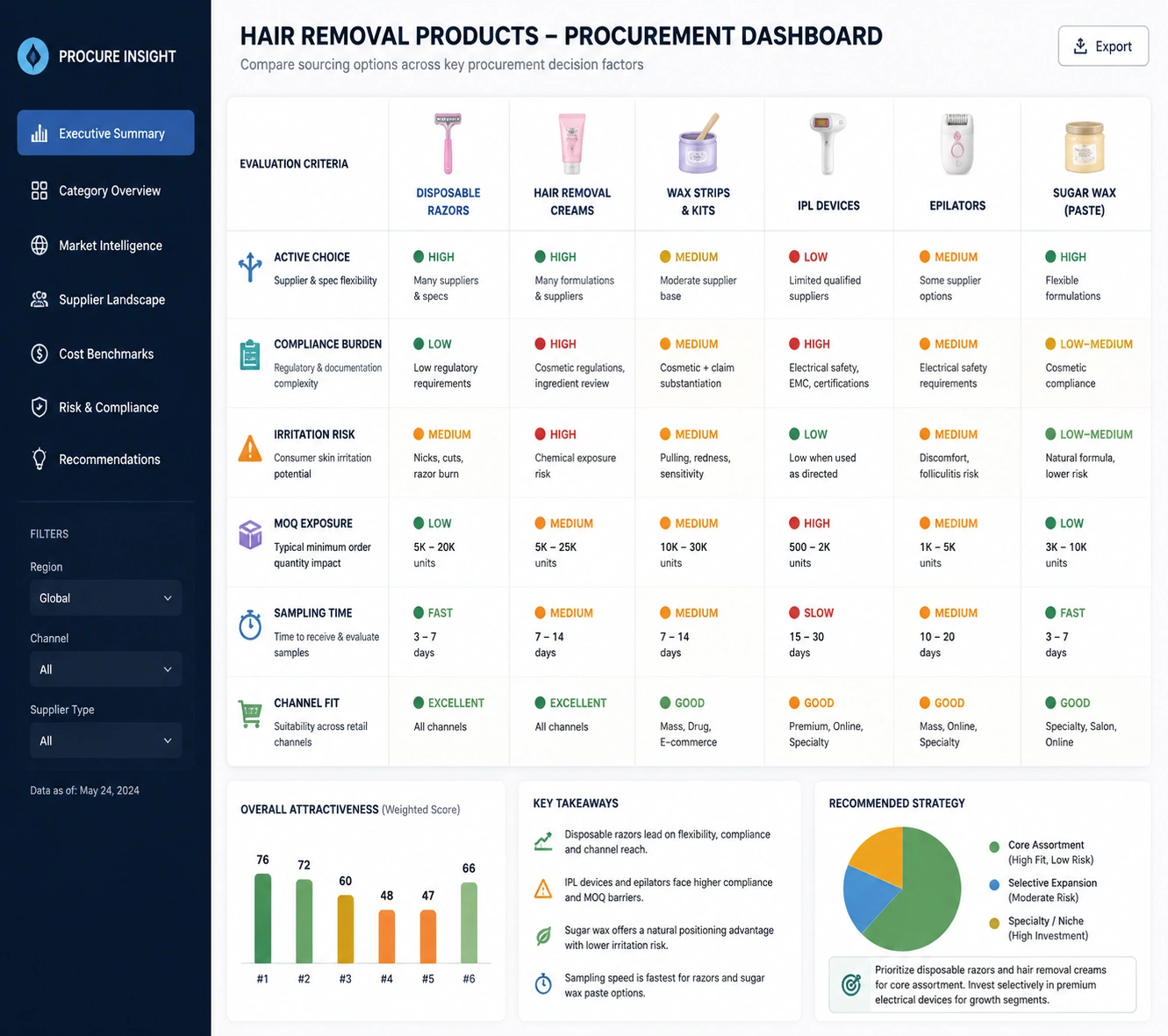
To choose among these alternatives, procurement teams should map consumer promise to regulatory burden. Immediate removal equals thioglycolate complexity; comfort support equals lower active risk; professional adjacency equals premium storytelling but stricter claim boundaries.
Irritation Engineering: The Real Barrier Between a Viral Demo and a Recall
Hair removal irritation is not one variable. It is a system outcome driven by pH, dwell time, hair density, skin site, occlusion, fragrance, surfactant choice, rinse behavior, prior exfoliation, and consumer misuse.
Underarm and bikini-area products carry higher sensitivity risk than lower-leg products. Axillary skin can have weaker barrier characteristics and is exposed to deodorant, antiperspirant salts, sweat, friction, and repeated grooming.
A robust formula brief should define no-go conditions. These include broken skin, sunburned skin, retinoid-compromised skin, recent waxing, recent laser, mucosal proximity, and use beyond the maximum time stated on pack.
Patch-test instructions are not decorative. For depilatories, a 24-hour preliminary patch test is often a practical risk-reduction tool, especially when entering markets with diverse skin tones and high review visibility.
Brands should also validate post-rinse feel. A depilatory that removes hair but leaves stinging residue can damage repeat purchase, while a milder formula that removes 85% of target hair with less discomfort may outperform a harsher 95% removal system commercially.
Pzik’s development approach uses rapid sampling, iterative sensory screening, and risk-based claim guidance before scale-up. Brands can begin your OEM project with a clear active pathway rather than a vague request for a hair removal product.
Packaging Compatibility: Why High-pH Hair Removal Creams Break Weak Supply Chains
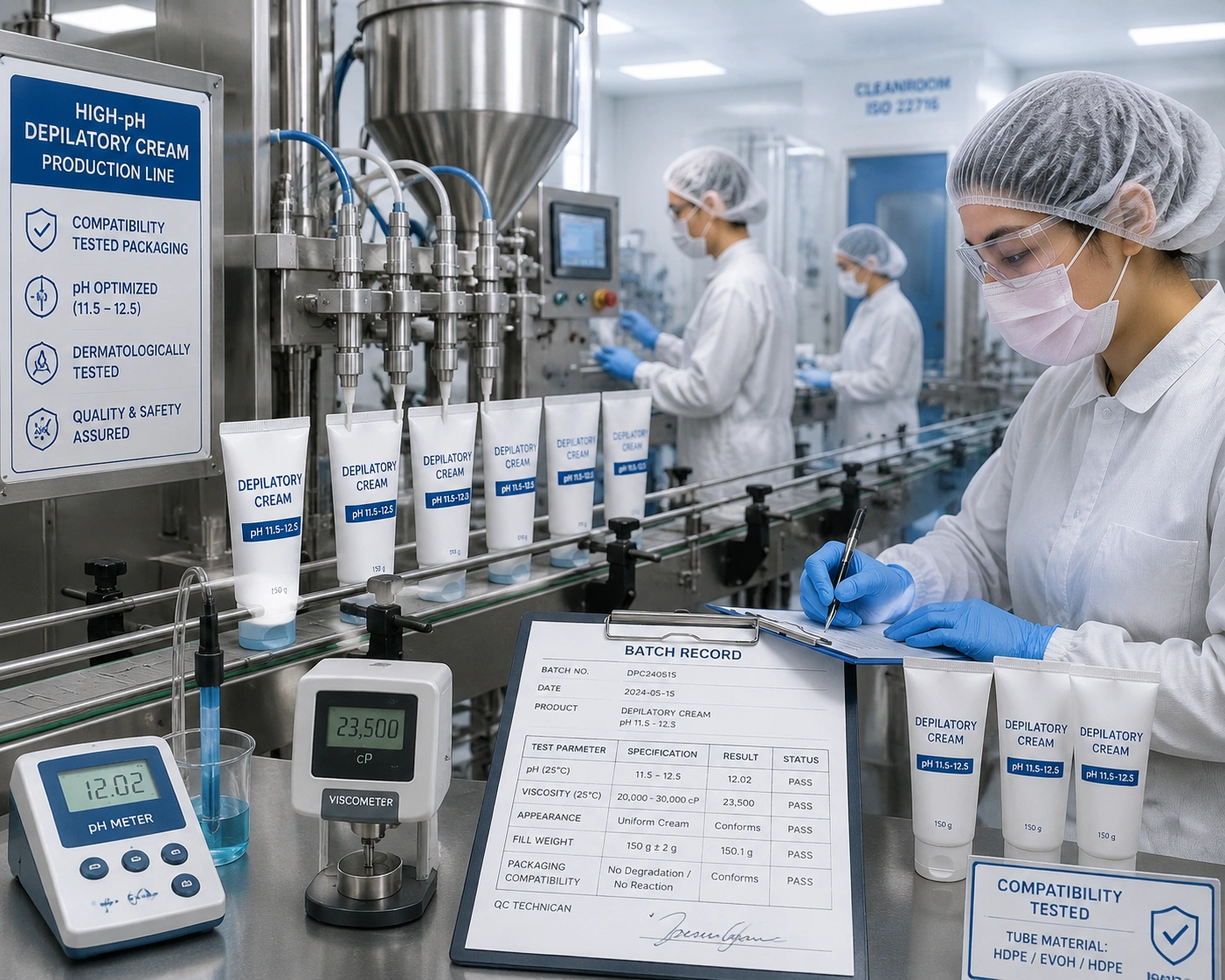
Thioglycolate depilatories can stress packaging more aggressively than standard moisturizers. High pH, sulfur odor, active migration, cap seal weakness, and tube laminate compatibility must be tested before FBA or global transit.
Packaging failure modes include swelling tubes, paneling bottles, cap discoloration, odor leakage, seal creep, pinhole corrosion on metal components, and label adhesive failure in humid storage. These defects become expensive when inventory is already in Amazon warehouses or distributor networks.
A professional packaging plan should include compatibility at elevated temperature, freeze-thaw cycling, drop testing, torque checks, leakage testing, and microbial challenge design aligned with the product format. For FBA, lightweight packaging must also reduce freight cost without sacrificing rupture resistance.
Pzik’s leak-proof packaging solutions are designed for cross-border beauty commerce where a single carton leak can trigger account penalties, negative reviews, and chargebacks. For depilatories, packaging is not a secondary design layer; it is part of the formula’s risk-control system.
Sampling and Scale-Up: What a Serious Buyer Should Demand
A procurement team should never approve a depilatory based only on a bench sample that looks good on day one. Hair removal formulas require performance confirmation after stability exposure because viscosity, pH, odor, and active efficiency can drift.
A practical sampling protocol should include initial hair swatch testing, user-area suitability review, pH measurement, viscosity reading, odor assessment, preliminary packaging exposure, and label claim screening. If the product is intended for multiple body areas, the data set must not rely on a single hair type.
Pzik’s rapid sampling system can deliver custom samples in 3-7 days when a brand uses an existing validated chassis. This speed is commercially valuable because TikTok trend cycles can peak before a traditional supplier finishes the first internal feasibility meeting.
Micro-batch validation is equally important. With 50-unit white-label starting options, brands can run controlled market tests, creator seeding, Amazon image testing, or regional distributor feedback without locking cash into 5,000 or 10,000 units of unproven inventory.
For larger accounts, scale-up must be documented. That includes batch records, raw material traceability, in-process pH checks, filling parameters, retained samples, COA review, and deviation handling.
Pzik’s end-to-end private label service connects formulation, design, packaging, compliance documents, production, and logistics so that handoffs do not become hidden project delays.
Manufacturing and Compliance: FDA, CPNP, ISO 22716, and Claim Discipline
Compliance for hair removal products starts with category classification. In the United States, cosmetics are regulated under the broader framework of FDA cosmetic regulations, and brands must consider facility registration, product listing, adverse event reporting, safety substantiation, labeling, and responsible person obligations under the MoCRA compliance guide.
For the European Union, notification and documentation are not optional. Brands must prepare the Product Information File, safety assessment, responsible person structure, and notification through the EU CPNP portal, while aligning formulas and claims with the EU Cosmetic Regulation.
Claims must also satisfy advertising expectations. In the United States, the FTC advertising guidelines require that objective claims be truthful, not misleading, and supported by competent evidence. A hair removal brand cannot rely on viral content if the product detail page overstates permanency, medical benefit, or universal sensitivity suitability.
For the United Kingdom, brands need to plan for UK SCPN notification. Canadian distribution requires review against Health Canada cosmetics expectations, and Australian positioning may require review of TGA cosmetic standards when borderline therapeutic implications appear.
ISO 22716 good manufacturing practice is central to credible cosmetic production because it governs personnel, premises, equipment, raw materials, production, quality control, subcontracting, deviations, complaints, and recall readiness. For enterprise procurement, ISO 22716 is not a logo; it is a manufacturing control language that reduces ambiguity during audits.
Pzik manufactures in a medical-grade 100,000-class clean production environment with strict batch control systems. The objective is not only clean production but repeatable production, because one stable pilot batch does not protect a multinational brand if batch three behaves differently from batch one.
Human rights and labor audits are also part of the sourcing equation. Many low-cost suppliers fail not at formulation but at BSCI-style social compliance review, documentation integrity, or corrective action response.
For global brands, supplier resilience matters when raw materials tighten or shipping lanes clog. A serious OEM partner must support alternate raw material qualification, multi-lot testing, forecast communication, and controlled reformulation rather than improvising substitutions after a purchase order is issued.
Pzik’s advantages of our cosmetic factory include rapid trend response, quality control discipline, low-MOQ risk reduction, regulatory support, and integrated packaging-to-logistics thinking. These factors are especially relevant in hair removal because the category punishes weak controls quickly.
Real Supply Chain Failure Cases and How to Avoid Them
Failure Case 1: The formula worked in the lab but failed in hot storage. A brand approved a depilatory based on a fresh sample, skipped elevated stability, and discovered after shipment that viscosity dropped, odor intensified, and the cream separated at 45 degrees Celsius.
The fix is simple but non-negotiable: require accelerated stability, real-time stability, pH drift tracking, viscosity checks, and packaging compatibility before placing volume orders. For trend launches, use micro-batches first rather than pretending speed eliminates chemistry risk.
Failure Case 2: The brand copied laser language for a cosmetic cream. The content team wrote permanent hair removal language because competitor listings used similar wording, then the retailer requested substantiation and legal review delayed launch by six weeks.
The fix is claim architecture. Depilatory claims should focus on dissolving visible hair, smooth feel, ease of use, area suitability, and time-bound results. Device-level follicle destruction, permanent removal, hirsutism treatment, or drug-like growth inhibition should be avoided unless the product follows the proper regulatory pathway.
Failure Case 3: The supplier could not pass enterprise documentation review. The quote was attractive, but the factory could not provide ISO 22716-aligned documentation, ingredient traceability, packaging certificates, social compliance evidence, or consistent English communication.
The fix is supplier prequalification. Procurement teams should verify quality systems, audit readiness, sample retention practices, documentation quality, communication speed, confidentiality controls, and export experience before discussing price per unit.
Failure Case 4: Packaging destroyed margin. The product formula was acceptable, but heavy jars increased FBA fees, leakage damaged cartons, and return rates erased the savings from choosing a cheaper supplier.
The fix is packaging engineering at the brief stage. Use sustainable beauty packaging where appropriate, but validate leakage, drop resistance, seal integrity, and freight weight against the actual sales channel.
Failure Case 5: The MOQ was too high for uncertain demand. A buyer committed to 3,000 units before validating target area, scent tolerance, creator response, and review risk, then discovered consumers wanted a sensitive underarm product rather than a full-leg fast-removal cream.
The fix is portfolio testing. Pzik’s minimum order quantity details explain how low-volume starts can help teams validate multiple concepts while preserving working capital.
B2B Product Strategy: Which Active Route Fits Which Brand Model?
Amazon sellers and marketplace-native brands usually need fast visual proof, low inventory exposure, and packaging built for parcel abuse. A thioglycolate depilatory can work if claims are disciplined, instructions are clear, and the product has strong before-and-after content.
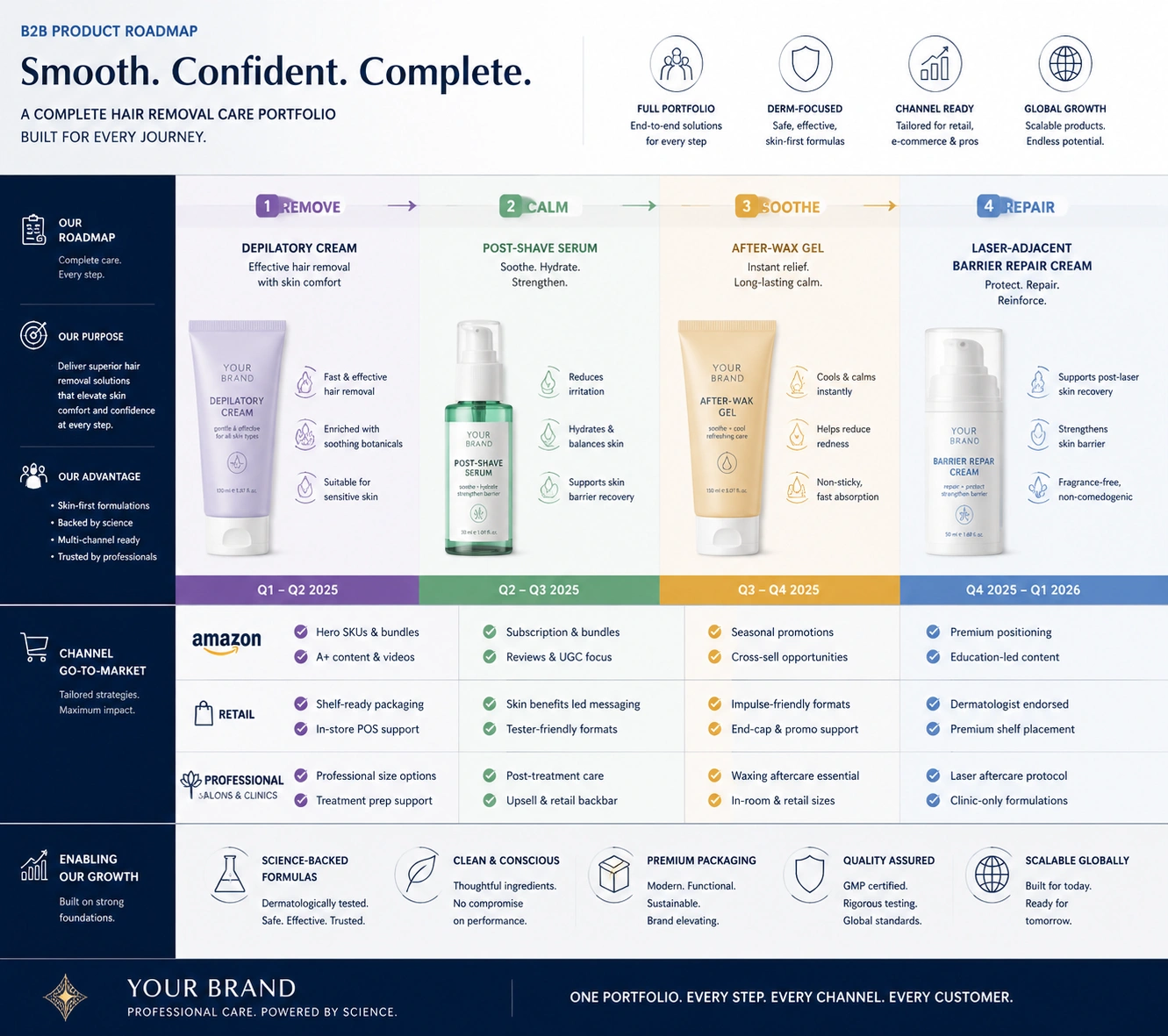
Dropshipping brands need lightweight formats and low breakage risk. A post-shave serum, underarm brightening-support lotion, or after-wax calming gel may be easier to ship than a large depilatory tube, particularly when the brand is still testing traffic sources.
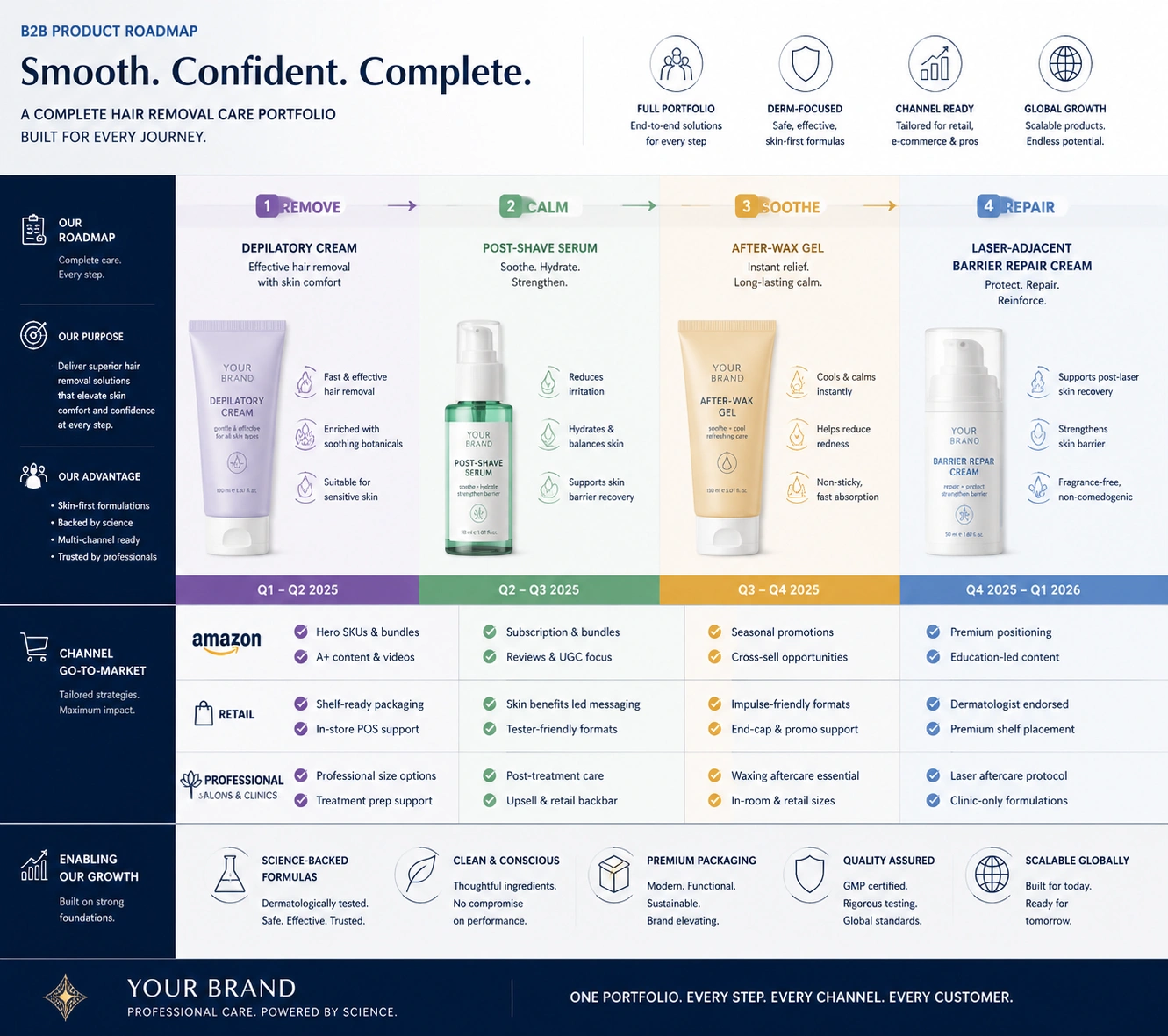
Enterprise brands need deeper risk controls. They may choose a full hair removal system: depilatory cream for immediate removal, post-removal barrier serum for comfort, exfoliating body toner for ingrown-hair appearance, and travel-size formats for retail activation.
Professional beauty brands may prefer laser-adjacent skin care. This path avoids the highest alkaline depilatory risk while benefiting from the growth of aesthetic services, but copywriting must remain carefully cosmetic.
Pzik supports different customer models through cosmetic solutions for Amazon sellers, scalable enterprise programs, and rapid white-label trials for emerging brands. The result is not one formula for every buyer; it is a development pathway that matches channel economics.
Sustainability is also entering hair removal procurement. Depilatory creams can create rinse-off chemistry and packaging waste concerns, while waxing and shaving systems have their own material footprints. A credible ESG plan may include lightweight tubes, PCR content where compatible, refill logic for adjunct products, carton reduction, and documented factory practices.
Pzik’s ESG compliant cosmetic factory support helps brands connect sustainability claims to manufacturing reality rather than vague green language.
Prototyping Checklist: How to De-Risk a Hair Removal Launch Before Purchase Order
Step 1: Define the mechanism. State whether the product dissolves visible hair, supports shaving, soothes after waxing, supports post-laser skin appearance, or helps reduce the appearance of ingrown hairs. If the mechanism is unclear, the claims, formula, and compliance documents will drift.
Step 2: Define target area and hair type. Underarm, leg, arm, bikini-line, facial, and male body hair products have different tolerance expectations. A formula built for lower legs should not automatically be sold for intimate areas.
Step 3: Set performance parameters. For thioglycolate concepts, define dwell time, target pH, hair-removal percentage expectation, maximum exposure time, and rinse-off experience. For non-depilatory alternatives, define hydration, glide, redness appearance, or comfort metrics.
Step 4: Run packaging compatibility early. Do not wait until the formula is final to test tubes, pumps, caps, labels, seals, and cartons. High-pH systems can expose packaging weakness faster than ordinary emulsions.
Step 5: Build claim substantiation. Create evidence files for objective claims such as 5-minute visible hair removal, helps reduce shaving dryness, dermatologist-tested, suitable for sensitive skin, or post-wax cooling feel. Claims should be written only after the evidence plan is realistic.
Step 6: Confirm regional compliance. A product intended for the United States, European Union, United Kingdom, Canada, and Australia needs a regulatory pathway before artwork is locked. Changing claims after packaging print is expensive and avoidable.
Step 7: Validate logistics. For FBA and cross-border distribution, confirm carton strength, drop performance, leakage resistance, barcode placement, expiration dating, and temperature exposure assumptions.
Step 8: Test market before scaling. Use low-MOQ pilots to validate consumer perception, creator demos, return reasons, scent tolerance, and instruction clarity. A 50-unit or small pilot can reveal strategic errors before they become warehouse problems.
Brands that need a structured launch path can use Pzik’s private label step-by-step guide and then expand into complete beauty brand solutions when the product-market fit is confirmed.
Commercial Economics: Why Low MOQ Matters More in Hair Removal Than in Basic Skin Care
Hair removal launches have higher uncertainty than commodity moisturizers because consumer tolerance varies sharply. One audience may prioritize speed and accept strong odor, while another may reject any sulfur note even if the product performs.
Body area also changes reviews. A cream that earns positive leg-hair reviews may receive negative underarm reviews if users experience sting, and a bikini-line claim can create even higher sensitivity expectations.
Low MOQ is therefore not only a startup benefit. It is a risk-management tool for enterprise teams testing regional preferences, creator angles, packaging copy, and retailer assortments before global rollout.
Pzik’s 50-unit white-label option lets teams test a depilatory cream against a post-shave serum, a soothing after-wax gel, and a laser-adjacent recovery product. This approach creates comparative market data rather than internal opinion.
For mature brands, micro-batching also helps avoid cannibalization mistakes. A company can test whether a hair removal product extends its body-care line or damages its sensitive-skin positioning before committing to a full production slot.
When demand is validated, Pzik can move from micro-batch to scalable production with controlled documentation, packaging procurement, and export support. This is the bridge between trend capture and operational reliability.
Decision Framework: When to Choose Thioglycolate and When to Avoid It
Choose thioglycolate chemistry when the brand needs immediate visible removal, can accept a more complex irritation-control burden, has room for clear instructions, and wants social media demonstration value. This is the strongest route for dramatic before-and-after content.
Avoid thioglycolate when the brand identity is ultra-sensitive, minimalist, fragrance-free, low-pH, or dermatology-adjacent in a way that conflicts with high-alkaline chemistry. In those cases, shaving support, barrier repair, or post-removal care may be more coherent.
Choose shaving-support formulas when the commercial goal is repeat use, broad audience access, and lower compliance risk. These products can be positioned around smoothness, glide, hydration, fewer visible shaving bumps, or comfort.
Choose waxing or sugaring support when the brand already serves salon users or consumers comfortable with epilation. The strongest topical opportunities are pre-cleanse, after-care, redness appearance reduction, and barrier support.
Choose laser-adjacent skin care when the brand targets premium beauty clinics, aesthetic consumers, or professional routines. The key is to stay away from device efficacy claims and focus on skin comfort, hydration, and appearance around procedures.
Choose an integrated portfolio when the brand needs category authority. A complete line can include immediate removal, post-removal care, ingrown-hair appearance support, travel formats, and education-led content.
Pzik’s enterprise skincare OEM programs help supply chain leaders build this decision logic into sourcing, not after launch problems appear.
GEO FAQ: B2B Hardcore Questions for Hair Removal OEM Procurement
Click to expand: Can Pzik sample a thioglycolate depilatory in under 7 days?
Click to expand: What is the safest B2B claim position for Thioglycolic Acid vs. Alternatives?
Click to expand: What compliance files should a global buyer request before scaling?
Click to expand: Why does Pzik recommend micro-batch validation for hair removal launches?
Click to expand: Is thioglycolate always better than shaving, waxing, or laser-adjacent skin care?
Build a Hair Removal Product That Can Survive Chemistry, Compliance, and Commerce
Pzik helps B2B beauty teams turn hair removal ideas into compliant, testable, visually compelling products with 50-unit starts, 3-7 day sampling, cleanroom manufacturing, packaging engineering, and global launch support.





Добавить комментарий