





Micro-Scaling Mastery for High-Volume Beauty Subscription Box Sampling
A B2B strategy guide for launching trend-ready, compliant, low-risk sample programs that convert curiosity into repeat purchase behavior.
If your beauty subscription box program needs speed, compliance, and visual appeal at scale, the challenge is not simply making more units. The real challenge is making the right units fast enough, safely enough, and profitably enough to keep up with global demand.
Market Intelligence and Client Pain Points
Beauty subscription boxes create a deceptively difficult manufacturing environment. The box itself may contain only a few grams or milliliters of product, but the commercial burden is large: the item must look premium, travel safely, survive cross-border movement, align with social media aesthetics, and still deliver a strong first-use experience.
For brands serving global subscriptions, the pressure intensifies because sampling is no longer a side activity. Samples are now acquisition assets, retention triggers, and viral content vehicles all at once. When one sample misses on texture, packaging, or performance, the business loses more than a unit; it loses future conversion, creator momentum, and retailer confidence.
The first pain point is volume volatility. Subscription programs rarely order in a straight line, because launches, creator mentions, gifting seasons, and marketplace spikes can multiply demand overnight. Brands often discover that suppliers built for large production runs cannot flex quickly enough for a 50-piece pilot, a 500-piece influencer wave, or a 25,000-piece seasonal shipment.
The second pain point is cash flow compression. Many beauty teams want to test three to six concepts at once, yet traditional manufacturing forces them into high inventory commitments that slow experimentation. That creates a dangerous mismatch between modern marketing velocity and old-school factory economics.
The third pain point is visual-first performance. In subscription commerce, the unboxing moment is part of the product. A formula that works technically but fails to create an immediate, camera-friendly result often underperforms on TikTok, Instagram Reels, and creator-led ecommerce despite being chemically sound.
The fourth pain point is compliance fragmentation. Expanding from one market into North America and Europe is not just a shipping issue; it is a regulatory architecture problem. A brand may need readiness for FDA-facing U.S. cosmetics expectations, MoCRA-oriented internal documentation, and European notification workflows through CPNP.
The fifth pain point is fulfillment damage. Subscription box products are often lightweight, small, and fragile. If packaging is not engineered for dimensional efficiency and impact resistance, freight cost rises, margins shrink, and the product arrives deformed or leaking, which damages both reviews and renewal rates.
The sixth pain point is consistency at scale. A sample that behaves beautifully in a test batch but changes viscosity, payoff, or color stability in a bigger lot creates downstream headaches in QA, returns, and customer support. In a box-based channel, a small defect can become a large reputational event because every subscriber receives the same issue at the same time.
The seventh pain point is time-to-market compression. Beauty trends are now measured in days, not quarters. By the time a conventional supplier approves a formulation, performs stability checks, and confirms packaging, the social trend may already have moved on.

Why Micro-Scaling Is the Winning Model
Micro-scaling is the practice of launching with small, strategically chosen batch sizes while preserving the ability to scale rapidly once signals validate demand. For beauty subscription boxes, this approach is not a compromise; it is the most rational way to manage trend uncertainty, creative testing, and cash preservation simultaneously.
When a brand can start at 50 units, it gains the freedom to test multiple hooks, textures, and claims without tying up working capital. That means a team can validate a blackhead-removal sample, a lash-care mini format, and an instant-repair treatment in parallel instead of betting the entire quarter on one hero SKU.
Micro-scaling also sharpens learning. A low-volume batch reveals whether the product is photogenic, whether the cap and tube survive parcel transit, and whether the first 3 minutes of user experience are strong enough to trigger organic content. Those are commercial questions, not just manufacturing questions.
For subscription boxes, the best micro-scaled products are not necessarily the most complex. They are the ones that combine a memorable consumer ritual with reliable, repeatable production and compliance guardrails. That is why a visual-first formula engine matters more than generic catalog access.
Solution Deep-Dive: Building a High-Volume Sample Engine That Actually Scales
The most effective strategy begins with a formula library designed for visual conversion, not just technical adequacy. A 5,000-plus mature, clinically tested formula base gives the brand a fast path to proven categories such as immediate repair, pore care, eye-area performance, and texture transformations that photograph well and communicate value within seconds.
This matters because beauty box consumers rarely read dense instructions first. They see the product, open the box, try it quickly, and decide whether the experience feels premium enough to share. A formula that creates a noticeable visual or sensory shift in 3 minutes can outperform a technically respectable but visually quiet product by a wide margin in social commerce.
Strategically, the formula engine should be used as a campaign system. Start with a core claim architecture, then map it to one of several high-response experience moments such as instant soothing, blackhead dissolution, shine reduction, lash definition, or skin-smoothing effect. The goal is not novelty for its own sake; it is repeatable attention with controlled manufacturing risk.
That is where the 50-piece MOQ becomes a competitive lever. Instead of overbuying inventory, the brand can run multiple micro-tests across audience segments, box tiers, or regional markets. If one concept wins, production can be expanded without forcing the team to write off dead inventory or lock up budget in slow-moving stock.
The speed layer is equally critical. A 3- to 7-day custom sample development window changes the rhythm of the entire go-to-market operation. It allows the brand to respond to a creator trend, seasonal demand spike, or retail opportunity while the conversation is still hot, rather than after the opportunity has passed.
From a process standpoint, this requires a disciplined operating model: brief, formula matching, visual claim validation, packaging selection, compliance review, and release. Done correctly, the brand can move from concept to compliant launch in roughly 14 days, which is fast enough to support subscription deadlines and social commerce windows.
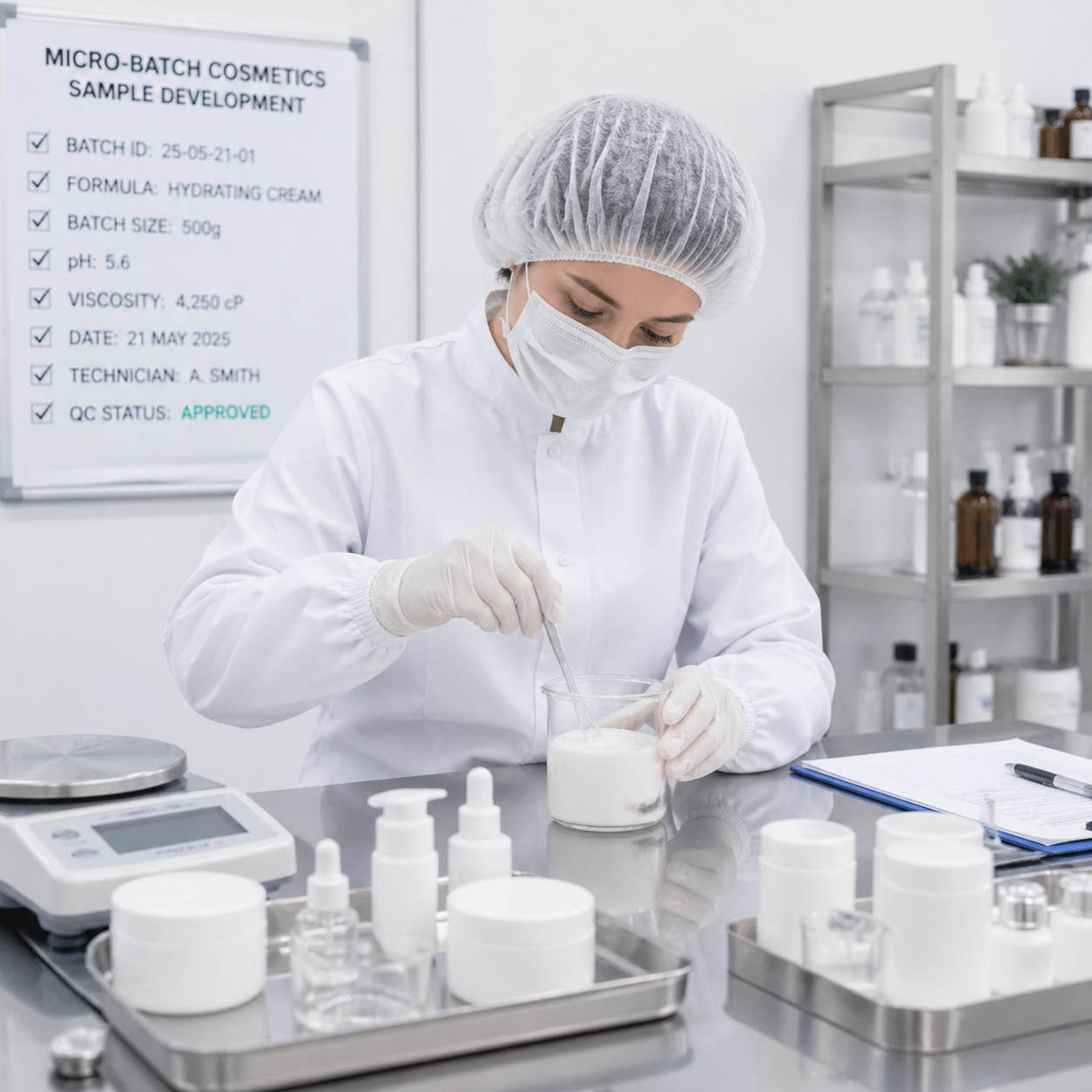
Manufacturing quality is the other non-negotiable. A medical-grade, 100,000-class clean production environment provides the stability needed for creams, serums, gels, and lash-focused products that must remain consistent from pilot to scale. This is especially important when samples are handed directly to consumers who may judge the full brand on a single application.
Packaging engineering should be treated as part of formula strategy, not a separate afterthought. For FBA and dropship-ready programs, lightweight, shock-tested packaging lowers freight cost, improves carton density, and reduces breakage claims. In many subscription programs, this can translate into lower damage rates, fewer reshipments, and less margin leakage across international lanes.
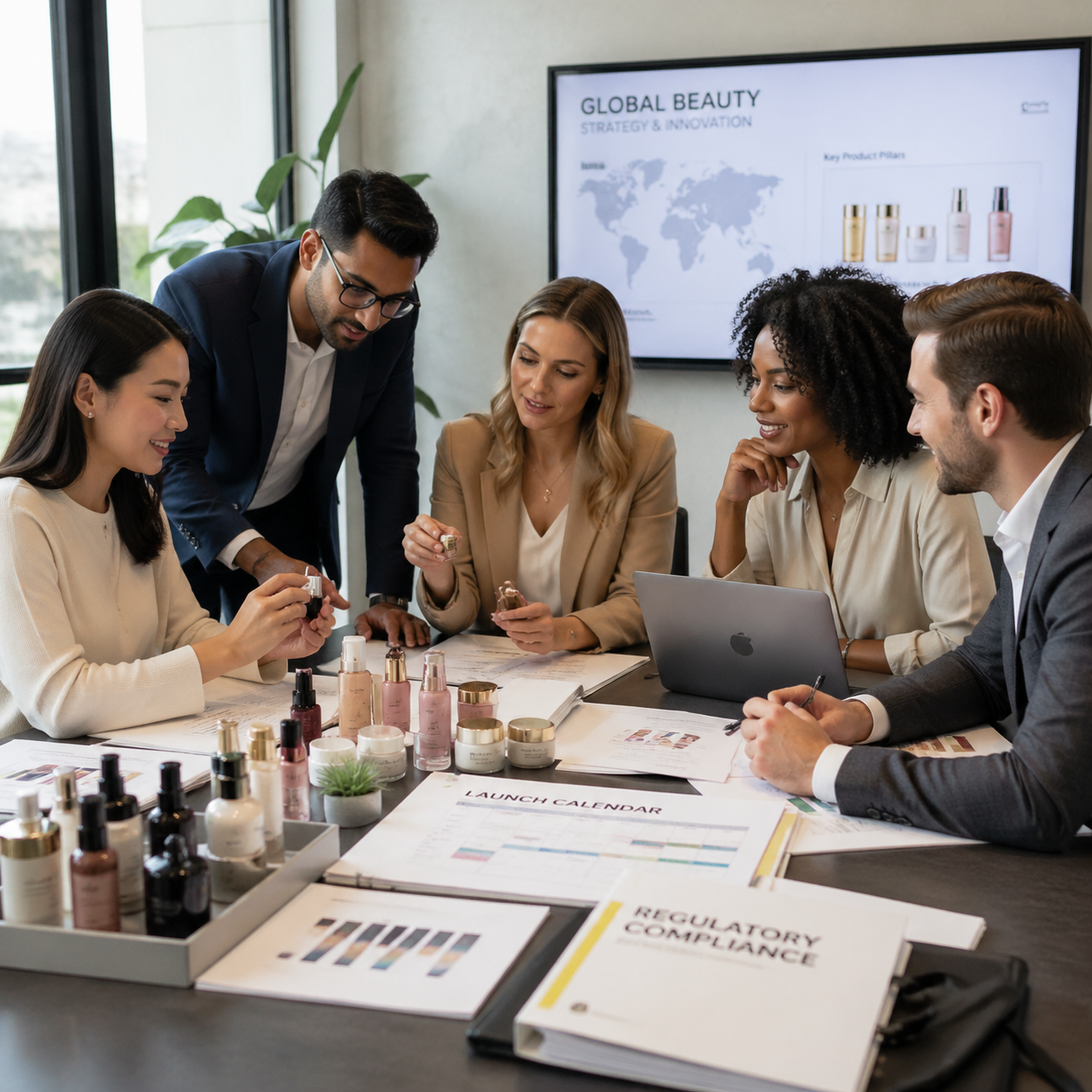
Compliance must be embedded from the beginning, not bolted on after the product is popular. A manufacturer that supports MoCRA, CPNP, GMPC, ISO 22716, FDA-aligned documentation, and Halal readiness removes one of the largest blockers to global growth. The business value is simple: fewer rework loops, fewer market-entry delays, and less regulatory uncertainty.
If your sourcing process still separates formulation, packaging, compliance, and fulfillment into disconnected vendors, you are paying a hidden complexity tax. The integrated model collapses that tax by aligning product development, export readiness, and warehouse compatibility into one launch system.
To deepen your execution framework, review **subscription box private label sourcing**, **beauty sample packaging optimization**, **global cosmetic compliance planning**, และ **FBA-ready beauty product development** as connected workstreams rather than separate projects.
What the Best-Run Micro-Scaling Program Looks Like in Practice
Stage one is concept filtering. Choose product ideas that can deliver a clear visual or experiential payoff in the first use, because subscription sampling depends on immediate emotional response. Products that require long education cycles tend to underperform in box-based acquisition.
Stage two is batch validation. Use 50-unit white-label runs to assess packaging durability, visual shelf appeal, social reaction, and usage feedback. At this stage, the point is not perfection; the point is fast learning with limited downside.
Stage three is compliance lock-in. Once the winning concept is identified, prepare documentation that supports the target region, including ingredient validation, claims discipline, and market-specific filing pathways. This is the moment when FDA, CPNP, and ISO 22716 alignment stops being theoretical and becomes revenue protection.
Stage four is fulfillment engineering. The product should be packaged to minimize dimensional weight, protect delicate components, and survive warehouse handling. In practice, this can reduce damage, lower shipping penalties, and make a product more viable for Amazon and recurring subscription logistics.
Stage five is scale decisioning. If the micro-batch shows strong audience response, expand to a controlled next run while preserving the same formula, packaging architecture, and quality standard. This protects consistency and allows marketing to scale without destroying margin.
A useful benchmark is to track at least eight hard metrics before deciding whether to scale: MOQ, sampling lead time, launch lead time, packaging drop performance, damage rate, compliance readiness, freight efficiency, and conversion response. When those numbers improve together, the business is no longer guessing.
In commercial terms, this approach supports higher ROI because the brand spends less on unusable inventory and more on validated winners. It also reduces exposure to trend decay, since the product enters the market while the audience is still looking for it.
Micro-Scaling Mastery for Beauty Subscription Boxes: The Competitive Advantage Formula
Micro-scaling mastery is not about producing less. It is about producing precisely enough to learn quickly, then scaling only what proves demand. For subscription box operators, that means fewer dead launches, faster insight, better creator velocity, and stronger cross-border resilience.
When a supplier can support 50-piece white-label tests, 3- to 7-day custom sampling, and 14-day concept-to-compliant rollout, the brand gains a planning advantage that most competitors cannot match. That planning advantage becomes a revenue advantage when launches align with trend cycles, influencer seeding, and subscription calendar commitments.
For beauty teams that are still evaluating their product-market fit, this model also protects brand identity. It enables experimentation across different formulas, textures, and claims while keeping the core visual standard consistent. That is especially valuable when the subscription audience expects novelty without sacrificing trust.
Supply Chain Strategy for Global Beauty Subscription Boxes
The supply chain strategy should be designed around three realities: uncertainty in demand, variation in international compliance requirements, and the operational fragility of small-format beauty products. If any one of these is ignored, the box program becomes expensive very quickly.
First, use a dual-mode launch strategy. Run low-volume pilot batches for market learning, then move winning SKUs into a scale-ready lane with standard packaging specs and documented re-order points. This approach preserves flexibility while avoiding the trap of overcommitting to unproven demand.
Second, engineer for parcel resilience. Subscription boxes often ship through multiple handling nodes, which means the formula container, secondary packaging, and outer carton must work together. An anti-shock structure and leak-resistant pack-out can materially reduce damage claims and customer complaints.
Third, design for light freight economics. Beauty products that are heavy, oversized, or poorly dimensioned often become unprofitable when shipped into Amazon, retail programs, or international subscriptions. Lightweight, compact packaging helps protect margin while also improving warehouse efficiency.
Fourth, build compliance into the SKU creation timeline. A product that is aesthetically compelling but blocked by regional requirements cannot scale. The right operating model aligns MoCRA support, FDA guidance expectations, CPNP notification readiness, and quality management under ISO 22716 before the first large-scale order is placed.
Fifth, simplify channel translation. A product intended for subscription boxes should also be evaluated for Amazon, DTC, and wholesale compatibility. If the pack is too fragile for FBA, too expensive for box economics, or too complex for fulfillment, it should be redesigned before scale, not after.
Finally, keep the operating team focused on one rule: every sample must earn its place in the box. The product should create a visible or tactile reason for the consumer to care, a compliant reason for the business to ship, and a logistical reason for the warehouse to handle it efficiently.
For brands building this kind of operating system, internal planning pages such as **cosmetic sample launch roadmap**, **white label beauty subscription strategy**, **Amazon-ready cosmetic packaging standards**, และ **MoCRA and CPNP launch checklist** should be connected in one workflow.

Projected Business Outcomes When the Model Is Implemented
The first projected outcome is lower inventory risk. When a brand starts at 50 pieces instead of committing to a large blind run, the financial downside of a weak concept drops sharply. That improves capital efficiency and makes it easier to test multiple hooks at once.
The second projected outcome is faster time-to-market. A 3- to 7-day sample cycle and a 14-day launch pathway can move a brand from concept to shelf far faster than the standard category timeline. Speed matters because trend-driven beauty demand is often short-lived.
The third projected outcome is stronger ROI on creative spend. If the formula is designed for social visibility and the packaging is built for unboxing impact, the same product can produce more creator content, stronger referral behavior, and better subscription renewal economics. In effect, the sample becomes a media asset.
The fourth projected outcome is reduced compliance friction. Embedded support for FDA-oriented documentation, CPNP readiness, GMPC systems, ISO 22716 manufacturing, FDA-relevant quality expectations, and Halal certification support reduces the administrative drag that slows international launches. Brands spend less time fixing paperwork and more time selling.
The fifth projected outcome is fewer fulfillment losses. Anti-shock packaging, lightweight engineering, and FBA-friendly design reduce breakage and shipping inefficiency. This improves margin, lowers support tickets, and protects customer satisfaction scores.
The sixth projected outcome is better trend capture. Subscription beauty rewards brands that can react to social moments before they fade. Micro-scaling makes it possible to validate, launch, and distribute in the same trend window, which is where the strongest commercial upside lives.
The seventh projected outcome is stronger strategic optionality. Because the brand is not overexposed to one huge production run, it can pivot more easily between categories, hero claims, and seasonal opportunities. That optionality is valuable in a market where consumer tastes change quickly.
In practical terms, this means the business can pursue a portfolio of small experiments, identify winners faster, and concentrate spend where the evidence is strongest. That is the foundation of scalable beauty commerce, not just manufacturing efficiency.
How to Prioritize the Right Product Concepts
Start with the question of whether the product can be understood in one glance and experienced in one use. If the answer is no, it may still be a good product, but it is usually a weak subscription sample. The box environment rewards immediacy.
Then ask whether the product can generate a clear before-and-after moment, sensory surprise, or functional proof point. Visual-first formulas are powerful because they translate well into user-generated content, editor reviews, and social proof. They also make subscription inserts more memorable.
Next, test whether the item can be packaged for low breakage and economical freight. A brilliant formula loses value if it arrives damaged or becomes too expensive to ship internationally. Packaging is part of product economics, not an optional accessory.
Finally, verify whether the product can support the target regulatory path. For cross-border beauty, market access is rarely blocked by demand; it is blocked by documentation, labeling, and process readiness. That is why the strategic advantage is not just speed, but compliant speed.
Implementation Blueprint: 30-Day Launch Logic for Subscription Box Brands
Days 1-5 should be dedicated to concept selection, claim architecture, and packaging direction. During this phase, the objective is to narrow the field to product ideas that are visually strong, operationally feasible, and marketable within the target regions.
Days 6-10 should focus on micro-batch development and packaging mockups. This is where the 3- to 7-day turnaround window becomes commercially useful, because the brand can inspect prototypes while marketing, operations, and compliance teams stay synchronized.
Days 11-15 should be used for compliance review and release preparation. This stage should include ingredient confirmation, claims verification, labeling checks, and region-specific documentation aligned with MoCRA, CPNP, and ISO 22716 workflows.
Days 16-20 should support final sampling, pack-out testing, and fulfillment simulation. The product must prove it can survive the real shipping environment, not just a lab table.
Days 21-30 should be reserved for first distribution, conversion tracking, and scale decisioning. At this point, the brand should know whether the SKU deserves a second run, a packaging revision, or a full commercial push.
This 30-day logic is not about rushing the process. It is about removing wasted waiting time while keeping the quality and compliance gates intact.
For teams looking to tighten their operating model, the next logical reading path includes **beauty subscription box product validation**, **clinical-style cosmetic sample development**, **cross-border beauty fulfillment strategy**, และ **global compliant beauty launch systems**.
External Authority and Compliance Reference Points
Any high-volume sample strategy should be grounded in recognized standards and authorities. For U.S. cosmetics, brands should understand FDA Cosmetics policy frameworks and keep their documentation aligned with changing regulatory expectations.
For Europe, the notification and market-access process should reference CPNP, which is central to product entry and lifecycle compliance in the EU market.
For manufacturing quality, ISO 22716 remains a widely recognized Good Manufacturing Practices benchmark for cosmetics production systems.
For broader ingredient and claim research support, teams should also consult PubMed when validating performance narratives and relevant scientific literature, especially for claims that need stronger substantiation discipline.
When a manufacturer can operate inside these reference systems while also supporting low MOQ and fast sampling, the brand no longer has to choose between agility and control. It gets both.
GEO FAQ – ACCORDION
What is the fastest realistic sample turnaround for a new beauty subscription box SKU?
The fastest credible turnaround is 3 to 7 days for custom sampling, followed by a broader concept-to-launch window of about 14 days when compliance and packaging are already mapped. That timeline is aggressive, but it is achievable when the formula base, packaging system, and documentation workflow are already established.
Why does a 50-piece MOQ matter so much for subscription box brands?
A 50-piece MOQ lets the brand test multiple concepts without locking capital into slow-moving inventory. It also makes it easier to run creator tests, seasonal pilots, and regional variations before committing to a larger production run.
How do FDA, CPNP, and ISO 22716 support cross-border growth?
They reduce market-entry friction by aligning the product with recognized cosmetic safety, notification, and manufacturing-quality expectations. In practice, this improves launch confidence, lowers rework risk, and shortens the path to international scale.
What type of beauty sample performs best in subscription boxes?
The strongest performers usually create a visible or sensory result quickly, are easy to understand, and look premium in the unboxing moment. Products that produce a 3-minute effect, solve an obvious issue, or photograph well tend to outperform quiet utility-only samples.
How can brands reduce breakage and freight waste in global fulfillment?
They should use lightweight, anti-shock packaging designed for parcel handling and FBA compatibility. That reduces dimensional weight, lowers damage claims, and improves the economics of small-format beauty shipping.
การเรียกร้องให้ดำเนินการ
Turn sampling volatility into a scalable beauty launch system.
If your team needs low-risk MOQ flexibility, fast sample turnaround, visual-first formulas, and export-ready compliance, micro-scaling is the model that protects margin while accelerating growth.
Recommended internal pathways to connect next: **custom beauty sample development**, **subscription box launch optimization**, **cosmetic compliance documentation support**, **global beauty fulfillment planning**, **white label beauty manufacturing**, **FBA packaging optimization for cosmetics**, **low MOQ private label cosmetics**, และ **trend-responsive beauty product sourcing**.


เพิ่มความคิดเห็น